
A serious dog attack can leave you with deep puncture wounds, nerve damage, or a scar that never fully fades. If you were bitten in Humble, Texas, a Humble dog bite lawyer at Joe I. Zaid & Associates can help you understand whether the dog’s owner, a landlord, or a business is legally responsible for what happened, and what your claim may realistically be worth.
Dog bite claims in Texas are not always straightforward. Insurance adjusters often try to shift blame onto the victim, question whether the injury was serious, or argue the owner had no way of knowing the dog was dangerous. Our attorneys built this firm on nearly a decade of insurance-industry experience, and we use that background to push back when an insurer undervalues a legitimate injury claim.
Our Humble office is open 24 hours a day, and we offer a free consultation to review the facts of your case. You owe no attorney fee unless we recover compensation for you.
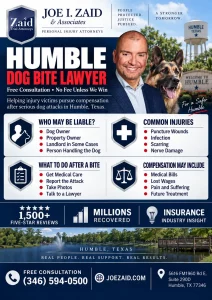
Why Hire Joe I. Zaid & Associates After a Dog Attack in Humble
Dog bite claims usually run through a homeowners or renters insurance policy, which means the case is decided as much by insurance rules as by the facts of the attack. Joe Zaid spent nearly a decade working inside the insurance industry before founding this firm, and that experience shapes how our attorneys evaluate coverage, respond to early settlement offers, and push back when an adjuster tries to minimize a legitimate injury.
Joe I. Zaid & Associates has 1,500+ five-star Google reviews across four Houston-area offices, and our attorneys have represented thousands of injury victims. When a case involves a disputed liability issue, such as a dog owner who denies knowing about the animal’s aggressive history, we build the evidence needed to establish what the owner actually knew.
Understanding Texas Dog Bite Law
Texas does not have a dedicated dog bite statute. Instead, civil liability for a dog attack comes from case law, most notably the Texas Supreme Court’s 1974 decision in Marshall v. Ranne. Understanding how this rule works matters before you decide whether pursuing a claim makes sense.
The “One-Bite” Rule and Strict Liability
Texas follows what courts and attorneys often call the “one-bite” rule. Under this standard, a dog owner can be held strictly liable for an attack if the owner knew, or reasonably should have known, that the dog had dangerous tendencies. That knowledge can come from a prior bite, but it does not have to. Evidence that the dog lunged at people, snapped at visitors, or had to be restrained because of aggressive behavior can also establish that the owner had reason to know the dog posed a risk.
If that knowledge exists and the owner failed to take reasonable steps to prevent an attack, the owner can be held responsible for the resulting medical bills, lost wages, and other damages, even if this was technically the dog’s first reported bite.
When You Can Still Sue Without a Prior Bite
The one-bite rule is not the only path to recovery. Texas law also allows a dog bite victim to pursue a negligence claim. A negligence claim does not require proof that the owner knew the dog was dangerous. Instead, it focuses on whether the owner failed to act reasonably, such as by violating a local leash requirement, letting the dog run loose, or failing to maintain a fence the owner knew was broken.
Our attorneys evaluate how much liability a dog owner may face after an attack under both theories before deciding how to position a claim, because a case that looks weak under the one-bite rule may still hold up under ordinary negligence principles.
Can I Sue for a Dog Bite in Texas?
Yes. Texas law allows a dog bite victim to file a civil claim against the dog’s owner, and in some situations against a landlord or property owner, when the facts support either strict liability or negligence. You generally have two years from the date of the attack to file suit under Texas Civil Practice and Remedies Code Section 16.003, though the strength of your case often depends on how quickly evidence is gathered. Whether a claim is worth pursuing usually comes down to the severity of the injury, the strength of the evidence showing the owner’s knowledge or negligence, and whether insurance coverage or other assets exist to satisfy a claim.
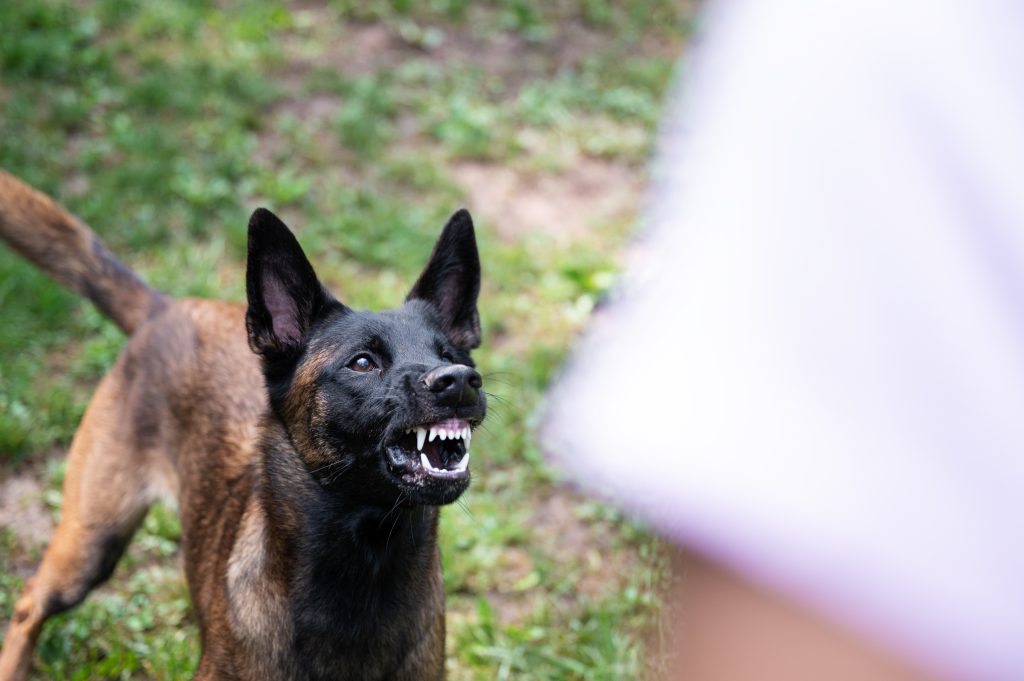
Who Can Be Held Responsible for a Dog Attack in Humble
Identifying every party who may share responsibility is one of the most important parts of a dog bite investigation. In some cases, more than one party can be held liable.
Dog Owners
The dog’s owner is the most common defendant in a dog bite claim. Liability generally depends on what the owner knew about the dog’s temperament and whether the owner took reasonable precautions, such as securing a fence, using a leash, or warning visitors about a dog with a history of aggression.
Landlords and Property Managers
Humble sits alongside a large concentration of apartment communities serving Kingwood, Atascocita, and the Lake Houston area, which means a meaningful share of local dog bite claims happen in shared residential spaces rather than single-family homes. Texas courts have recognized that a landlord can be held responsible for a tenant’s dog under certain conditions. In the 2003 case Batra v. Clark, the Houston Court of Appeals held that a landlord who has actual knowledge of a dangerous dog’s presence on the property, and who retains the ability to control the premises, owes a duty of care to people who may be harmed by that dog.
In practice, this means a landlord who received complaints about an aggressive dog, or who was told the dog had already bitten someone, may share responsibility if the landlord failed to act. When a dog bite claim involves a property owner rather than only a dog owner, it often overlaps with a broader Humble premises liability claim, and our attorneys evaluate both theories together.
Business and Commercial Property Owners
Dog attacks are not limited to residential settings. Humble’s retail corridor along Deerbrook and FM 1960 brings a steady flow of foot traffic through parking lots and shopping centers, and pets are sometimes present in those spaces. A business that allows dogs on its property, or that fails to address a known dangerous animal near an entrance or loading area, may bear some responsibility for an attack that happens on its premises. Our firm has evaluated what happens when someone is bitten by a dog outside a retail store, and the same liability questions can apply anywhere a business controls the property where an attack occurs.
How Insurance Companies Handle Dog Bite Claims
Most dog bite claims in Texas are paid through the dog owner’s homeowners or renters insurance policy rather than out of pocket. The Texas Department of Insurance has confirmed that homeowners insurance may help cover the cost of a dog bite, including medical payments coverage for injuries that happen away from the insured’s home. That same guidance notes that some policies exclude certain breeds entirely, which can complicate a claim before it ever begins.
Insurers treat dog bite claims as a significant and growing liability expense. According to Insurance Information Institute data reported by ConsumerAffairs, the average cost of a dog-related insurance claim reached nearly $69,272 nationally in 2024, and Texas consistently ranks among the top three states for both the number of claims filed and the total dollars paid out. That data reflects insurance industry averages, not a promised outcome, but it does show that insurers take dog bite exposure seriously and often resist paying full value on a claim.
Because Joe Zaid spent years working inside the insurance industry, our attorneys understand how adjusters evaluate dog bite claims, including how they use recorded statements, gaps in medical treatment, or a claimant’s own account of “playing” with the dog before the attack to argue the injury was less serious or partly the victim’s fault. We also review whether and how insurance actually pays for a dog bite claim early in the case, since policy limits can directly affect what compensation is realistically available.
What Is a Dog Bite Claim Worth in Texas?
There is no fixed formula for valuing a dog bite claim, and any attorney who promises a specific number before reviewing your medical records and the facts of the attack is not giving you an honest answer. Several factors typically drive the value of a claim:
- The severity of the bite wounds, including whether surgery, stitches, or reconstructive treatment was needed
- Whether the injury caused permanent scarring or disfigurement, especially on the face or hands
- Nerve damage, infection, or complications that developed after the initial injury
- Psychological effects, such as a lasting fear of dogs, particularly in children
- Lost income from missed work during recovery
- The available insurance policy limits and whether the owner carries other assets
- Whether liability is clear or disputed, and how strong the supporting evidence is
Insurance industry data shows the average dog bite claim nationally now approaches $69,000, but that figure includes everything from minor puncture wounds to severe maulings, so it should not be treated as a prediction for any individual case. A relatively minor bite with quick treatment and no scarring will typically resolve for far less, while a severe attack involving surgery, permanent scarring, or a young child’s face can be worth substantially more, particularly when the owner carries adequate coverage.
Whether pursuing a claim is worth it usually depends less on the dollar figure and more on whether liability can be established and whether a source of recovery, typically an insurance policy, actually exists. A claim with clear liability and available coverage is often worth pursuing even when the injury is moderate, because the alternative is paying medical bills out of pocket for an injury someone else caused. A claim with murky liability and no identifiable insurance coverage requires a more careful evaluation before deciding whether litigation makes sense.
How Our Firm Builds a Dog Bite Case
Dog bite claims often come down to a single disputed question: what did the owner know, and when did they know it? Our attorneys focus on developing that evidence early, before memories fade and records disappear.
- Obtaining animal control records and any prior bite or complaint history involving the dog
- Interviewing neighbors, other tenants, or witnesses who may know about the dog’s past behavior
- Reviewing lease agreements and any prior complaints made to a landlord or property manager about the dog
- Documenting the wound with medical photographs and records from the treating provider
- Investigating the applicable homeowners, renters, or commercial insurance policy and its coverage limits
- Identifying every party who may share responsibility, including an owner, landlord, or business
This kind of multi-party investigation is not unique to dog bite claims. In one premises liability case, our firm secured an $85,000 settlement after an unmarked hazard raised the question of responsibility between more than one party. Dog bite claims frequently present the same challenge, since a pet owner and a landlord or business may each bear some share of responsibility depending on what each party knew and controlled. Past results do not guarantee a similar outcome in any future case, but they reflect the kind of investigation our attorneys apply when more than one party may be at fault.
What to Do After a Dog Bite in Humble
The steps you take in the hours and days after an attack can affect both your health and your claim.
- Seek medical treatment promptly, even if the wound seems minor, since dog bites carry a meaningful risk of infection
- Photograph the injury, the location of the attack, and any visible restraint or lack of restraint involving the dog
- Report the bite to animal control, since Texas rabies and quarantine rules require documentation of dog attacks. Within Humble, Humble Animal Services handles local reporting and can help confirm whether the dog has a prior history
- Get the contact information for the dog’s owner and, if the attack happened on a rental property, the property manager or landlord
- Avoid giving a recorded statement to an insurance adjuster before speaking with an attorney, since early statements are often used to minimize a claim later
Common Dog Bite Injuries and Their Long-Term Effects
Dog bites can cause more lasting harm than the initial wound suggests. Puncture wounds and lacerations carry a significant infection risk, and bites to the hands, face, or joints can damage tendons, nerves, or underlying structures that affect function long after the skin heals. Facial and hand injuries often require plastic surgery consultation to minimize permanent scarring, and children in particular can develop a lasting fear of dogs that affects their daily life well beyond the physical recovery.
Consistent medical follow-up matters for more than your health. Gaps in treatment, or stopping care once the wound closes on the surface, can give an insurance adjuster a reason to argue the injury was minor, even when scarring, nerve sensitivity, or emotional effects continue.
How Much Does a Humble Dog Bite Lawyer Cost?
Joe I. Zaid & Associates handles dog bite claims on a contingency fee basis. That means you pay no attorney fee upfront, and you owe nothing unless we recover compensation for you. This structure exists specifically so that the cost of medical bills and lost wages after an attack does not prevent someone from getting legal help. Our attorneys are paid a percentage of the recovery only if the case settles or succeeds, which keeps our interests aligned with getting you the strongest result available under the facts of your case.
Common Questions About Dog Bite Claims in Humble
What if the dog had never bitten anyone before?
A first bite does not automatically end your claim. If the dog showed warning signs of aggression, such as snapping, lunging, or growling at people, that history can still support liability. A negligence claim based on how the owner handled or controlled the dog may also apply even without a prior bite.
What if I was accused of provoking the dog?
Provocation is a common defense that insurers raise, but Texas follows a comparative responsibility system. If you are found partly at fault, your recovery may be reduced by your percentage of responsibility, and you are barred from recovering only if you are found more than 50 percent at fault. Whether an interaction actually amounted to provocation is often disputed, and it should not be assumed against you.
What if the dog owner doesn’t have insurance?
If no homeowners or renters policy applies, recovery becomes more difficult, though not always impossible. Our attorneys investigate every available policy, including a landlord’s or business’s coverage when a property owner shares responsibility, before determining whether pursuing a claim makes sense.
How long do I have to file a dog bite claim in Texas?
Texas law generally requires a personal injury lawsuit to be filed within two years of the date of the attack under Texas Civil Practice and Remedies Code Section 16.003. Waiting can also make it harder to obtain animal control records, locate witnesses, or document the dog’s prior behavior, so earlier evaluation of your claim is usually better.
Contact a Humble Dog Bite Lawyer
If a dog attack left you with an injury, our Humble office is available around the clock to talk through what happened and explain your options. For injuries involving a broader premises or property issue, our Humble personal injury attorneys can evaluate the full scope of your case alongside the dog bite claim itself.
Joe I. Zaid & Associates offers a free consultation, and we handle dog bite cases on a contingency fee basis, so you owe no attorney fee unless we recover compensation for you. Contact our Humble dog bite attorneys today to discuss your case.