
Pool party injury lawsuits can involve homeowners, property managers, event organizers, and other parties whose negligence caused an injury. If you or someone in your family was hurt at a pool party in Houston, a pool party injury lawyer can investigate who may be responsible, which insurance policies apply, and what evidence is needed to build your case.
Joe I. Zaid & Associates represents guests hurt at pool parties held at private homes, apartment complexes, hotels, and event venues across Houston. Our attorneys investigate the pool, the party, and every person or company that may share responsibility. We handle injury cases on a contingency fee basis, so you pay no attorney fees unless we recover compensation. You can schedule a free consultation with our team at any time.
Why Injured Guests Choose Our Houston Pool Party Injury Lawyers
Pool party evidence disappears fast. Guests go home. The host cleans the deck. The only video sits on someone’s phone. We start building the claim on day one, before the other side controls the story.
Joe Zaid founded Joe I. Zaid & Associates in 2013 after graduating from South Texas College of Law Houston. Before that, he spent nearly a decade working inside the insurance industry. That background matters in pool party cases, because the money usually comes from a liability policy. We identify the carrier, the coverage, and the policy limits early, since those facts shape every settlement decision.
Joe was selected to Super Lawyers in 2026. He is an active member of the Houston Trial Lawyers Association and the Texas Trial Lawyers Association. He has also written about legal issues for major publications, including Law360. Our clients have left more than 1,500 five-star Google reviews across our four offices.
Pool party claims often involve more than one defendant. Consider our $85,000 premises liability settlement. A construction crew had installed an unmarked step at a grocery store entrance. Our client caught her shopping cart on it, fell, and broke her foot. The store, the construction company, or both could bear responsibility. The store’s adjuster asked her to send her bills and records directly. We pursued every responsible party instead. That case did not involve a pool, but the lesson applies. When a host, a manager, and a contractor all touch the same hazard, each one deserves scrutiny. Past results do not guarantee or predict a similar outcome in future cases.
How We Investigate a Pool Party Injury
Pool party cases need evidence from two places: the property and the party itself. We collect both.
Records From the Pool and the Property
We send preservation letters for surveillance footage and incident reports. At apartment complexes and hotels, we also seek gate and key fob access logs. We request maintenance and repair records for the deck, ladders, railings, gates, and drain covers, along with gate inspection logs. Public pool operators must keep chemical testing logs for three years under the state public pool rules. Those rules also require documentation showing that drain covers and suction outlets comply with safety standards.
Regulators can hold useful files too. The City of Houston Health Department handles pool permits within city limits. Harris County Public Health permits and inspects public pools in unincorporated Harris County. A property with a Houston mailing address may sit outside the city limits. We confirm which agency has jurisdiction before we request permit and inspection history.
Evidence From the Party
Private parties leave a different trail. We look for the guest list, invitations, group chats, and photos or videos that guests posted. We identify who served alcohol, who watched the pool, and who saw the injury. We also gather EMS and 911 records and your medical records.
Chaotic events rarely produce incident reports. In our $90,000 slip and fall settlement, a client tripped over mats at a League City fitness center. She fractured her ribs and pelvis. No one could confirm an incident report, and our client had no witness contact information. We built the claim from photos her family took and accounts from the client and her son, who saw her fall. We then tied the fall to her fractures. A pool party can leave the same gaps. Past outcomes do not guarantee future results.
Legal Grounds for Pool Party Injury Lawsuits in Texas
Texas law does not treat every pool party injury the same way. The legal theory decides who you can sue and what you must prove. We often plead several theories together and let the evidence sort them out.
Premises Liability for Dangerous Conditions
A premises liability claim targets a hazardous condition on the property. Examples include a slick or cracked pool deck, a loose ladder or railing, and a broken gate latch. Others include a missing drain cover, poor lighting around the water, and broken glass near the pool. The claim runs against whoever controls the property. As the Texas Supreme Court has explained, a claim based on a property’s condition stays a premises claim, however the plaintiff pleads it. Pool hazards fit within broader premises liability claims, and falls on wet decks can also raise Houston slip and fall claims.
Negligent Activity: What Someone Did
Negligent activity claims focus on conduct instead of conditions. A host who organizes rough games near the shallow end may face one. So may a guest who shoves someone into the pool, or staff who let too many people onto a slide. Texas courts treat these claims differently from premises claims. Ordinary negligence principles apply when contemporaneous activity causes the injury. That distinction matters because the visitor status rules below mainly shape premises claims. A guest who injures another guest through horseplay may also face a claim, and that guest’s own household insurance may matter.
Negligent Supervision and Negligent Undertaking
Parents often ask whether the host failed to supervise the children. Texas law generally does not require a person to protect others. But a duty of reasonable care can arise when someone takes on a task. The Texas Supreme Court limits that duty to the task undertaken. A host who says “I’ll watch the kids in the water” may have taken on that job. So may a venue that advertises lifeguards or pool monitors. We examine what the host or venue promised and what the contract said. We also look at what staff did and whether a lapse in that job caused the harm.
Event Organizer and Host Negligence
When a company or promoter organizes a pool party, it takes on duties tied to the event. Those can include crowd limits, staffing, pool rules, alcohol service, and security. Overcrowding, intoxicated guests, and fights can support negligent security claims when the organizer or venue knew conduct was escalating and did not respond. Event contracts often divide responsibility among the host, the venue, and the vendors. We read them early.
Defective Equipment and Product Claims
Pool slides, diving boards, ladders, inflatables, drain covers, pool lights, and electrical equipment can fail. A manufacturer, a seller, an installer, or a pool service company may share responsibility. Texas sets special rules for claims against manufacturers and sellers, so these cases need separate analysis. Keep the equipment if you can. Our attorneys handle defective product claims when equipment failure causes serious injuries.
How Your Visitor Status Shapes a Texas Pool Party Claim
In a premises claim, Texas law asks why you were on the property. That label sets the duty the owner owed you. It often decides how much proof your case needs.
Invitees: Hotel, Venue, and Paying Guests
An invitee enters with the owner’s knowledge and for the mutual benefit of both. Hotel guests, guests at a rented event, and customers at a commercial venue usually fit. Under Texas Supreme Court precedent, the owner must use reasonable care. The owner must make the premises safe or warn of dangers it knew about or should have known about. The “should have known” standard makes inspection routines and maintenance records central evidence.
Licensees: Social Guests at a Private Home
Texas courts of appeals have classified a social guest as a licensee. Houston’s Fourteenth Court of Appeals repeated that rule in an unpublished opinion. A licensee receives less protection. The owner must not injure a guest through willful, wanton, or grossly negligent conduct. The owner must also warn of, or make safe, a hidden danger the owner actually knew about and the guest did not.
Actual knowledge becomes the central issue. We look for prior complaints, earlier injuries, and repair requests. We also look for texts about a loose board or broken gate and the host’s own statements about the hazard. Proving gross negligence sets a higher bar. It requires proof that the owner knew of an extreme risk and proceeded anyway. Many private-home cases turn on what the host knew before the party started.
Tenants’ Guests and Uninvited Visitors
A tenant’s guest at an apartment pool presents a closer question. We review the lease, the pool rules, the complex’s guest policy, and whether staff allowed guests to use the pool. Trespassers receive the least protection. Texas owners owe them a duty not to injure them willfully, wantonly, or through gross negligence. Facts decide status, so we do not assume a label on day one.
Where the Party Happened Changes Who Owes You a Duty
Private Residences
The state public pool rules exclude residential pools that serve private property for no more than two resident families and their guests. Chapter 757 of the Health and Safety Code also excludes single-family homes outside condominium projects. A claim from a backyard pool party therefore usually rests on the visitor status rules above, not on a pool code violation. Records still exist. The City of Houston Health Department reviews new residential pool construction and responds to complaints about improperly maintained pools and spas. Permit and complaint history can show what a homeowner knew.
Apartment Complexes and HOA Pools
Apartment complexes and property owners associations face the most detailed statute. Chapter 757 of the Texas Health and Safety Code requires a pool yard enclosure at least 48 inches high. Gates must be self-closing and self-latching, and they must open outward. Owners must use ordinary and reasonable care to maintain and repair gates and enclosures. They must inspect them at least every 31 days. The chapter provides remedies, including actual damages for harm caused by noncompliance. It also directs courts to read it liberally to prevent swimming pool deaths and injuries.
The public pool rules add requirements for depth markers, rescue equipment, emergency phones, and drain covers. A pool must stay closed until the owner fixes a missing or broken drain cover. Apartment corridors extend across metro Houston, and many complexes maintain shared pools. Ownership and management often split among different companies. Knowing how to sue an apartment complex starts with identifying who controlled the pool, the gate, and the maintenance.
Hotel Pools
Hotel and motel pools fall under the state public pool rules, but Chapter 757 excludes facilities for overnight guests. Hotel guests are usually invitees, so the reasonable care standard applies. Houston’s Downtown and Uptown districts concentrate hotels, restaurants, and event properties. Group events at hotel pools, such as birthday celebrations and corporate gatherings, add questions about event contracts, security staffing, and alcohol service. Our attorneys address those issues in hotel injury claims.
Event Venues and Rented Spaces
Many venues rent a pool area for private events. The venue controls the property, and the renter controls the guest list. That split invites finger-pointing. The rental agreement may say who provides lifeguards, security, alcohol service, and insurance. A renter’s event policy, if one exists, may add coverage. Commercial attractions that host group outings raise related questions, including water park injury claims.
Texas Rules That Can Reduce or Block a Pool Party Claim
Shared Fault and Responsible Third Parties
Texas uses proportionate responsibility under Chapter 33 of the Civil Practice and Remedies Code. A jury assigns each person a percentage of fault. That rule, often called comparative negligence, reduces your damages by your percentage. You recover nothing if your share exceeds 50 percent. Each defendant generally pays only its own percentage unless its share exceeds 50 percent.
Defendants can also ask the court to designate a responsible third party. That can move blame onto someone who is not in the lawsuit. At a pool party, the host may blame a guest, and the venue may blame the host. A defense lawyer may argue that you dove into shallow water or drank alcohol. We identify every responsible party early so blame has fewer places to hide.
Open and Obvious Hazards
Defendants also argue that a danger was open and obvious, such as a wet deck or a posted depth marker. In premises cases, owners generally have no duty to warn of dangers that are open and obvious or already known to an invitee. The Texas Supreme Court has recognized exceptions, including when an invitee must use the dangerous area and the owner should have anticipated the harm. These arguments depend heavily on the facts.
Waivers and Rental Agreements
Hotels, venues, and event companies may ask guests to sign waivers. A signed form does not automatically end a claim. Courts look at what the document says, how clearly it says it, and who signed it. For children, Houston’s Fourteenth Court of Appeals held in Munoz v. II Jaz Inc. that a parent cannot waive a child’s injury claim. As Texas A&M AgriLife explains, the Texas Supreme Court has not addressed the question, and federal courts have followed Munoz. We review every form you signed.
Alcohol at the Party
Alcohol changes the analysis. Chapter 2 of the Alcoholic Beverage Code limits when a person who provides alcohol can face liability for an intoxicated person’s conduct. The rules differ for guests under 18 and adults. An adult who is 21 or older and knowingly serves a minor can face liability for damages the minor’s intoxication causes. The same applies when that adult allows a minor to be served on property the adult owns or leases. Exceptions cover parents and guardians. We learn who poured drinks and who drank before we evaluate any claim.
Filing Deadlines
Texas generally gives you two years to sue for a personal injury. Wrongful death claims also carry a two-year deadline, measured from the date of death, under Section 16.003 of the Civil Practice and Remedies Code. Minors receive tolling while they are under 18, but we do not recommend waiting. Parents may also have claims of their own, and evidence fades. Missing the Texas statute of limitations can end a case no matter how strong the facts.
Insurance Coverage in Pool Party Injury Claims
Pool party claims rarely involve a single policy. Depending on the facts, coverage may come from several sources:
- A homeowner’s liability policy, which may include medical payments coverage for guests
- A renter’s policy held by the tenant who hosted
- A commercial liability policy held by an apartment complex or property owners association
- A hotel’s or venue’s liability policy
- Policies held by event companies, contractors, or pool service companies
- A guest’s own household policy, if that guest caused the injury
Policy terms, limits, and exclusions vary, so we request the actual policies. Insurers may argue that alcohol, horseplay, or shared fault limits payment. Adjusters often ask for a recorded statement early, before you know your full injuries. Joe Zaid’s years inside the insurance industry help us anticipate how carriers evaluate these claims and where coverage disputes arise.
What a Pool Party Injury Claim May Be Worth
No formula sets the value of a pool party injury claim. Several facts drive it. They include how severe and permanent the injury is, what treatment you needed and still need, and how long you missed work. They also include how the injury changed your daily life, whether the defendants dispute liability, whether you share fault, and how much insurance exists.
Pool settings can produce serious injuries. Near-drowning can cause brain injury from oxygen loss. A dive into shallow water can injure the spine. Falls on wet decks cause fractures and head injuries, and broken glass can cause deep lacerations. Chemical exposure and electrical shock also occur around pools.
For injuries that change daily life, we document how pain, limits, and lost activities affect you. Evidence of pain and suffering often comes from medical records, work records, and the people who see the change. If a guest dies, Texas law lets the surviving spouse, children, or parents bring a wrongful death claim.
What to Do After a Pool Party Injury
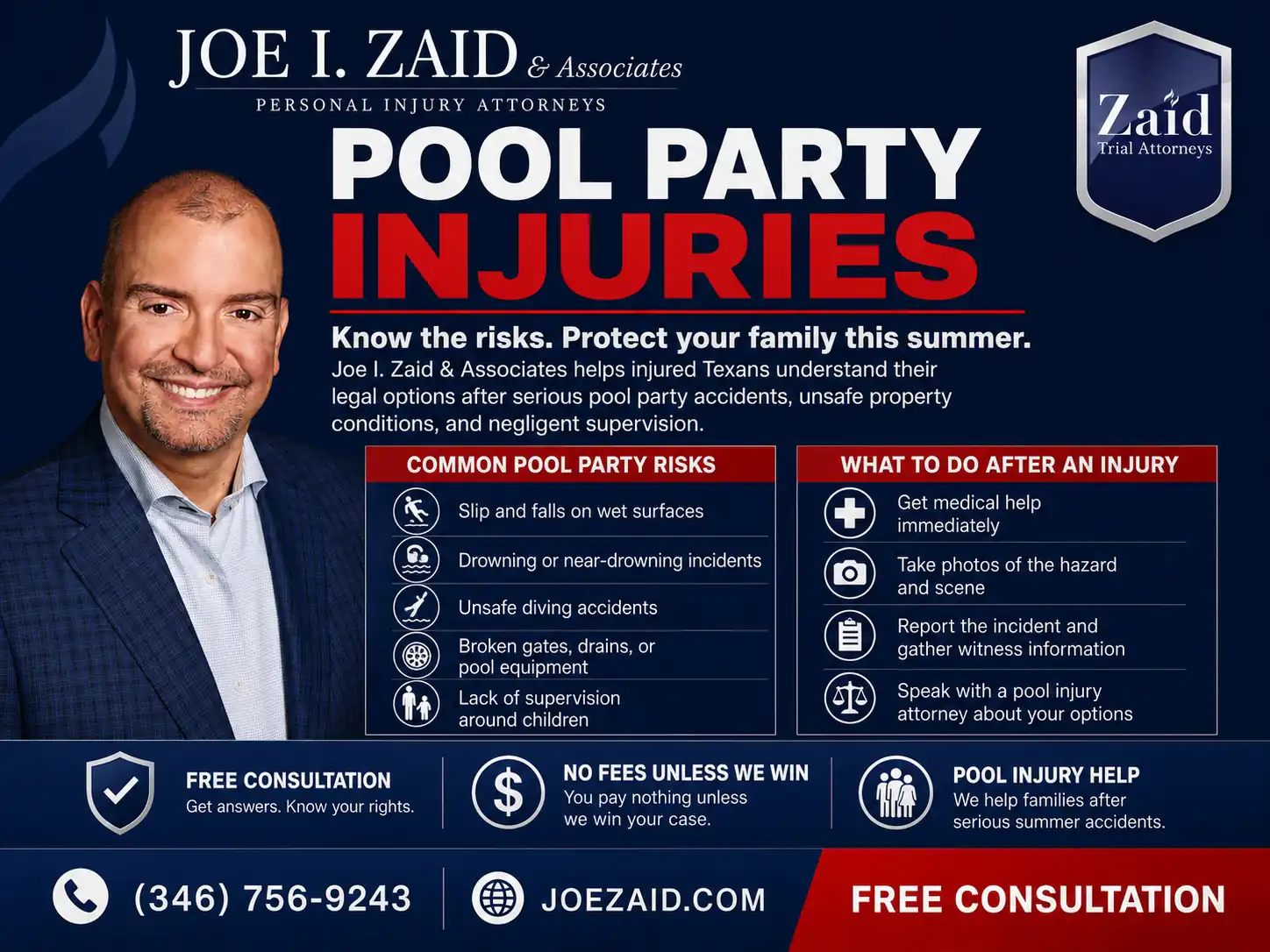
The steps below fit pool party injuries specifically:
- Get medical care and tell providers exactly how the injury happened.
- Photograph the pool area, deck, gate, equipment, and posted signs before anyone changes them.
- Keep any equipment or product involved, such as a slide, ladder, or float.
- Collect names and phone numbers for guests, staff, and anyone who saw what happened.
- Save invitations, group chats, and party photos or videos. Avoid posting about the injury.
- Identify who hosted, who owns the property, and who manages the pool.
- Report the injury to the host, landlord, or manager in writing, and ask for any incident report.
- Think carefully before you give a recorded statement to any insurer.
If you are unsure whether you have a claim, a free consultation costs nothing. You owe no attorney fees unless we recover compensation.
Houston Pool Party Injury Claim FAQs
Can I sue a friend who hosted the pool party where I got hurt?
You may have a claim even when you know the host. These claims often proceed against the host’s liability insurance, though coverage varies. Your status as a social guest and what the host knew about the hazard will shape the case. Awkwardness should not keep you from a legal review before deadlines pass.
Can I still recover if I was drinking at the party?
Possibly. Drinking does not automatically bar a claim. Defendants will argue shared fault, and a jury will assign percentages. You cannot recover if your share exceeds 50 percent. Evidence showing how the hazard caused the injury matters most.
Does a pool without a lifeguard mean the owner was negligent?
Not by itself. The state public pool rules do not require a lifeguard at every public pool. A pool without one must display a sign saying so. A missing lifeguard matters more when the owner or venue promised one. It also matters when other safeguards failed, such as gates, rescue equipment, or drain covers.
How much does a Houston pool party injury attorney cost?
We handle pool party injury cases on a contingency fee basis. You owe no attorney fees unless we recover compensation, and the first consultation is free.
How long does a pool party injury case take?
It depends on your treatment, whether the defendants dispute liability, and how many insurers are involved. Cases with several defendants often take longer. We do not push you to settle before the full extent of your injuries is clear.
Talk With a Houston Pool Party Injury Attorney
If a pool party left you or your child hurt, a Houston pool party injury attorney from our team can review what happened, identify who owed a duty, and explain your options. We also handle other serious injuries as Houston personal injury attorneys. Call any office below for a free consultation. Each office is open 24 hours daily.
- Downtown Houston office: 1001 Texas Ave Suite 1400, Houston, TX 77002, (346) 340-0800
- Pasadena office: 4701 Preston Ave, Pasadena, TX 77505, (346) 756-9243
- Clear Lake office: 16821 Buccaneer Ln #226, Houston, TX 77058, (346) 690-0500
- Humble office: 5616 Farm to Market 1960 Rd E Suite 290D, Humble, TX 77346, (346) 594-0500