A failed restraint, a ride that starts too soon, or a hazard in a crowded walkway can turn a family day into months of medical care. If you need a Texas theme park injury attorney, Joe I. Zaid & Associates can review what happened, identify who may be responsible, and explain your options. We offer free consultations and handle injury cases with no attorney fee unless we recover compensation. Call our Downtown Houston office at (346) 340-0800 at any time. Every office is open 24 hours daily.
Theme park claims differ from ordinary store falls. They fall under premises liability law, but Texas also regulates rides under a separate statute. Parks hire contractors and vendors, and their insurers often respond within hours. Our lawyers build park cases around those facts. This page explains how Texas law treats park injuries, which evidence matters, and what we do for clients across Texas.
Why Texas Families Choose Our Theme Park Injury Lawyers
Joe Zaid founded the firm in 2013 after graduating from South Texas College of Law Houston. Before that, he spent nearly a decade working inside the insurance industry. He learned how adjusters read incident reports, challenge liability, and value injuries. That background matters in park claims, because the park’s insurer often shapes the story before the injured guest hires a lawyer.
Joe has represented thousands of clients in personal injury and wrongful death cases. The firm has earned more than 1,500 five-star Google reviews across its four offices. Joe was selected to Super Lawyers in 2026 and belongs to the Houston Trial Lawyers Association and the Texas Trial Lawyers Association. He has also written about legal issues for publications such as Law360.
A Result That Shows How We Handle Hazards With More Than One Responsible Party
One of our clients was leaving a grocery store when her shopping cart caught on a new step at the entrance. A construction crew had installed the step with no warning sign or marking. She fell and broke her foot, and her granddaughter, who was riding in the cart, was also hurt. The store’s adjuster asked her to send bills and records directly, before she had a lawyer.
We reviewed the photos she took right after the fall. We also noted the barricade that appeared around the step later. Then we pursued both the store and the construction company, which produced an $85,000 premises liability settlement. Past results do not guarantee or predict a similar outcome in any other case.
That case involved a store, not a theme park. The same issues drive park claims, though: contractors who change the property, unmarked hazards, early adjuster contact, and photos that prove what the scene looked like. We look for each of them from day one.
How We Build a Theme Park Injury Case
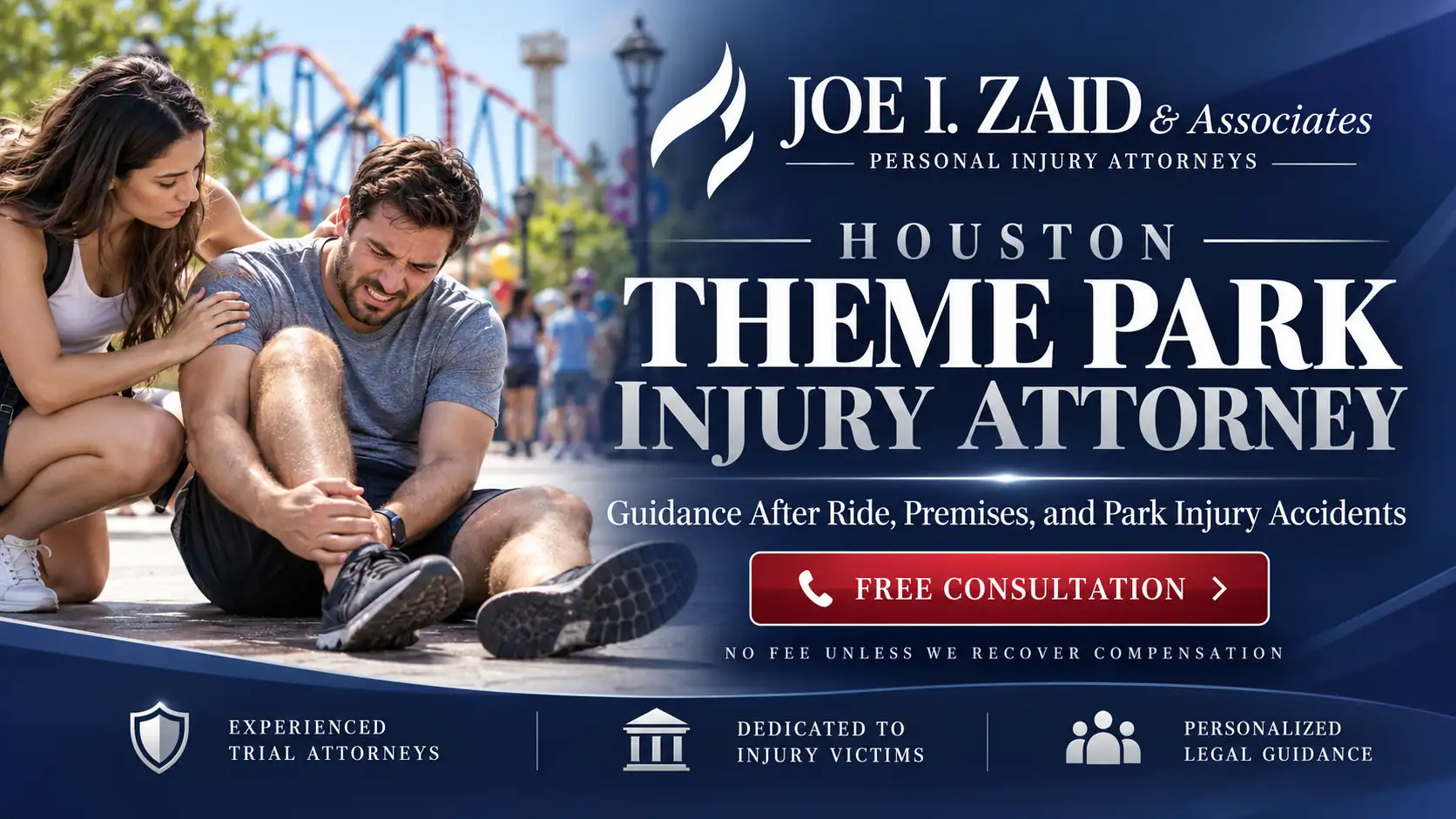
Park evidence disappears quickly. Operators return rides to service, security video overwrites itself, and seasonal employees move on. We start building your claim on day one.
Preservation Letters and Video
We send preservation letters that tell the park, its insurer, and any contractors to keep footage, ride data, and records. We ask for queue cameras, loading platform cameras, and any other footage that exists. We also search for guest photos and videos posted online on the day of the incident.
Ride, Maintenance, and Operator Records
For a ride claim, we request maintenance logs, daily inspection checklists, restraint inspection records, operator training files, and the manufacturer’s operating requirements. A pattern of missed repairs or skipped checks can show negligence. A clean record may point toward operator error or a defective part instead.
Inspection Certificates, Policies, and Injury Reports
Texas requires ride operators to obtain annual inspection certificates, carry liability insurance, and file quarterly injury reports. So we look for the certificate, the policy, and earlier injury reports tied to the same ride. We confirm coverage early and investigate the size of every available policy, including policies that contractors and vendors carry.
Witnesses and Medical Documentation
We identify witnesses, including friends, other guests, and employees who saw the incident. We also work with your medical providers so your records show what happened and how the injury affects your work and daily life. We do not give medical advice. We do explain how gaps in treatment can hurt a claim.
Types of Theme Park Injury Claims We Handle
Ride Malfunctions, Restraint Failures, and Operator Errors
Mechanical failures and operator mistakes can cause the most serious injuries. Examples include a lap bar that releases, a train that stops short, a loading error, or a ride that starts before a guest is secured. These cases usually turn on ride records and on what the operator did in the moments before the injury.
Falls and Unsafe Conditions Inside the Park
Not every park injury happens on a ride. Guests also fall on wet surfaces, damaged steps, uneven pavement, and poorly lit stairs. These claims follow notice rules that decide many outcomes. Our slip and fall lawyers handle that evidence every day.
Water Attractions and Resort Parks
Wet decks, slide platforms, wave pools, and lifeguard coverage raise different questions than dry rides. We handle water park injury claims and injuries at resort water parks such as Great Wolf Lodge.
Boardwalks, Midways, and Inflatables
Boardwalk rides, carnival midways, and inflatables raise their own questions. We handle boardwalk accident claims and bounce house injuries. We also review rodeo accident claims when someone is hurt on an event midway.
Crowd and Security Failures
Large crowds, alcohol, and long lines can lead to fights and assaults. When a park or venue ignores a foreseeable danger, a negligent security claim may follow.
Texas Law That Shapes a Theme Park Injury Claim
Ride Operators Owe Ordinary Care
Many people assume a ride operator owes the highest possible duty of care. Texas does not. In Speed Boat Leasing v. Elmer, the Texas Supreme Court held that amusement ride operators owe ordinary care and are not common carriers.
Ordinary care still means the care a reasonably prudent operator would use, given the risks of the ride. A high-speed or elevated ride carries more risk than a carousel, so reasonable care demands more. The practical effect is that we must prove what the operator did wrong. We do that with records, training files, and witness accounts.
Ride Operation Claims and Unsafe Condition Claims Follow Different Rules
Texas separates negligent activity claims from premises defect claims. A negligent activity claim covers harm from what someone was doing when the injury happened, such as dispatching a ride before a guest was secured. A premises defect claim covers a dangerous condition, such as a broken stair or a wet walkway.
In a premises defect case, the guest must show the park knew or reasonably should have known about the condition. The Texas Supreme Court restated the elements in United Supermarkets v. McIntire. They require actual or constructive knowledge, an unreasonably dangerous condition, a failure to use reasonable care, and causation. The court looks at factors such as whether the condition was marked, how large it was, and whether it caused earlier complaints or injuries.
Those factors explain why photos, measurements, and prior complaints matter. Notice often turns on how long a hazard existed and whether staff inspected the area, which is central to proving a slip and fall case. Choosing the right legal theory early shapes the evidence we gather.
What Texas Requires of Ride Operators
The Amusement Ride Safety Inspection and Insurance Act, found in Chapter 2151 of the Texas Occupations Code, sets the baseline. The Texas Department of Insurance administers it. Operators must have each ride inspected at least once a year by the insurer or a person the insurer hires. The inspection must test critical parts for stress and wear damage.
Operators must also carry minimum liability insurance, and the amount depends on the ride class:
- Class A rides are fixed rides designed mainly for children younger than 13. They require at least $100,000 in bodily injury and $50,000 in property damage coverage per occurrence with a $300,000 aggregate, or a $150,000 combined single limit with a $300,000 aggregate.
- Class B rides are every other ride. They require at least $1 million in bodily injury and $500,000 in property damage coverage per occurrence, or a $1.5 million combined single limit.
Operators must keep records of each ride injury that results in death or requires medical treatment. They must file those reports with the state every quarter. The Act excludes some attractions, including trampolines, nonmechanized playground equipment, and small vinyl waterslides.
Federal oversight is limited. The Consumer Product Safety Commission states that it has jurisdiction only over mobile amusement rides, so fixed park rides depend on state law. For rides that move from site to site, Texas directs its insurance commissioner to require daily safety restraint inspections.
A passed inspection does not prove a ride ran safely. The inspection tests equipment for wear. It does not decide whether staff loaded guests correctly or checked each restraint. Those questions belong to the negligence case.
Partial Fault and Responsible Third Parties
Texas uses a proportionate responsibility system under Chapter 33 of the Civil Practice and Remedies Code. A guest who is more than 50 percent responsible cannot recover damages. Otherwise, the recovery shrinks by the guest’s percentage of fault.
Parks use this rule aggressively. They argue that a guest ignored posted rules, rode with a known condition, or misused a restraint. In the Elmer case, a jury assigned 65 percent of the fault to the rider, and she recovered nothing. How juries assign those percentages is the heart of comparative negligence in Texas.
Texas also lets a defendant designate a responsible third party, such as a manufacturer or contractor, to shift blame. That makes early identification of every responsible company important.
Waivers, Tickets, and Releases
Many parks print release language on tickets, wristbands, or online checkout screens. A release does not automatically end your claim. Texas requires fair notice. The release must state in specific terms that it covers the park’s own negligence, and it must be conspicuous. A buried clause in fine print may fail.
Children raise another issue. A Houston court of appeals decided Munoz v. II Jaz Inc. in 1993 in a case involving an amusement park injury. The court held that a release signed by the injured child’s older sister did not bar the child’s claim, and it stated that parents could not waive a child’s rights in advance. Federal courts in Texas have followed that reasoning, but the Texas Supreme Court has not decided the question.
Appellate courts that have considered the issue have also generally held that pre-injury releases cannot excuse gross negligence in Texas personal injury cases. We review the actual language you accepted and how the park presented it.
Deadlines for Adults and Children
Under Chapter 16 of the Civil Practice and Remedies Code, most injured adults have two years from the injury to file suit. A wrongful death suit has its own two-year period that starts at the date of death. Evidence deadlines arrive much sooner than legal ones.
Children generally get more time, because the limitations clock pauses until age 18. Do not assume that extension covers every part of a family’s claim, such as a parent’s separate claim for a child’s medical bills. Because exceptions exist, we check Texas statutes of limitations for personal injury claims at intake in every case.
Who May Be Responsible After a Park Injury
Park cases often involve several companies. The company that owns the land may not be the company that runs the ride.
- The park owner or operator. It controls the property, sets inspection routines, and trains staff.
- A separate ride or concession operator. Some attractions run through a lessee or vendor with its own employees and insurance.
- The ride manufacturer or a parts supplier. A defective restraint or control system can support a product liability claim.
- Maintenance and construction contractors. Work on rides or walkways can create hazards. Rules on liability for a fall at a location under construction apply the same way.
- Event organizers and security companies. They may share responsibility when a crowd or security failure causes harm.
Defendants often blame each other. Identifying every responsible company early keeps one defendant from pushing all of the blame onto a company that never joins the case.
Evidence That Can Prove What Happened
The strongest park cases combine records from the park with proof you collect yourself. Useful evidence includes:
- Incident reports. Parks often write one, and you may never see it. We request it and ask the park to preserve it.
- Video and photos. Queue cameras, platform cameras, and guest videos can show restraint use and ride motion.
- Ride and maintenance records. Logs, work orders, and inspection checklists can show how the park treated known problems.
- Tickets, wristbands, and clothing. They prove you were there and can show how a restraint or surface failed.
- Witness information. Names and phone numbers matter, because witnesses leave the park and forget details.
- Medical records. They connect the incident to your injuries and show how treatment unfolded.
A missing report does not always end a claim. In our $90,000 slip and fall settlement, no one confirmed that the business created an incident report, and no one collected witness contact information. We built the claim around photos from the client’s family and her son’s account of the fall. Past results do not guarantee similar outcomes, because every case depends on its own facts.
Insurance Issues in Theme Park Claims
Park claims usually involve commercial liability insurance. The statute sets minimum limits for rides, but a minimum is a floor, not a measure of what your claim is worth. Parks may carry excess or umbrella coverage above the primary policy. Contractors and vendors carry separate policies. We investigate every layer.
The park’s adjuster may call within days. That adjuster may ask for a recorded statement or request your records directly. Joe’s years inside the insurance industry taught him how those calls work. Guests who talk first often give the insurer a version of events that shifts blame to them.
Adjusters use familiar tactics to avoid paying accident victims, such as disputing fault and questioning treatment. Quick offers also arrive before anyone knows the full extent of an injury, and pressure to settle fast can cost injured people later. We start settlement strategy early and prepare each claim to withstand a dispute.
Injuries and Compensation After a Park Incident
Compensation depends on your injuries, your treatment, and the proof behind both. Damages may include past and future medical care, lost income, reduced earning ability, pain, mental anguish, and physical impairment. Disfigurement can also matter.
Ride forces and falls from height can cause spine, head, and fracture injuries. Surgery, rehabilitation, and long-term limits can raise a claim’s value. So can clear proof of how the injury changed your daily life. The true cost of a personal injury extends well beyond medical bills and lost wages.
Some injuries permanently change a person’s life, and we explain when a personal injury becomes a catastrophic injury.
Fatal Theme Park Accidents and Wrongful Death Claims
When a theme park accident results in a death, surviving family members may have grounds for a wrongful death claim under Texas law. Fatal accidents can involve ride malfunctions, falls from height, drownings at water attractions, or other failures involving park operations and safety procedures. Texas law generally allows a surviving spouse, children, or parents to pursue wrongful death damages, which may include lost financial support, companionship, and mental anguish. Our attorneys investigate what caused the accident, identify potentially responsible parties, and help families understand their legal options.
When Texas Families Get Hurt Away From Home
Many Texas amusement venues sit far from the city where a family lives. Families in Houston, Dallas, Austin, and San Antonio regularly travel to parks in other parts of the state, and where the injury happened affects the courts, the evidence, and the defendants.
Parks and Boardwalks in the Houston and Galveston Area
Kemah Boardwalk on Galveston Bay, the Galveston Island Historic Pleasure Pier, and water parks in Galveston and Katy draw families from across the region. Our Clear Lake premises liability lawyers and our team handling Galveston injury claims work on the southeast side of the Houston metro, so these cases stay close to home.
Cotaland and Central Texas Parks
Texas also has newer destinations. Cotaland held its grand opening on September 26, 2026, at Circuit of the Americas near Austin. The park offers more than 30 rides and attractions, including a tilt roller coaster, a log flume, and a swing ride. A new park does not mean an unsafe park. It does mean new equipment, new staff, new vendors, and a short injury history. Each of those can affect how we investigate.
Whether a particular Cotaland attraction counts as an amusement ride under Texas law is a question we answer early. The answer determines which inspection and insurance requirements apply.
Texas’s general venue rule ties a lawsuit to the county where the events happened. Depending on the defendant, it can also tie the case to where the defendant lives or keeps its principal Texas office. You can find the rule in Chapter 15 of the Civil Practice and Remedies Code. A family hurt near Austin should expect Central Texas courts to matter. We serve clients across Central Texas, and any of our offices can start the review.
Dallas-Fort Worth, San Antonio, and Other Texas Metros
Large parks cluster around the state’s biggest metros. Six Flags Over Texas and Hurricane Harbor Arlington serve the Dallas-Fort Worth area, and Six Flags Fiesta Texas draws guests to San Antonio. Schlitterbahn in New Braunfels sits between San Antonio and Austin. A family from any of these cities can be hurt at a park in another one, so we start by working out which county, which operator, and which insurers are involved.
Guests hurt at larger chain parks should also know the immediate actions to take after an injury at Six Flags. The same evidence rules apply no matter which park caused the harm. Falls on wet walkways or damaged steps follow the same notice rules in every Texas city, including San Antonio slip and fall claims.
Trips Out of State
Trips out of state add another layer, because another state’s law may apply. Guests hurt at parks such as Disney World should preserve the same evidence and call us to discuss their options.
What to Do After a Theme Park Injury
- Report the injury to park staff. Ask for a written incident report and write down the name of the employee who took it.
- Get medical care right away. Tell providers exactly how you were hurt, even if your symptoms seem mild.
- Photograph everything. Capture the ride, the restraints, the walkway, your injuries, and any signs.
- Collect witness names and phone numbers. Do this before you leave the park.
- Keep your tickets, wristbands, and damaged items. They can serve as evidence.
- Write down what happened. Record details while your memory is fresh.
- Do not sign anything or accept a quick offer. Free tickets, refunds, and paid medical bills can come with release language.
- Call a lawyer quickly. We can send preservation letters before the park returns equipment to service or overwrites video.
Hiring a Texas Theme Park Injury Lawyer
Hiring a Texas theme park injury lawyer should not add financial pressure. We handle these cases on a contingency fee basis. You owe no attorney fee unless we recover compensation, and your first conversation with us is a free consultation.
After you hire us, we confirm liability and insurance coverage early. We communicate with the insurers so you do not have to. We coordinate with your medical providers, build the evidence, and negotiate from a documented position. If an insurer refuses to treat the claim fairly, we are ready to litigate.
Timelines vary. A case with clear liability and a finished treatment plan moves faster than one with several defendants. Factors such as the severity of your injuries and the insurer’s response shape how long a personal injury lawsuit takes to settle. We keep you informed at each stage.
Texas Theme Park Injury Attorney FAQs
Does passing a state inspection mean the park cannot be liable?
No. The annual inspection tests critical parts for wear and confirms the insurance requirements. It does not decide whether staff operated the ride safely or maintained the grounds. A park can pass inspection and still face a negligence claim.
Does the $1 million insurance minimum mean my claim is worth that much?
No. The $1 million figure is the statutory minimum for Class B rides, not a value for your claim. Your claim’s value depends on your injuries, treatment, losses, and the evidence of fault. Available coverage can also affect strategy, which is why we investigate every policy.
What if the park offers free tickets or pays my emergency room bill?
Review any paperwork before you accept. A goodwill gesture can include release language that limits your rights. Call us before you sign anything, and we will explain what the document says.
What if I did not report my injury before I left the park?
You may still have a claim. An unreported injury makes the case harder, but photos, tickets, witnesses, and medical records can fill gaps. Contact us quickly so we can ask the park to preserve its records.
What if I was hurt at Cotaland near Austin?
Texas premises liability and negligence law applies to a Texas park, and the same evidence rules apply. Report the injury, document the scene, and keep your records. Because the park is new, its inspection and injury records may be limited, so early preservation requests matter. Any of our offices can start your case review.
Contact a Texas Theme Park Injury Attorney Today
If you or a family member was hurt at a theme park, boardwalk, water park, or event midway, our Texas theme park injury lawyers can review your case. We investigate what happened, identify every responsible party, and handle the insurance companies. Call any office below, or use our contact form or free case evaluation. We offer free consultations and charge no attorney fee unless we recover compensation.
- Downtown Houston office: 1001 Texas Ave Suite 1400, Houston, TX 77002, (346) 340-0800
- Pasadena office: 4701 Preston Ave, Pasadena, TX 77505, (346) 756-9243
- Clear Lake office: 16821 Buccaneer Ln #226, Houston, TX 77058, (346) 690-0500
- Humble office: 5616 Farm to Market 1960 Rd E Suite 290D, Humble, TX 77346, (346) 594-0500
Our offices serve injured people in communities across Texas. Our personal injury attorney team also handles claims that fall outside the theme park category, so we can help whatever the circumstances of your injury.