
As an Amazon defective product liability lawyer, the firm sees the same question come up in nearly every case: who actually sold the product, and does Texas law treat that party as legally responsible. When one of those products turns out to be defective and causes an injury, figuring out who is actually responsible is rarely straightforward. The product may have been manufactured overseas, sold by a third-party vendor most buyers never notice, and delivered through Amazon’s own warehouse and shipping network.
If a product you bought on Amazon caused a serious injury, Joe I. Zaid & Associates can help you sort out who can be held accountable and pursue compensation for your medical bills, lost income, and other losses. The firm handles these claims as part of its broader product liability practice, with the added investigative work that online marketplace purchases require.
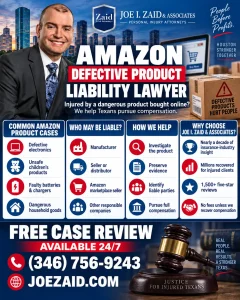
Why Work With Joe I. Zaid & Associates on an Amazon Product Claim
Amazon product injury cases usually turn on a question most people never think about until they need to answer it: who actually sold the product, and does Texas law treat that party as legally responsible? Getting that answer wrong can mean pursuing the wrong defendant or missing a viable one entirely.
Joe Zaid spent nearly a decade working inside the insurance industry before founding the firm, experience that shapes how the firm evaluates coverage once a manufacturer or seller is identified. The firm has represented thousands of personal injury clients and recovered millions of dollars in settlements, backed by 1,500+ five-star Google reviews across its Houston-area offices. That experience matters here because an Amazon product claim often requires identifying more than one potentially liable party before a case can move forward at all.
Joe I. Zaid & Associates handles these cases on a contingency fee basis, meaning clients do not owe attorney fees unless the firm recovers compensation for them. A free consultation can help you understand whether your situation involves a viable claim before you commit to anything.
How Our Firm Investigates an Amazon Product Injury Claim
An Amazon purchase leaves behind a different kind of evidence trail than a product bought in a store, and some of it can disappear quickly if a listing is removed or a seller account closes.
The firm works to preserve the physical product and its packaging, since a defect often needs to be examined by an expert before it can be altered or discarded. Amazon order history, confirmation emails, and account records document exactly what was purchased, when, and from whom. Screenshots of the original product listing, including the seller’s name and any safety warnings, capture information that may not be available once a listing is edited or taken down. Customer reviews mentioning similar problems with the same product can support a pattern of prior complaints relevant to a design or manufacturing defect.
The firm also checks CPSC recall records and other regulatory databases for the specific product, works to identify the manufacturer and any third-party seller through Amazon’s records and available business filings, and reviews what insurance coverage may apply once the responsible parties are identified. Given Joe Zaid’s background inside the insurance industry, the firm brings practical insight into how a manufacturer’s or seller’s insurer is likely to evaluate and respond to a claim.
Common Amazon Purchases Behind Defective Product Injuries
Amazon’s catalog spans nearly every consumer product category, and certain types of purchases show up repeatedly in defective product injury claims.
Lithium-ion battery devices, including power banks, phone chargers, and cordless tools, are especially prone to overheating, swelling, and fire. The Belkin power bank fire recall affected thousands of Amazon buyers and illustrates how quickly a battery defect can turn into a house fire or serious burn.
Home gym equipment ordered through Amazon, from resistance machines to adjustable dumbbells, has produced its own pattern of home gym equipment failures, often tied to weld failures, cracked frames, or footing that gives way under load. Children’s products, including furniture, toys, and sleepwear, carry particular risk because young children cannot recognize or avoid a hazard on their own. Kitchen appliances, power tools, and personal care devices such as hair dryers and curling irons round out the categories that generate the most claims.
What Makes a Product Legally Defective in Texas
Texas recognizes three general categories of product defects, and identifying which one applies shapes how the case gets built.
A manufacturing defect occurs when a product leaves the assembly line different from how it was designed, such as a battery cell with a flaw introduced during production. A design defect exists when the product’s design itself creates an unreasonable risk. Texas law requires the injured person to prove a safer alternative design existed, one that would have reduced the risk without significantly limiting the product’s usefulness or cost, under Section 82.005 of the Civil Practice and Remedies Code. A marketing defect, also called a failure to warn, involves inadequate instructions or warnings about a known risk, such as a charger sold without warnings about overheating during extended use.
Building any of these claims follows the same evidence-driven process the firm uses for defective product claims generally, with additional steps specific to online marketplace purchases.
Why Amazon Purchases Complicate These Claims
A product bought at a local store usually involves one identifiable retailer. A product bought on Amazon can involve a manufacturer, a third-party seller with a storefront name that reveals little about who actually owns it, and Amazon’s own fulfillment and delivery network. Texas courts and federal regulators have drawn different lines around each of these parties.
Is Amazon Itself Liable?
In Amazon.com, Inc. v. McMillan, 625 S.W.3d 101 (Tex. 2021), the Texas Supreme Court addressed whether Amazon could be held strictly liable as a “seller” for a defective product sold by a third party through Amazon’s marketplace. The case involved a young child injured by a battery from a remote control purchased through Amazon’s Fulfillment by Amazon program. The court held that under Chapter 82 of the Civil Practice and Remedies Code, a party must have held or relinquished title to a product to qualify as a seller. Because Amazon never held title to that third-party listing, even though it controlled storage, shipping, and the transaction process, the court found Amazon was not a seller under Texas law.
That distinction matters because Amazon’s marketplace includes different types of listings. A product marked “sold by” a third-party vendor generally falls under the McMillan holding, meaning a lawsuit against Amazon itself for strict product liability faces a significant legal barrier. A product that is Amazon-branded, or listed and sold directly by Amazon.com rather than a third party, involves Amazon actually holding title to the goods, which changes the analysis. Reviewing the original product listing and order details early in a case helps determine which category applies.
Hurt By an Amazon Delivery Driver or at an Amazon Warehouse?
Not every Amazon-related injury involves a defective product. If you were hurt in a crash involving an Amazon delivery driver, or injured while working at or visiting an Amazon warehouse, those situations involve different legal issues and different potentially responsible parties than a defective product purchased through the site.
Amazon’s Status as a Federal Distributor
Separate from the McMillan ruling, the U.S. Consumer Product Safety Commission has taken its own position on Amazon’s responsibility for third-party products. In July 2024 and January 2025 orders, the CPSC found that Amazon’s Fulfillment by Amazon program makes the company a distributor under the Consumer Product Safety Act for more than 400,000 hazardous items, including faulty carbon monoxide detectors and children’s sleepwear that failed federal flammability standards. That designation creates recall and notification duties for Amazon, separate from private lawsuits under Texas tort law. Amazon has challenged the CPSC’s authority in federal court, and that litigation remained ongoing as of 2026. A CPSC finding on a specific product or recall can still serve as useful evidence in a personal injury claim, even though it does not resolve who pays compensation to an injured person.
Finding the Manufacturer and Third-Party Seller
Because Amazon itself is often shielded from strict liability for marketplace listings, most Amazon product injury claims need to identify the manufacturer, the third-party seller, or both. Texas law generally protects non-manufacturing sellers from liability under Section 82.003 of the Civil Practice and Remedies Code, unless the injured person can show the seller participated in the product’s design, altered it, provided an inadequate warning it controlled, or made a false representation about the product. One important exception applies when the manufacturer is not subject to a Texas court’s jurisdiction, often because it is based overseas and cannot be served or does not respond to the lawsuit. In that situation, the seller who placed the product into commerce may be pursued directly. This exact scenario played out in McMillan, where the manufacturer never appeared in the case at all.
Amazon marketplace sellers frequently operate under storefront names that give little indication of the underlying business, and many source products from manufacturers based in other countries. Investigating who actually held title to the product, and whether that party can realistically be brought into a Texas lawsuit, is often the first substantive step in an Amazon product injury case.
Compensation for Injuries Caused by a Defective Amazon Purchase
Compensation in a product liability claim generally accounts for both economic and non-economic losses. Economic damages may include medical expenses, future treatment or care needs, and lost income if the injury affected the person’s ability to work. Non-economic damages may include pain and suffering and the broader effect the injury had on the person’s daily life. In cases involving a fatal defect, the family may have grounds for a wrongful death claim.
What a specific case may be worth depends on the severity of the injury, the strength of the evidence connecting the defect to the harm, and whether the identified manufacturer or seller has insurance coverage or assets available to satisfy a judgment. A claim against an overseas manufacturer that cannot be brought into Texas court, for example, may need to focus on a domestic seller or distributor instead.
Texas Deadlines for Filing an Amazon Product Injury Claim
Texas generally gives injured people two years from the date of the injury to file a product liability lawsuit, under Section 16.003 of the Civil Practice and Remedies Code. Texas also imposes a 15-year statute of repose for product liability claims under Section 16.012, meaning a lawsuit generally cannot proceed more than 15 years after the product was first sold, regardless of when the injury occurred. In some cases involving an injury that was not immediately apparent, Texas courts may apply a discovery rule that affects when the two-year clock begins, though this does not override the 15-year outer limit.
Because Amazon product claims often require identifying a specific seller or manufacturer before a lawsuit can even be filed correctly, starting that investigation as early as possible helps protect these deadlines.
What To Do After Getting Hurt by a Product Bought on Amazon
The steps taken soon after an injury can affect how strong a later claim is.
- Seek medical care and keep records of the diagnosis and treatment.
- Keep the product itself, along with its packaging, manual, and any charging cords or accessories, rather than returning or discarding it.
- Save your Amazon order history, confirmation emails, and any screenshots of the product listing before it can be edited or removed.
- Photograph the product, the defect, and your injury.
- Avoid giving a detailed statement to a manufacturer’s or seller’s insurance representative before speaking with an attorney.
- Contact an attorney promptly, since marketplace listings and seller accounts can change or disappear without notice.
Frequently Asked Questions
When should I contact an Amazon defective product liability lawyer?
If a product purchased through Amazon caused a serious injury, it’s worth having the purchase and the injury reviewed before you’re locked into a return, a refund, or a recorded statement with an insurer.
What if I do not know who actually manufactured or sold the product?
This is common with Amazon purchases. Order records, the original listing, and Amazon’s own seller information can often help identify the manufacturer and seller, which is typically one of the first steps in these cases.
Does it matter if the seller was based overseas?
It can work in your favor in some respects. Texas law includes an exception allowing a claim against a non-manufacturing seller when the manufacturer is not subject to a Texas court’s jurisdiction, which often applies when a manufacturer is based abroad and cannot be reached.
What if the product has already been recalled?
A recall notice or a CPSC finding about the product can support a claim, but it does not automatically resolve who is responsible for compensating you. Recall information is typically used as one piece of evidence alongside the specific facts of your injury.
How long do I have to file a claim in Texas?
Generally two years from the date of the injury, with an outer limit of 15 years from the date the product was first sold. Specific circumstances can affect these deadlines, so it is worth having a claim reviewed promptly.
What does it cost to hire a lawyer for this type of claim?
Joe I. Zaid & Associates handles product liability claims on a contingency fee basis, meaning there is no attorney fee unless the firm recovers compensation for you.
Talk to Joe I. Zaid & Associates About Your Amazon Product Injury
If a defective product purchased through Amazon caused a serious injury, an Amazon defective product liability lawyer at Joe I. Zaid & Associates can help you sort out who can be held responsible under Texas law. Joe I. Zaid & Associates offers a free consultation to review your purchase, your injury, and the parties who may be liable, with no attorney fee unless the firm recovers compensation for you. Contact the firm to get started.