

You were in a car accident that wasn’t your fault. Your back, which has bothered you for years due to an old sports injury, is now significantly worse. You need surgery. But when you file a claim, the insurance adjuster says: “This is a pre-existing condition. We’re not paying for it.”
If you have a pre-existing injury and were in a car accident in Texas, you’re probably worried that your prior medical history will disqualify you from receiving compensation. This is exactly what insurance companies want you to believe—but it’s not true. Under Texas law, you can recover compensation when an accident aggravates a pre-existing condition, and in many cases, pre-existing injuries actually increase settlement values because they lead to more severe overall harm.
Understanding your rights under Texas law is critical to getting the compensation you deserve. Here’s what you need to know about pre-existing injuries and car accident settlements in Texas.
The Texas Eggshell Plaintiff Rule Protects You
Texas follows a legal doctrine called the “eggshell plaintiff rule” (also known as the “thin skull rule”). This rule states that a negligent party must take the victim as they find them, regardless of any pre-existing physical or medical conditions.
In simple terms: if someone causes an accident and your pre-existing condition makes your injuries more severe, the at-fault driver is still 100% responsible for the full extent of your damages.
For example, imagine you have degenerative disc disease in your back. You manage it with occasional physical therapy. Then you’re rear-ended in a car accident on I-10. The impact causes your back condition to deteriorate dramatically, requiring surgery you wouldn’t have otherwise needed. Under the eggshell plaintiff rule, the at-fault driver’s insurance company must pay for that surgery and all related treatment.
This protection is routinely recognized by Texas courts and is a fundamental principle of Texas personal injury law. When a jury considers your case, they receive specific instructions that they must compensate you for any aggravation of a pre-existing condition caused by the accident.
What You Can Recover: The “But For” Test
Under Texas law, if you’ve been hurt in a crash that wasn’t your fault, the insurance company must pay for any medical treatment you wouldn’t have otherwise needed. This is called the “but for” test: but for the accident, would you have needed this treatment?
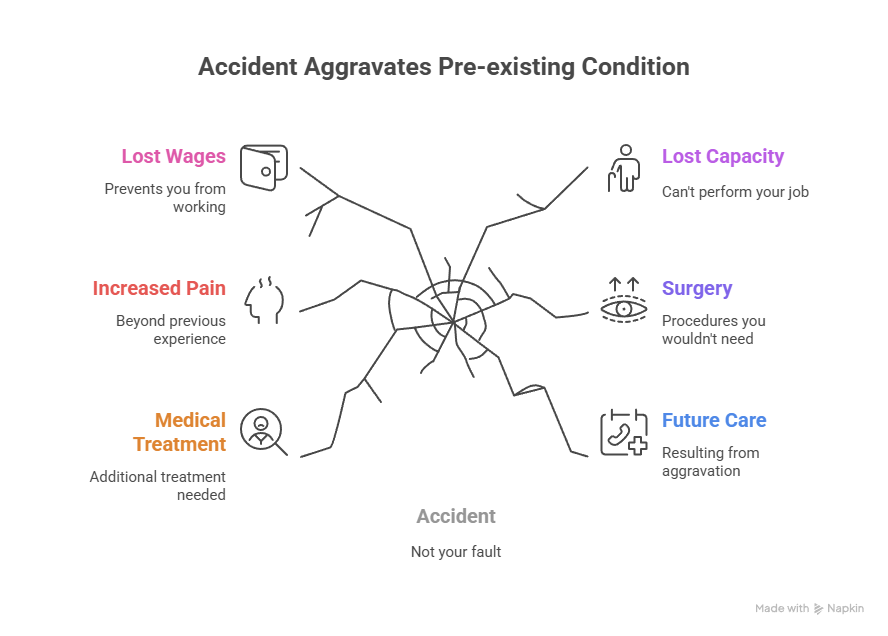
If the accident aggravated your pre-existing condition, you’re entitled to compensation for:
- Additional medical treatment necessitated by the aggravation
- Increased pain and suffering beyond what you experienced before
- Lost wages if the worsened condition prevents you from working
- Lost earning capacity if you can no longer perform your job
- Surgery or procedures you wouldn’t have needed without the accident
- Future medical care resulting from the aggravation
The key distinction is this: you cannot recover compensation for the pre-existing condition itself or treatment you were already receiving. However, you can and should recover full compensation for the worsening of that condition caused by the accident.
Why Pre-Existing Conditions Often Increase Settlement Value
Insurance adjusters want you to believe that pre-existing conditions reduce your claim value. The opposite is often true.
Someone with a pre-existing condition often recovers more in a settlement because they suffer an overall greater level of injury due to that condition. Here’s why:
1. More Severe Injuries: A person with osteoarthritis who gets hit in a car accident may suffer fractures or joint damage that a healthy person wouldn’t experience from the same impact. The eggshell plaintiff rule ensures full compensation for these more severe injuries.
2. Higher Medical Costs: Aggravating a pre-existing condition frequently requires more intensive treatment—surgery instead of physical therapy, long-term pain management, or permanent disability accommodations. Higher medical costs mean higher settlement values.
3. Greater Impact on Quality of Life: If you were managing your condition and living normally before the accident, but now you’re disabled or in chronic pain, that dramatic change in quality of life increases your non-economic damages.
According to industry data, settlements for aggravated pre-existing conditions in car accidents typically range from $50,000 to $300,000, with severe cases—such as an accident requiring spinal surgery for someone with prior back problems—reaching $500,000 or higher.
Common Insurance Company Tactics (And How to Fight Them)
Insurance companies have a playbook for denying or minimizing claims involving pre-existing conditions. Knowing these tactics helps you protect your rights:
Tactic #1: “This is all pre-existing damage.” Adjusters categorize all your injuries as “pre-existing,” even when the accident clearly made things worse. Fight back by obtaining detailed medical records from before and after the accident showing the objective worsening of your condition.
Tactic #2: “You were already seeing doctors for this.” They’ll argue that since you had prior treatment, the accident didn’t cause new harm. Fight back by having your doctor document the specific increase in symptoms, new limitations, or additional treatment needed post-accident.
Tactic #3: “Your medical history shows you’ve had this problem for years.” They’ll request all your medical records hoping to find any mention of similar symptoms. Fight back by working with a Houston car accident attorney who knows how to present medical evidence showing causation—that the accident directly caused or significantly worsened your condition.
Tactic #4: Delay and lowball offers. They’ll drag out the claim hoping you’ll accept a low settlement out of financial desperation. Fight back by understanding the true value of your claim (see our guide on how much your claim is worth) and refusing quick settlements that don’t account for aggravation of your pre-existing condition.
Proving Your Pre-Existing Condition Was Aggravated
Successfully recovering compensation for an aggravated pre-existing condition requires strong medical evidence. Here’s what you need:
1. Medical Records from Before the Accident: Documentation showing your condition before the crash—how you were managing it, what treatment you were receiving, and your functional limitations. If you had back pain but were working full-time without restrictions, that’s important baseline evidence.
2. Medical Records from After the Accident: Treatment records, diagnostic imaging (MRIs, X-rays, CT scans), and doctor’s notes documenting the worsening of your condition. If imaging shows objective changes—like a herniated disc that wasn’t there before—your case becomes much stronger.
3. Expert Medical Testimony: A medical expert can testify that the accident caused or significantly contributed to the aggravation of your pre-existing condition. This expert testimony is often critical for establishing causation and overcoming insurance company arguments.
4. Comparative Functional Evidence: Show how your life changed after the accident. If you were playing golf every weekend before the crash and now you can’t walk without pain, that demonstrates aggravation. If you need surgery now when you were managing with conservative treatment before, that’s strong evidence.
5. Timeline Documentation: Keep detailed records of your symptoms, limitations, and treatment from the moment of the accident forward. A gap in treatment can hurt your claim, so follow all doctor’s orders and document everything.
For more guidance on evidence preservation, read our article on what to do after a car accident.
Texas Comparative Negligence and Pre-Existing Conditions
Texas follows a modified comparative negligence rule, which can interact with pre-existing condition claims in important ways.
If you’re found partially at fault for the accident, your compensation is reduced by your percentage of fault—but only if you’re less than 51% at fault. If you’re 51% or more at fault, you recover nothing.
Insurance companies may argue that your pre-existing condition somehow makes you more at fault (for example, claiming your arthritis prevented you from reacting quickly enough). These arguments rarely succeed, but they’re worth being aware of. An experienced attorney will shut down these tactics quickly.
Why You Need an Attorney Who Understands Pre-Existing Condition Claims
Pre-existing condition cases are more complex than straightforward injury claims. Insurance companies fight harder, demand more medical records, and hire medical experts to minimize your claim.
Joe Zaid, founder of Joe I. Zaid & Associates, is a seasoned personal injury attorney whose client-centered approach delivers results for his clients. Since 2013, Joe has represented thousands of clients in cases of personal injury and wrongful death and has recovered millions of dollars in settlements, including numerous seven-figure settlements on behalf of individual clients. Joe specializes in personal injury cases, ranging from minor impact collisions to those resulting in life-altering injuries.
Joe was nominated by H-Texas Magazine as one of Houston’s Top Lawyers and was also nominated as a Top 40 under 40 Trial Lawyer. He is an active member of the Houston Trial Lawyers Association and Texas Trial Lawyers Association.
Joe’s experience with pre-existing condition claims provides critical advantages:
- Understanding of the eggshell plaintiff rule and how to apply it effectively
- Relationships with medical experts who can testify about causation and aggravation
- Knowledge of how to present “before and after” evidence persuasively
- Experience countering insurance company medical experts
- Track record of recovering substantial settlements for clients with pre-existing conditions
Joe I. Zaid & Associates Office: (346) 756-9243 4701 Preston Ave, Pasadena, TX 77505 https://joezaid.com
We serve accident victims throughout Houston, Pasadena, Friendswood, League City, and surrounding communities. We work on a contingency fee basis—you don’t pay any upfront costs, and we only get paid if we win your case.
Don’t Let Pre-Existing Conditions Stop You from Seeking Compensation
If you’ve been in a car accident and you have a pre-existing condition, do not let the insurance company convince you that you’re not entitled to compensation. Under Texas law, you have rights.
The eggshell plaintiff rule exists specifically to protect people like you—people who were more vulnerable to injury and suffered greater harm because of that vulnerability. The at-fault driver doesn’t get a discount just because you had a prior medical condition.
Act quickly:
- Texas has a 2-year statute of limitations for personal injury claims
- Medical evidence is strongest when documented immediately
- Insurance companies move fast to build their defense
Call Joe I. Zaid & Associates today at (346) 756-9243 for a free case evaluation. We’ll review your medical history, explain how Texas law protects you, and fight to recover full compensation for the aggravation of your pre-existing condition. You’ve already been dealing with one injury—don’t let the insurance company make it worse by denying your rights.