A school day should not end in an emergency room, but when it does, Texas families often discover that a school accident claim works nothing like a typical injury case. If a public school district is involved, state law shields it from most lawsuits and caps what a family can recover even when a claim succeeds. If a private school, daycare, or contracted transportation company is involved, ordinary negligence rules apply instead, with no immunity and no damage cap standing in the way. Sorting out that distinction early is the first job of a Texas school accident lawyer, and it often decides whether a family has a case at all.
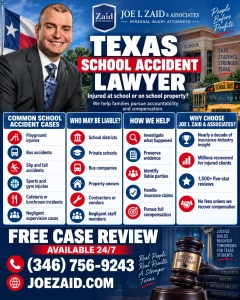
Joe I. Zaid & Associates represents injured students and their families throughout Texas after school bus crashes, campus injuries, daycare accidents, and school-sponsored activities that went wrong. The firm offers free consultations and handles school accident claims on a contingency fee basis, meaning a family owes nothing unless the firm recovers compensation.
Joe I. Zaid & Associates has represented thousands of injured clients across Texas and holds 1,500+ five-star Google reviews across its Houston-area offices. Joe Zaid was selected to Super Lawyers in 2026, and is an active member of the Houston Trial Lawyers Association and Texas Trial Lawyers Association.
Why School Accident Claims Work Differently Than Other Texas Injury Cases
Most personal injury claims start with one question: who was negligent? A school accident claim starts a step earlier: can this defendant even be sued? Independent school districts, charter schools, and their employees are governmental entities under Texas law, and governmental entities generally cannot be sued for negligence unless a specific statute allows it. Private schools, daycare centers, after-school programs, and independently contracted transportation companies do not get that protection. They answer to the same negligence and premises liability rules that apply to any Texas business.
That difference changes almost everything about how a case should be built, from which deadlines apply to how much a claim may ultimately be worth. Joe Zaid spent nearly a decade working inside the insurance industry before founding the firm in 2013, and that background shapes how the firm approaches these claims from the first phone call. Instead of assuming a school or district is automatically liable, or automatically protected, the firm identifies the correct legal category for each defendant before deciding how to proceed.
That investigative approach matters most when a vehicle is involved. In one case, the firm’s commercial vehicle attorneys traced a vehicle that fled the scene back to the private company that owned and operated it, and secured a $455,000 settlement for the client (case results reflect the facts of that specific case and do not guarantee a similar outcome in another matter). The same strategy, looking past the driver to the company responsible for hiring, training, and supervising them, applies directly to crashes involving privately contracted school buses, daycare vans, and other third-party transportation providers.
How Joe I. Zaid & Associates Investigates a School Accident Claim
The firm’s process for a school accident claim starts with confirming who the responsible party actually is, since that decision drives every deadline and strategy that follows. From there, the firm’s work typically includes:
- Requesting and preserving the incident report, along with any written statements the school or district created
- Identifying whether a school bus, contracted van service, or district-owned vehicle was involved, since that changes which liability rules apply
- Sending preservation letters for bus or hallway surveillance footage before it is recorded over, which can happen within days on some systems
- Reviewing maintenance, inspection, and driver personnel records when equipment or vehicle condition may have contributed to the injury
- Documenting the child’s medical treatment and working with providers to make sure the injury and its effects are properly recorded
- Evaluating available insurance coverage, including the district’s or school’s liability policy and any UM/UIM coverage that may apply if a third-party driver was at fault
- Coordinating the settlement process required whenever the injured person is a minor, which in Texas generally involves court approval before funds can be released
Because the firm’s clients are minors in most school accident claims, every step also has to account for how Texas courts supervise a minor’s settlement. A settlement involving a child typically requires court approval before it becomes final, and the funds are often placed under court supervision until the child reaches adulthood. The firm walks families through that process so it does not become another source of confusion during an already stressful time.
Types of Texas School Accident Claims We Handle
School accident claims cover a wide range of situations, and the legal rules that apply can shift depending on where the injury happened and who was in charge at the time.
School Bus and Student Transportation Accidents
When a school district employee negligently operates a district-owned bus, the Texas Tort Claims Act waives governmental immunity for that specific type of claim, which is one of the few real exceptions to a school district’s broad legal protection. Newer buses used to transport students generally must be equipped with three-point seat belts, and districts are required to have students use them when available, though funding for retrofitting older buses has historically lagged behind the requirement. Drivers who illegally pass a stopped school bus displaying its stop-arm signal can also face criminal penalties under Texas law, and that violation often becomes central evidence in a claim against a third-party driver.
Transportation is also where the line between public and private liability matters most. Many Texas districts and private schools contract with outside van or bus companies rather than operating their own fleets, and those companies do not share the district’s immunity. A crash involving a privately operated school van or contracted bus is generally treated as an ordinary commercial vehicle accident, without the notice deadlines or damage caps that apply to a claim against the district itself.
Playground, Classroom, and Campus Premises Injuries
Unmarked hazards, broken equipment, and unsafe flooring cause a significant share of school injuries, but this is also where public school immunity is at its strongest. Texas law generally does not waive a school district’s immunity for ordinary premises conditions, which means a fall on district property often cannot proceed as a standard premises liability claim the way it could against a private property owner.
Private schools and daycare centers are a different story. As private entities, they owe students the same reasonable duty of care that any property owner owes an invitee, and a claim over a dangerous condition or inadequate supervision can proceed under ordinary Texas premises liability principles, without a governmental cap limiting the recovery.
Field Trips and Off-Campus School Activities
A field trip introduces additional parties into a claim, including chartered transportation companies, museums, amusement parks, and other third-party venues that may bear responsibility alongside or instead of the school. Our field trip injury attorneys evaluate each party’s role separately, since the venue’s own negligence is not limited by any protection the school itself might have.
Parents are often asked to sign a permission slip or liability waiver before a field trip, and many assume that signature closes off any future claim. Texas courts have generally disagreed. In Munoz v. II Jaz Inc., Houston’s own court of appeals held that a parent cannot sign away a minor child’s own right to sue for a personal injury, even with a waiver in hand. That does not mean every field trip injury results in a viable claim, but a signed waiver alone should not stop a family from having the situation reviewed.
Daycare and After-School Program Injuries
Daycare centers, preschools, and after-school programs are private businesses under Texas law, regardless of whether they operate on a school campus. That means a daycare facing a negligent supervision or premises claim cannot raise governmental immunity as a defense, and families are not limited by the notice deadlines that apply to a public school district. When an afterschool transportation program is involved, the same private-operator rules apply to the van or driver responsible, an issue our firm has written about in the context of afterschool van crashes in Houston.
Sports, Athletics, and Extracurricular Injuries
Voluntary participation in school sports can raise assumption-of-risk arguments for injuries that are an ordinary part of the game, but that defense has limits. Negligent supervision, defective or poorly maintained equipment, failure to follow concussion protocols, and inadequate response to heat-related illness can all support a claim independent of the ordinary risks of the sport itself. Whether governmental immunity applies still depends on whether the school is public or private, and on which specific act or omission caused the injury.
School Zone and Third-Party Driver Accidents
Drivers who speed through school zones, run crosswalks, or fail to yield to crossing guards can cause serious injuries to students walking or biking to school. These claims generally proceed as ordinary car accident cases against the driver’s personal auto policy, including uninsured or underinsured motorist coverage when the at-fault driver carries little or no insurance. Our analysis of Houston school zone accidents during back-to-school season covers several of the liability issues that come up most often in these cases.
Sexual Misconduct and Failure-to-Report Claims
Texas historically limited a public school district’s liability almost entirely to motor vehicle claims, which left families with few options when a district failed to properly hire, supervise, or respond to misconduct by an employee. That changed on September 1, 2025, when House Bill 4623 created Chapter 118 of the Texas Civil Practice and Remedies Code. Under this law, a public school that is grossly negligent, reckless, or engages in intentional misconduct in hiring, supervising, or employing a professional school employee can now be held liable when that employee commits sexual misconduct against a student or fails to report suspected abuse or neglect, with damages available up to $500,000 per claimant. The law applies only to conduct occurring on or after its effective date, and it requires the individual employee to be named as a defendant alongside the school.
Private schools and daycare centers were never protected by governmental immunity in the first place, so claims involving inadequate screening, training, or supervision at a private institution proceed under ordinary Texas negligence law. Parents who want to understand the warning signs that can precede this kind of harm may find our overview of recognizing daycare abuse and pursuing compensation useful as a starting point.
Who May Be Held Legally Responsible After a Texas School Accident
Depending on the facts, one or more of the following parties may bear legal responsibility:
- The independent school district or charter school, but only within the narrow exceptions the Texas Tort Claims Act allows
- A private school or daycare operator, which answers to ordinary negligence and premises liability standards
- A contracted bus, van, or transportation company, treated as a commercial vehicle defendant rather than a governmental one
- An individual school employee, who has some personal immunity for discretionary acts under the Texas Education Code, but not for negligence causing bodily injury, excessive force, or the operation of a motor vehicle
- A third-party driver, in school zone, crosswalk, or bus stop-arm accidents
- An equipment manufacturer or maintenance contractor, when defective or poorly maintained equipment causes the injury
- A volunteer chaperone or activity sponsor, depending on the role they played and who they were acting on behalf of
Identifying every potentially responsible party matters because governmental caps only limit recovery against the governmental defendant itself. A private contractor, vendor, or third party sharing fault is not protected by the district’s immunity, even when the district is also involved.
Governmental Immunity and the Texas Tort Claims Act
The Texas Tort Claims Act generally protects public school districts from lawsuits for negligence, and the exceptions to that protection are narrow. Under Section 101.021 of the Texas Civil Practice and Remedies Code, a school district can be held liable for injury or death caused by an employee’s negligent operation or use of a motor vehicle. Districts are also separately, and even more narrowly, excluded from the broader premises liability waiver that applies to other units of local government, so an ordinary slip, fall, or equipment injury on school property usually cannot proceed as a standard premises claim against the district itself.
When a claim does fall within the motor vehicle exception, Texas law still caps what a family can recover. Section 101.023 limits a school district’s liability to $100,000 per person and $300,000 per occurrence, and exemplary or punitive damages are not available against a governmental unit at all. Those caps apply no matter how serious the injury, which is one reason identifying every potentially liable party, not just the district, matters so much in a serious case.
Individual school employees have their own layer of protection. Under Texas Education Code Section 22.0511, a professional employee generally cannot be held personally liable for discretionary acts within the scope of their job, except when their negligence causes bodily injury to a student or involves excessive force in discipline. That immunity does not extend to operating a motor vehicle, and House Bill 4623’s new Chapter 118 removed it entirely for the specific sexual misconduct and failure-to-report claims described above.
None of this applies to private schools or daycare centers. As private businesses, they carry no governmental immunity and no statutory damage cap, which means a claim against a private institution is evaluated under the same negligence principles that apply to any other Texas business.
Deadlines That Can Affect Your Child’s Case
Texas gives injury victims two years from the date of an accident to file a personal injury lawsuit, and that clock is generally paused, or tolled, while the injured person is a minor. For a claim against a public school district, though, a separate and much shorter deadline applies first. Section 101.101 of the Texas Civil Practice and Remedies Code requires written notice of the claim to the district within six months of the incident, describing the injury, the time and place it occurred, and what happened. Texas courts have generally required strict compliance with this notice deadline even when the injured person is a minor, so families should not assume the same tolling that extends the filing deadline will also excuse a missed notice.
Beyond the legal deadlines, evidence in a school accident case tends to disappear quickly. Bus and hallway surveillance systems commonly overwrite footage within days or weeks, and witnesses, classmates, staff, and bystanders can become harder to locate once a school year ends. Acting early gives a claim the best chance of being built on solid evidence rather than secondhand accounts.
What Compensation May Be Available
The categories of damages available after a Texas school accident are similar to any personal injury claim, but what a family can actually recover depends heavily on who is responsible.
- Current and future medical expenses, including therapy, rehabilitation, and specialist care
- Pain and suffering related to the injury and its recovery
- Disfigurement or permanent impairment
- The long-term educational or developmental impact of a serious injury
- Parents’ out-of-pocket costs directly tied to the child’s care and treatment
- Lost future earning capacity in cases involving catastrophic or permanent injury
- In fatal cases, damages available through a wrongful death claim brought on behalf of the family
When the responsible party is a public school district, the $100,000 per person and $300,000 per occurrence caps discussed above apply regardless of the severity of the injury. When a private school, daycare, contractor, or third-party driver shares responsibility, that party’s exposure is not limited by the district’s cap. This is part of why the firm reviews an unmarked hazard or equipment failure carefully rather than assuming the school premises is the only party involved. In one premises liability case, the firm pursued both a business and the outside contractor responsible for an unmarked construction hazard, securing an $85,000 settlement once both parties’ roles were established (case results reflect the facts of that specific case and do not guarantee a similar outcome). The same approach, looking at every party who touched the hazard, applies directly to a campus injury involving a contractor, vendor, or maintenance company working on school property.
Common Questions From Texas Families
Can I sue a public school district in Texas?
In most cases, only if the claim falls within a specific exception, most commonly an employee’s negligent use of a motor vehicle, or the newer Chapter 118 claims involving sexual misconduct or a failure to report abuse. Ordinary premises or supervision claims against a district are difficult to pursue because of governmental immunity, though the specific facts still matter.
Does a permission slip or liability waiver stop me from filing a claim?
Not necessarily. Texas courts have generally held that a parent cannot waive a minor child’s own right to sue for a personal injury, even when a waiver was signed for a field trip or activity. A waiver may still affect the case, but it is not automatically a complete bar.
What if the school says the injury was accidental and no one was at fault?
That is a common response, and it is not always the final word. An investigation into supervision levels, maintenance records, and how similar incidents were handled in the past can reveal negligence that was not obvious from an initial incident report.
How does a settlement work when my child is a minor?
Texas courts generally require approval of any settlement involving a minor before it becomes final, and the funds are often placed under court supervision until the child turns 18. This adds a step to the process, but it is designed to protect the child’s interests.
What if I am not sure whether a public school, a private company, or an individual is responsible?
This is one of the most common questions families have, and it is exactly the kind of issue an early investigation is meant to resolve. A crash involving a school-owned bus, a contracted van service, and a third-party driver, for example, can involve three different sets of rules within a single accident.
Should I speak with the district’s insurance company or risk management office before contacting an attorney?
Any statement made to a district’s insurer or risk management staff can become part of the record used to evaluate or dispute a claim. Speaking with a lawyer first, before giving a recorded statement, helps make sure nothing said early on works against the claim later.
What To Do After a Texas School Accident
- Report the incident to the school or district in writing, and request a copy of any incident report that is created
- Seek medical attention for your child and follow through with any recommended treatment
- Take photographs of the location, equipment, or vehicle involved, if it is safe and possible to do so
- Write down what your child and any witnesses remember while the details are still fresh
- Keep any permission slip, waiver, or consent form connected to the activity
- Avoid giving a recorded statement to a school’s insurer or risk management office before speaking with an attorney
- Contact a lawyer promptly, given how quickly the notice deadline for a public school claim can pass
Why Texas Families Choose a Texas School Accident Lawyer at Joe I. Zaid & Associates
Joe Zaid has also contributed insurance-industry analysis to legal publications such as Law360, and that same background is what allows the firm to spot which party in a school accident, the district, a contractor, or a third-party driver, is actually exposed to liability before a claim is ever filed
That background matters in school accident claims specifically, where correctly identifying whether governmental immunity applies, and building the case around whichever party is actually exposed to liability, often determines the outcome before a claim is ever filed. The firm represents families from its offices in Pasadena, Clear Lake, Humble, and downtown Houston, and takes school accident cases from across Texas on a contingency fee basis, with no attorney fee unless the firm recovers compensation.
If your child was hurt at school, on a school bus, at daycare, or during a school-sponsored activity, contact Joe I. Zaid & Associates for a free consultation to find out where your family actually stands.