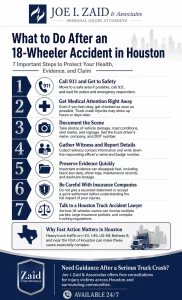
After an 18-wheeler accident, get medical care first, then call the police to request a crash report, document the scene if it is safe to do so, and get the truck driver’s information along with the name of the trucking company. Avoid giving a recorded statement to the trucking company’s insurance adjuster until you understand what you are agreeing to, and consider speaking with an attorney soon afterward. Trucking companies often send their own investigators to the scene within hours, and some of the evidence that matters most, like electronic logging data and dashcam footage, can be lost or overwritten within days.
Because 18-wheeler claims usually involve a driver, a trucking company, and one or more insurance policies, many people find it useful to speak with a Houston truck accident attorney early, even before deciding whether to pursue a claim. Houston’s position along the Houston Ship Channel and Port Houston, combined with heavy freight traffic on corridors like I-10, I-45, I-69, Beltway 8, SH 225, and SH 146, puts large commercial trucks on the road throughout much of the metro. That freight activity is part of why 18-wheeler accidents happen here and why claims tied to them often move differently than a typical car accident case.
Get Medical Attention First
Get checked by a medical professional even if you feel capable of walking away from the accident. Crashes involving 18-wheelers generate far more force than typical passenger vehicle collisions, and injuries like whiplash, internal bleeding, or concussions do not always produce symptoms right away.
Getting evaluated quickly protects your health and also creates a medical record that ties your injuries to the accident date. A gap between the crash and your first visit to a doctor can give an insurance adjuster a reason to question whether the accident actually caused your injuries.
Call the Police and Request a Crash Report
Call 911 so officers can respond to the scene, document the accident, and create an official crash report. In Houston, the Houston Police Department generally investigates crashes within city limits, and the department has noted that crash reports typically require some processing time before they become available to the public.
The crash report will usually include basic facts like the date, location, parties involved, and the responding officer’s initial observations. It is not the final word on fault, but it becomes an important starting point for any later claim.
Document the Scene and Exchange Information When It Is Safe
If your injuries allow it and the scene is safe, take photos of the vehicles, the road conditions, any visible damage, and your injuries. Try to get the truck’s company name, USDOT number, and license plate, along with the driver’s name, license number, and insurance information. If there were witnesses, ask for their contact information before they leave.
This on-scene documentation is only the starting point. Some of the evidence that can support a truck accident claim exists inside the truck itself or with the trucking company, and it is not something you can collect at the scene on your own.
Why Time Matters So Much After an 18-Wheeler Accident
Truck accident claims tend to move faster than typical car accident claims because trucking companies often have more at stake and more resources to respond quickly. Many carriers dispatch their own investigators or a rapid response team to the scene within hours of a serious crash, sometimes before the injured person has left the hospital.
Large commercial trucks are also required by federal regulation to use electronic logging devices that record a driver’s hours, speed, and vehicle movement, and this data is not necessarily kept indefinitely. Dashcam footage, dispatch records, and maintenance logs can also be overwritten, deleted, or lost as part of a company’s normal recordkeeping cycle. Once this information disappears, it generally cannot be recovered.
Joe I. Zaid & Associates focuses on preserving this type of evidence early, including sending preservation letters to trucking companies and insurers before information can be lost or altered. Getting an attorney involved soon after the accident is often what makes early preservation possible.
Be Careful Before Speaking With the Trucking Company’s Insurance Adjuster
It is common for a trucking company’s insurance adjuster to reach out shortly after a crash, sometimes to ask for a recorded statement or to offer an early settlement. You are not required to give a recorded statement to the other side’s insurer, and it is worth thinking carefully before you do.
An early settlement offer may not reflect the full extent of your injuries, especially if you have not finished treatment or do not yet know how the injury will affect your work or daily life. Joe Zaid spent nearly a decade working inside the insurance industry before founding the firm, which gives our attorneys practical insight into how these adjusters evaluate claims and where they may try to limit what they pay.
Understand That More Than One Party May Share Responsibility
Unlike a typical two-car accident, an 18-wheeler crash can involve more than one potentially responsible party. Depending on the facts, the truck driver, the trucking company, a maintenance contractor, or even the company responsible for loading the cargo may share responsibility for what happened.
Sorting out how liability works after a truck accident often requires reviewing driver logs, maintenance records, and company policies that are not available to the public. This is part of why disputed fault does not automatically mean there is no case, even when the initial facts seem unclear.
When to Contact a Truck Accident Attorney
There is no requirement to hire an attorney after an 18-wheeler accident, but many people find it helpful to speak with one soon after the crash, particularly if the trucking company’s insurer has already made contact, if fault is disputed, or if your injuries are serious enough to require ongoing treatment.
Getting legal guidance early does not commit you to anything. It simply gives you a clearer picture of your options before you have to make decisions about statements, medical treatment, or settlement offers that can be difficult to undo later. If you were injured in an 18-wheeler accident in Houston, our attorneys can review what happened and explain what steps may help protect your position going forward.