Often, yes. Not wearing a seat belt does not automatically bar a claim in Texas. It also does not make the other driver any less responsible for causing the crash. The other side can still argue that you made your own injuries worse. If a jury agrees, Texas law reduces your compensation by the share of responsibility it assigns to you. A share above 50 percent bars recovery entirely.
Adjusters can raise seat belt use early, before anyone has shown that a belt would have changed your injuries. This article explains how Texas courts treat seat belt evidence, how much it can cost you, and what proof decides the issue.
If an insurer has already blamed your seat belt, a free consultation can show you where your claim stands.
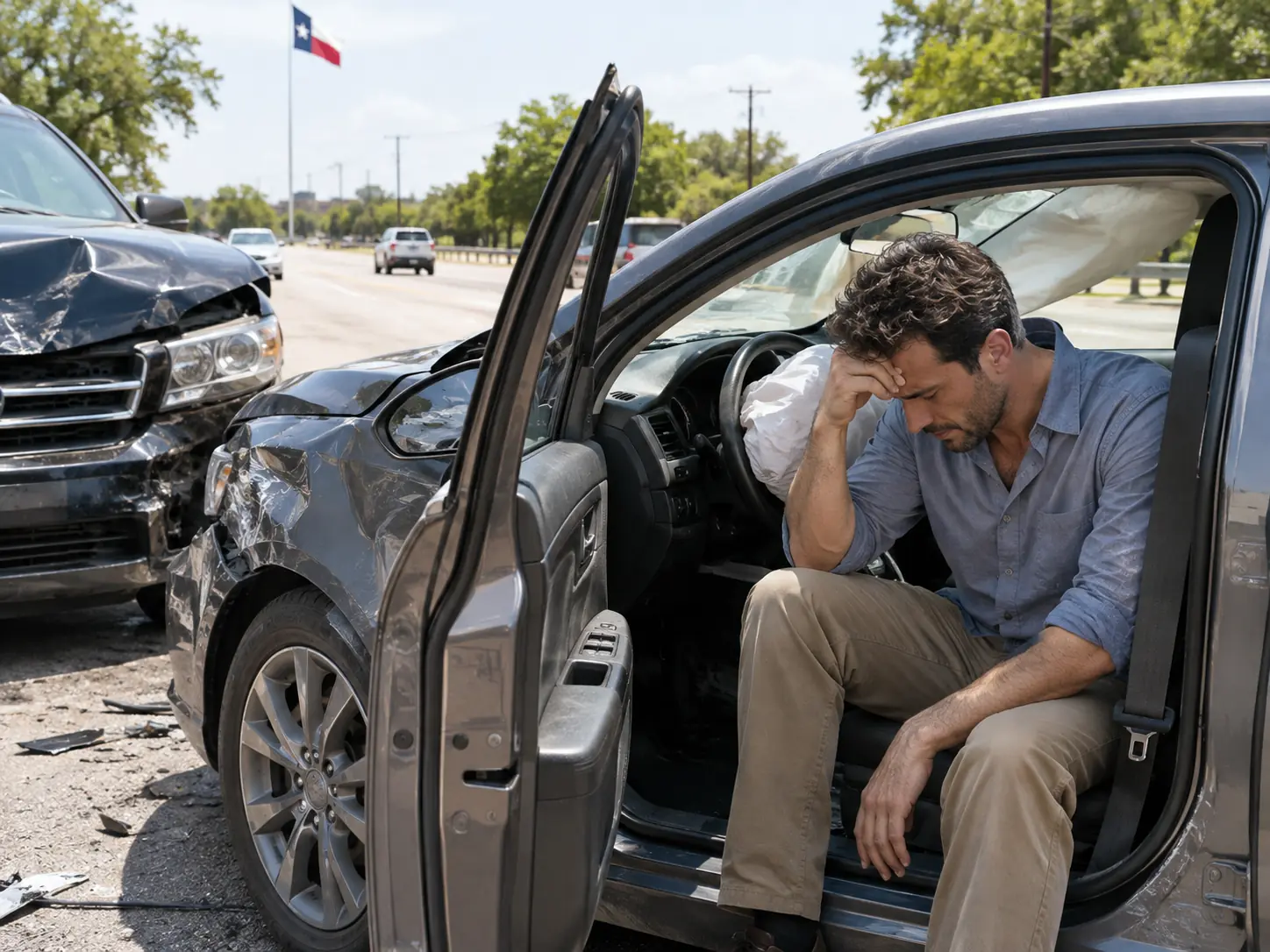
Not Wearing a Seat Belt Does Not Cause the Crash
A seat belt does not prevent a collision. It reduces injuries after a collision happens. That distinction drives how Texas treats this issue.
If another driver ran a red light or rear-ended you, that driver caused the crash. Your belt use does not change who broke the traffic law. Your Texas car accident claim still starts with proving that the other driver was negligent.
The seat belt argument comes in at a second step. The other side claims your injuries are worse than they would have been with a belt. That argument targets your injuries, not the crash.
What Texas Law Says About Seat Belt Evidence
Texas law requires people age 15 and older in a passenger vehicle to wear a seat belt in any seat that has one, front or back. Limited exceptions apply. The rule appears in Section 545.413 of the Texas Transportation Code.
For roughly four decades, that law did not help insurers in injury lawsuits. Texas courts kept seat belt nonuse away from juries in civil cases. The Texas Supreme Court ended that rule in 2015.
In Nabors Well Services v. Romero, the court held that relevant evidence of seat belt use or nonuse is admissible when a jury divides responsibility. The court reasoned that nonuse cannot cause a crash, but it can contribute to a person’s injuries or death. A person who skips the belt can therefore share responsibility for the harm, even when someone else caused the collision.
The ruling did not make the argument automatic. Judges can still exclude the evidence when its relevance is weak or when it could unfairly sway a jury.
How a Seat Belt Defense Can Reduce Your Compensation
Texas divides blame through proportionate responsibility under Chapter 33 of the Texas Civil Practice and Remedies Code. The jury assigns a percentage of responsibility to each person who contributed to the harm, and that can include you. Two rules follow:
- The 50 percent bar. You cannot recover damages if your percentage of responsibility is greater than 50 percent.
- The percentage reduction. If your share is 50 percent or less, the court reduces your damages by that percentage.
Here is a simple illustration. Suppose a jury finds $100,000 in damages. It assigns 20 percent of the responsibility to the choice not to wear a belt. The court reduces the award by $20,000, and you recover $80,000. This example is hypothetical, and real outcomes depend on the facts and the evidence.
Lawyers often call this system comparative negligence. It works the same way whether the shared blame involves a seat belt, speeding, or another choice.
The Insurer Still Has to Connect the Belt to Your Injuries
Nonuse alone does not reduce your recovery. The party raising the defense must show that not wearing the belt caused or contributed to your specific injuries. The trial judge decides whether that proof is relevant before the jury hears it. Experts often supply the proof, although the court did not require expert testimony in every case.
That requirement matters because belts do not prevent every injury. Ejection from the vehicle or striking the dashboard are the kind of harm a belt is designed to reduce. A burn, a cut from broken glass, or a fracture from cabin intrusion may have happened with or without a belt.
The science behind belts is strong. The National Highway Traffic Safety Administration reports that a belt cuts the risk of fatal injury by 45 percent for front seat car occupants. For light truck occupants, the figure is 60 percent. Those figures explain why insurers raise the argument and why an injury by injury analysis matters.
Fault for the Crash and the Belt Argument Can Overlap
The Texas Supreme Court said a jury can cover two things in one question. Those are conduct that caused the crash and conduct that worsened injuries. That matters when fault for the collision is also disputed. A higher percentage moves your claim closer to the 50 percent bar.
What If You Were a Passenger or Riding With a Child?
Passengers face the same framework. An unbelted passenger can receive a percentage of responsibility for injuries a belt would have reduced. The driver who caused the crash still answers for the collision itself. A passenger may have a claim against more than one driver. The compensation car accident passengers can expect depends on who caused the crash and what insurance applies.
Children get different treatment. Under Romero, a jury may assign responsibility for an unbelted child to the adult who had to restrain the child, usually the driver.
Evidence That Can Settle the Seat Belt Question
Belt use can seem obvious to the person who lived through the crash, but the proof can be thin or conflicting. These sources usually matter most:
- The crash report. Texas crash reports record restraint use for each person. An officer may fill in that entry from a quick look at the scene or a short statement. Mistakes happen, and errors in a police report can shape how an adjuster values a claim.
- Vehicle event data. Federal regulations require an event data recorder in a covered vehicle to log whether the driver’s belt was fastened. Passenger belt status appears only when the vehicle records it.
- Medical records. Emergency responders and hospital staff can note belt marks, how the person sat in the vehicle, and the pattern of the injuries. A treating doctor can also explain which injuries a belt would not have changed.
- Photos and the vehicle itself. Interior photos, the condition of the belts and airbags, and the damage pattern help experts explain how a person moved in the crash. Repairs or salvage can erase that proof.
- Witnesses. Other drivers, passengers, and first responders may know whether a person wore a belt or how the person left the vehicle.
We start documenting injuries and collecting this evidence on day one. When a vehicle could be repaired or sold for salvage, we send preservation letters so the data stays available.
What to Do When an Insurer Raises the Seat Belt Argument
Your first response shapes how the rest of the claim goes. These steps help:
- Answer honestly. Never say you wore a belt if you did not. A false statement can damage your credibility on every other point in the claim.
- Pause before giving a statement. Adjusters can ask about belt use during a call. Think carefully before you agree to a recorded statement after a car accident.
- Ask which injuries the insurer blames on the belt. A reduction without a named injury and a reason is only an assertion.
- Keep the vehicle until someone documents it. Check with a lawyer before the car goes to salvage or a repair shop.
Joe Zaid spent nearly a decade inside the insurance industry. He knows how adjusters use a seat belt argument to discount a claim, and he knows that a discount needs support. When an insurer cannot tie the belt to a specific injury, the argument can carry far less weight.
When to Talk to a Lawyer About a Seat Belt Defense
Consider calling a lawyer if an insurer reduces an offer because of your belt. The same goes if you share blame for the crash or have serious injuries. Joe I. Zaid & Associates offers free consultations, and we handle injury cases with no fee unless we recover compensation. We can review the crash report, the vehicle data, and your medical records to see what the evidence supports.