Houston gets flood warnings several times a year, and most drivers focus on which streets might close. Few think about what a thin layer of water does to a car moving at highway speed. That thin layer is enough to cause hydroplaning, and hydroplaning is behind a meaningful share of crashes that happen the moment a flood warning goes into effect.
This guide stays focused on car accidents tied to flood warnings: what causes them, which crash types become more common, and what happens to a claim once flooding is part of the story.
What Changes on Houston Roads When a Flood Warning Is Issued
A flood warning means the National Weather Service expects flooding that is happening or about to happen, not just possible. That distinction matters for drivers because road conditions can shift in minutes, not hours.
Harris County’s flat terrain and dense network of bayous, including Brays Bayou, White Oak Bayou, and Buffalo Bayou, make heavy rain events especially unpredictable. Water that overwhelms storm drains tends to pool fastest in highway underpasses and low-lying intersections, often before drivers realize a warning has even been issued.
The same storm systems that trigger flood warnings frequently knock out power to traffic signals along the route. A dead intersection should legally function as a four-way stop, but many drivers either do not know that rule or do not notice the signal is out until they are already through the intersection.
Joe I. Zaid & Associates, a Houston-area car accident injury law firm, sees a recognizable pattern in flood-related crash claims each storm season. The crashes rarely happen because a driver did something dramatic. They happen because ordinary driving habits stop working once water is on the road.
Why Hydroplaning Becomes More Likely During a Flood Warning
Hydroplaning happens when water builds up between the tires and the road faster than the tread can move it away. The car partially lifts off the pavement, and the driver loses meaningful steering and braking control.
Flood warning conditions create close to ideal hydroplaning weather. Rainfall often falls faster than storm drains and road grading can handle, so standing water builds up on stretches of highway that felt dry an hour earlier. Worn tire tread makes the problem worse, but even newer tires can hydroplane once water depth outpaces the tread’s ability to clear it.
Drivers often notice hydroplaning before they fully understand what is happening. The steering wheel suddenly feels light, the engine may rev without the car gaining speed, and the back end can drift slightly to one side. By the time most drivers recognize those signs, the car has already lost some contact with the road.
Highway speeds that feel normal in dry weather can be enough to cause hydroplaning once water builds up this way. A driver does not need to be speeding to lose control. They only need to be moving too fast for the water actually on the road in front of them.
Crash Patterns That Become More Common During Flood Warnings
Certain types of crashes show up again and again once a flood warning is active. Recognizing the pattern helps explain why these accidents happen and what evidence ends up mattering later.
Rear-End Collisions When Stopping Distances Get Misjudged
When a vehicle ahead hydroplanes or brakes suddenly, the driver behind often has less than a second to react. Wet roads already extend stopping distances, and heavy rain reduces visibility at the same time.
Many flood-warning crashes on highways like I-45 and US-59 start this way. A driver several car lengths back may still be following too closely for the actual conditions, even if they were keeping a normal following distance for dry weather. Anyone dealing with a crash like this may want to look at how weather factors into rear-end accident claims.
Vehicles Stalling or Trapped in Flooded Underpasses
Underpasses along highways such as I-610 and Beltway 8 can fill with water faster than drivers expect, even during a short, intense downpour. A stalled vehicle sitting in standing water creates a hazard for everyone still moving through the area, especially when visibility is already poor.
Drivers behind a stalled car often have little warning before they are on top of it.
Multi-Car Crashes From Reduced Visibility and Spray
Heavy rain can cut visibility to a fraction of normal range within seconds. Spray from larger vehicles, including trucks and SUVs, makes it worse for drivers nearby.
These conditions are part of why flood-warning periods tend to see more multi-vehicle crashes than an average rainy commute.
Intersection Crashes When Traffic Signals Lose Power
Storms strong enough to trigger a flood warning often cause brief power outages along the same corridors. A signal that goes dark in the middle of rush hour creates confusion fast, especially when several drivers in different lanes all assume they have the right of way.
These crashes tend to happen at busy intersections rather than highways, and disputed fault is common because no signal was working to establish who should have stopped first.
When a Flood-Related Crash Becomes a Serious or Fatal Accident
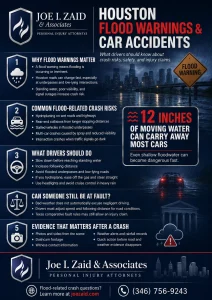
Flood-related crashes carry a higher risk of serious injury or death than a typical fender bender. Based on guidance from the National Weather Service, just 12 inches of water can float a car or small SUV, and 18 inches of moving water can carry away a larger vehicle. A vehicle swept off a roadway or trapped in rising water creates a danger that goes beyond normal collision forces.
These crashes can also involve secondary collisions, when a stalled or partially submerged car gets struck by another vehicle that did not see it in time. Emergency responders may also reach the scene more slowly than usual if nearby roads are flooded, which can affect how quickly injured people get help.
Families dealing with a fatal accident in these conditions are not only confronting grief. They are often facing an insurance company that wants to point at the weather instead of the driver. Families in this situation can review fatal car accident claims to understand what factors, beyond the storm itself, actually affect liability.
What to Do Behind the Wheel When a Flood Warning Is Active
A few habits can reduce risk significantly once a flood warning is in effect.
- Slow down before reaching standing water, not after.
- Increase following distance well beyond the usual three-second rule.
- Avoid underpasses and low-lying roads when water depth is unclear.
- If the car starts to hydroplane, ease off the gas and steer straight instead of braking hard.
- Treat any dead traffic signal as a four-way stop.
- Turn on headlights even during the day to help other drivers see you.
- Skip cruise control on wet roads, since it can delay your reaction if the car loses traction.
None of these steps eliminate risk completely. They reduce the chances that an ordinary commute turns into a serious crash.
How Insurance Companies Respond to Weather After a Crash
Insurance adjusters often try to treat a flood warning like a built-in excuse. If the weather was bad, the thinking goes, maybe no one is really at fault.
That argument leaves out an important point. Drivers are still expected to adjust their speed and following distance for the conditions in front of them. A driver who hydroplanes at highway speed during a flood warning may still have been driving too fast for the actual road conditions, even if they were under the posted speed limit.
Because Joe Zaid spent nearly a decade inside the insurance industry before founding the firm, he understands how adjusters build a weather defense and where that defense tends to fall apart. That insight matters most when rain or flooding becomes the center of a liability dispute.
Does a Flood Warning Mean No One Is at Fault?
Not by itself. Texas follows a modified comparative negligence rule, meaning an injured driver can still recover damages even if they shared some fault, as long as they were not found more than 50 percent responsible.
Weather alone rarely makes a driver more than half at fault for a crash. Insurance companies sometimes push hard in that direction anyway, especially when a flood warning was active at the time. Drivers can look at how Houston car accident claims handle disputed fault to see which facts, beyond the weather report, matter most.
Can You Still Have a Car Accident Claim If Houston Was Under a Flood Warning?
Yes. A flood warning does not erase another driver’s duty to drive carefully for the conditions in front of them.
A car accident claim still depends on the same basic question. Did another driver act unreasonably given what was happening on the road? Speeding through standing water, following too closely in heavy rain, or driving around a barricade can all support a negligence claim. The weather played a role, but the driver’s choices still matter.
Driving past a “Road Closed” sign or a high water barricade during an active flood warning can actually strengthen a claim. It shows the driver chose to ignore a known hazard instead of encountering an unexpected one.
Having a claim and knowing what it may be worth are two different questions. The facts, the available insurance coverage, and the evidence gathered after the crash all affect how insurers evaluate a flood-related claim.
Evidence That Can Disappear Quickly After a Flood-Related Crash
Flood-related crash evidence does not last long. Standing water recedes, skid marks wash away, and Houston’s freeway traffic cameras often overwrite footage within days.
Specific weather records, including the official flood warning and rainfall totals tied to the time and location of the crash, can matter when liability is disputed. Photos taken at the scene, dashcam footage, and witness contact information carry more weight in these cases than in an average fender bender, because the weather itself becomes part of the disagreement.
Early case preparation can help preserve this kind of evidence before it disappears. Speaking with a Houston personal injury attorney soon after the crash can help clarify what to gather and how quickly to act.
Getting Help After a Flood-Related Car Accident in Houston
A flood warning does not automatically explain away a crash. Drivers are still expected to adjust for the conditions in front of them, and insurance companies know that as well as anyone.
If you were hurt in a car accident during a flood warning in the Houston area, reviewing your options before accepting an early settlement may help clarify what the claim actually involves. You can contact Joe I. Zaid & Associates to talk through what happened and what steps may make sense next.