
A defective product can cause serious harm without warning. A car part can fail on the freeway, a machine can malfunction on a refinery job site, or a household item can catch fire during normal use. When a Houston product liability lawyer at Joe I. Zaid & Associates reviews a defective product injury, the review starts with how the product was designed, built, and sold, and who along that chain may be legally responsible.
Product liability claims move differently than most personal injury cases. The product itself is often the most important piece of evidence, the company on the other side is usually a manufacturer or national retailer with its own legal team, and Texas law places specific proof requirements on the person bringing the claim. Joe I. Zaid & Associates works with injured clients and their families to identify what happened, who may be liable, and what the claim requires under Texas law. Consultas gratuitas are available, and the firm works on a contingency fee, so there is no attorney fee unless compensation is recovered. Call (346) 340-0800 to talk with the Houston office about a defective product injury.
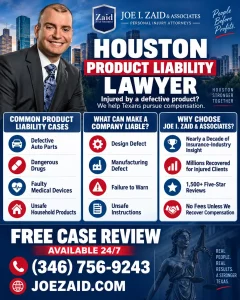
Why Choose a Houston Product Liability Lawyer at Joe I. Zaid & Associates
Antes de fundar la empresa en 2013, joe zaid spent nearly a decade working inside the insurance industry. That background is particularly useful in product liability claims, where the opposing side is rarely a single driver’s insurer. It is often a product liability or commercial general liability insurer working on behalf of a manufacturer, a distributor, or a national retail chain, each with its own strategy for minimizing what it pays.
Joe Zaid graduated from South Texas College of Law Houston and has represented thousands of clients in personal injury and wrongful death matters. He was selected to Super Lawyers in 2026 and is an active member of both the Houston Trial Lawyers Association and the Texas Trial Lawyers Association. He has also contributed legal analysis to Law360, a publication followed closely by attorneys who litigate complex commercial and injury claims of the kind that product liability cases often become. The firm has built a reputation across the Houston area for client communication and case preparation, reflected in Más de 1500 reseñas de cinco estrellas en Google. en sus cuatro oficinas.
Defective product claims frequently involve multiple potential defendants, competing insurance policies, and technical questions about how a product was engineered or manufactured. Handling that complexity well from the beginning can affect how the claim is positioned later.
Resultados del caso
Joe I. Zaid & Associates has recovered results across a range of personal injury and liability claims, including:
- Acuerdo de $1,2 millones. After another law firm could not establish liability, the firm rebuilt the case and secured this recovery for the client.
- Liquidación $455,000. The investigation expanded beyond the driver to develop a negligent hiring claim against the company that owned the vehicle.
- Liquidación $237,500. The at-fault person’s policy limits were insufficient, and additional recovery came through the client’s own coverage.
Past results depend on the specific facts of each case and do not guarantee or predict a similar outcome in any future case. More results are available on the firm’s case results page.
Types of Defective Product Claims We Handle in Houston
Not every defective product injury looks the same, and the company or companies that may be responsible depend heavily on what kind of product caused the harm.
Defective Vehicles, Tires, and Auto Parts
A failed tire, a defective airbag, a steering or braking component that does not perform as designed, or a loose part that separates from a vehicle can turn an otherwise survivable situation into a serious injury. These claims often involve a vehicle recall, and the manufacturer’s own records on the defect can become central evidence. A Retirada de Kia involving hundreds of thousands of vehicles with loose interior parts illustrates how a single component defect can affect an entire vehicle line.
Defective Industrial and Job site Equipment
Houston’s industrial and energy economy means defective tools, machinery, and safety equipment are a distinct local exposure. A pressure valve, gauge, safety switch, or piece of heavy equipment that fails on a plant or job site can cause catastrophic injury to workers and bystanders. These claims frequently overlap with the firm’s accidente industrial work, and when a defective component contributes to a fire or explosion at a refinery or chemical facility, the case may also involve the firm’s chemical plant and refinery explosion práctica.
Defective Consumer Electronics
Lithium-ion batteries in phones, laptops, e-bikes, and portable power banks have caused a wave of fire-related recalls in recent years. A recalled Belkin power bank fire hazard is one example of how a defect in a widely sold electronic product can create a serious burn or fire risk in an ordinary household setting.
Defective Children’s and Baby Products
Car seats, cribs, strollers, and other products marketed for infants and young children carry heightened safety expectations. When a defective car seat or similar product fails to protect a child as intended, the resulting injuries can be severe, and parents often have real questions about whether the product itself, rather than an accident, caused the harm.
Defective or Poorly Maintained Rental Equipment
Equipment rented for home projects, construction work, or events can also cause injury when it is defective or has not been properly maintained by the rental company. These claims can raise both product liability and premises-related issues, and the firm’s equipment rental accident work addresses the maintenance and inspection side of that overlap.
Manufacturing Defects, Design Defects, and Failure to Warn
Texas product liability claims generally fall into one of three categories, and identifying the right one shapes how the claim is built.
A defecto de fabricación occurs when a specific unit of a product deviates from its intended design, such as a batch with a missing weld, a contaminated ingredient, or a wiring error that did not affect every unit off the line.
A defecto de diseño exists when the product’s overall design creates an unreasonable risk, even though it was manufactured exactly as intended. Under Texas Civil Practice and Remedies Code Section 82.005, a claimant alleging a design defect must prove there was a safer alternative design that would have reduced the risk without significantly impairing the product’s usefulness, and that the safer design was economically and technologically feasible at the time the product was sold. This is a specific evidentiary requirement, not a general argument that a product could have been safer in the abstract.
A marketing defect, often called a failure to warn, involves inadequate instructions or warnings about a known risk. If a company complied with mandatory federal safety standards that governed the specific risk involved, Texas law creates a rebuttable presumption that the company is not liable for that aspect of the product. For pharmaceutical products specifically, a similar presumption applies when the warning matched FDA-approved labeling. These presumptions can be overcome, but they show why the government’s role in approving a product does not automatically resolve the question of liability, and why the specific facts of how the product failed matter.
Who Can Be Held Responsible for a Defective Product
Texas law generally places responsibility for a defective product on the manufacturer first. A manufacturer is broadly defined to include any company involved in designing, building, or assembling the product or a component of it.
Retailers and other sellers who did not manufacture the product are treated differently. Under Texas’s non-manufacturing seller statute, a retailer is generally not liable for a defective product it sold unless the claimant can show something specific, such as that the seller helped design the product, altered it before selling it, installed it improperly, or gave inadequate instructions it had direct control over. This protection exists because Texas law assigns primary responsibility, and the duty to indemnify a seller’s legal costs, to the manufacturer.
This distinction matters more than ever with online shopping. When a defective product is purchased through Amazon or another third-party marketplace, identifying the legally responsible party can become more complicated. Texas law generally focuses on the manufacturer and qualifying sellers, and the Texas Supreme Court has specifically examined whether Amazon qualifies as a “seller” under Chapter 82 in third-party transactions. The answer can depend on how the particular sale and distribution arrangement worked. Our firm’s dedicated work on Amazon and third-party marketplace defective product claims addresses this issue in more depth.
Many defective product cases end up naming more than one defendant, such as a manufacturer and a component supplier, or a manufacturer and a distributor, because responsibility is not always concentrated in a single company.
How Insurance Companies and Manufacturers Defend These Claims
Manufacturers and large retailers typically carry product liability or commercial general liability coverage, and their insurers are experienced at defending these claims. Common defense strategies include arguing that the product was altered or misused after it left the manufacturer’s control, that the injury resulted from a failure to follow instructions rather than a defect, or that compliance with a government safety standard should limit liability.
Texas also applies a proportionate responsibility framework to these claims. If a jury finds that the injured person was more than 50 percent responsible for their own harm, such as through significant misuse of the product, recovery can be barred entirely. Below that threshold, any compensation is reduced by the injured person’s percentage of responsibility. Because Joe Zaid’s insurance background involved evaluating these kinds of claims from the inside, the firm approaches misuse and comparative fault arguments with an understanding of how insurers build and support them, rather than treating them as an afterthought.
How We Investigate a Defective Product Case
Product liability cases depend on evidence that can disappear quickly if it is not handled correctly, which makes early investigation especially important.
The firm’s process typically includes:
- Preserving the product itself. Unlike most personal injury claims, the physical product is often the single most important piece of evidence. Repairing, discarding, or returning a defective product to the manufacturer before it has been examined can seriously damage a claim.
- Sending preservation letters to prevent a product from being altered, repaired, or destroyed before it can be inspected.
- Reviewing recall and complaint history through databases maintained by the Consumer Product Safety Commission y el Administración Nacional de Seguridad del Tráfico en las Carreteras to determine whether a manufacturer already knew about the defect.
- Identifying every company in the chain of distribution, from the manufacturer and any component suppliers to distributors and retailers, since more than one company can share responsibility.
- Working with engineering and technical experts who can evaluate whether a safer alternative design existed and whether it was feasible at the time the product was sold.
- Pursuing manufacturer records through discovery, including internal testing, design documentation, and prior complaint data, once litigation is underway.
Houston’s Industrial and Import Economy Creates Distinct Product Liability Risks
Houston’s role as a national energy, industrial, and trade hub shapes the kinds of defective product claims that arise locally. The region’s refineries, chemical plants, and offshore and oilfield operations depend on specialized machinery, valves, pressure equipment, and safety gear, and a defect in any of those components can put workers at serious risk on the job.
Houston is also one of the country’s busiest ports. Port Houston’s public terminals handled more than 2.23 million TEUs and 28 million tons of cargo in the first half of 2026 alone, and much of that volume includes industrial equipment, machinery components, and consumer goods entering the domestic market. That scale of import activity also places Houston close to a major distribution point for industrial equipment, machinery components, electronics, household goods, and other products entering the U.S. market.
Joe I. Zaid & Associates maintains a Downtown Houston office and additional offices in Pasadena, Humble, and Clear Lake, giving the firm coverage across the industrial corridors and communities that make up Greater Houston.
Texas Law on Product Liability Claims and Deadlines
Texas addresses product liability primarily through Chapter 82 of the Civil Practice and Remedies Code, which applies to claims against a manufacturer or seller for harm caused by a defective product, regardless of whether the claim is framed as strict liability, negligence, or breach of warranty.
Two separate deadlines can affect a Texas product liability claim, and both matter.
The general personal injury statute of limitations gives an injured person two years from the date of the injury to file a lawsuit. Separately, Texas imposes a 15-year statute of repose on product liability claims, measured from the date the product was originally sold. This means a claim can potentially be barred even if the injury just happened, if the product itself is old enough. There are limited exceptions, including when a manufacturer expressly warranted in writing that the product would remain safe for longer than 15 years. Because these deadlines interact in ways that are easy to misjudge, reviewing the purchase date and the product’s history early in a case is important.
What a Product Liability Claim May Be Worth
Compensation in a defective product case depends on the severity of the injury, the strength of the evidence connecting the defect to the harm, and the insurance coverage available from the responsible companies. Depending on the facts, damages may include:
- Past and future medical expenses, including surgery, rehabilitation, and long-term care
- Pérdida de salarios y reducción de la capacidad de generar ingresos futuros
- Pain and suffering and physical impairment
- Disfigurement or permanent scarring
- Property damage connected to the product failure
When a defective product causes a death, surviving family members may be able to pursue a demanda de muerte por negligencia for their own losses, including loss of companionship, loss of financial support, and funeral and burial expenses. No specific outcome or dollar figure can be promised in any case, since value depends entirely on the facts involved.
What to Do After a Defective Product Injury
A few early steps can materially affect a defective product claim.
Keep the product, including its packaging, manuals, and any receipt or proof of purchase, and do not attempt to repair it or return it to the manufacturer before it has been reviewed. Photograph the product and the injury as soon as possible. Seek medical care promptly, both for the injury itself and to create a documented record connecting the injury to the product. Be cautious about giving a recorded statement to a manufacturer’s insurer before speaking with an attorney, since these statements are often used later to support a misuse or alteration defense. Checking the product’s recall history on CPSC.gov or NHTSA.gov can also help clarify whether the manufacturer already knew about a problem.
Frequently Asked Questions About Product Liability
Do I still have a case if I no longer have the defective product?
It can still be possible, but it is more difficult. Without the product itself, a case may depend more heavily on photos, medical records, recall history, and expert analysis of what happened. If the product still exists in any form, preserving it immediately is one of the most important things an injured person can do.
Does a product recall mean my claim is automatically covered?
Not automatically. A recall can be strong evidence that a defect existed, but it does not by itself establish that the defect caused a specific injury or resolve questions about misuse, timing, or which company is responsible. Each recall situation still requires its own review.
When should I contact a Houston product liability lawyer?
As soon as possible after the injury, ideally before the product is repaired, discarded, or returned to the manufacturer. Contacting a lawyer early also helps before giving a recorded statement to a manufacturer’s insurer, since that statement can later be used against the claim.
What if I bought the product from an online marketplace instead of directly from the manufacturer?
This affects who may be liable. Depending on how the transaction was structured, responsibility may fall on the manufacturer or a qualifying seller. Texas courts have also examined whether online marketplaces qualify as sellers under Chapter 82, so the specific way the product was sold and distributed can matter.
Can the manufacturer argue that I misused the product?
Yes, misuse is one of the most common defenses in product liability cases. Manufacturers frequently argue that an injury resulted from using a product outside its intended purpose or ignoring warnings, rather than from a defect. Whether that argument holds up depends heavily on the specific facts and instructions involved.
How long do I have to file a product liability claim in Texas?
Generally two years from the date of the injury, though Texas also applies a 15-year statute of repose measured from the date the product was originally sold. Both deadlines can affect whether a claim can move forward, so reviewing the timeline early matters.
Can my family file a claim if a defective product caused a loved one’s death?
In many cases, yes. Surviving family members may be able to pursue a wrongful death claim when a defective product causes a fatal injury, separate from any claim the estate itself may have.
Contact a Houston Product Liability Attorney at Joe I. Zaid & Associates
Defective product claims move quickly against the injured person, especially once a company becomes aware that its product may be at issue. Joe I. Zaid & Associates offers consultas gratuitas and handles these cases on contingency, so clients owe no attorney fee unless the firm recovers compensation.
The firm serves the Houston area from four locations:
- Oficina en el centro de Houston, 1001 Texas Ave Suite 1400, Houston, TX 77002, (346) 340-0800
- oficina de pasadena, 4701 Preston Ave, Pasadena, TX 77505, (346) 756-9243
- Oficina humilde, 5616 Farm to Market 1960 Rd E Suite 290D, Humble, TX 77346, (346) 594-0500
- Oficina de Clear Lake, 16821 Buccaneer Ln #226, Houston, TX 77058, (346) 690-0500
All four offices are open 24 hours daily. If a defective product has caused a serious injury in the Houston area, contact Joe I. Zaid & Associates to discuss what happened and what the next steps may look like.