Motorcycle accidents in Houston often lead to serious injuries and disputed insurance claims because riders have little physical protection and drivers frequently claim they never saw the motorcycle before impact. Fractures, road rash, head injuries, and other trauma can require months of treatment even when the damage to the other vehicle appears relatively minor. If another driver caused your crash, a Abogado de accidentes de motocicleta en Houston at Joe I. Zaid & Associates can investigate what happened, identify the insurance coverage available, and help you understand what your claim may involve. We handle motorcycle accident cases on a contingency-fee basis, so you owe no attorney fees unless we recover compensation for you. Call our Downtown Houston office at (346) 340-0800 para consulta gratis.
Why Houston Riders Turn to Joe I. Zaid & Associates
Joe Zaid spent nearly a decade working inside the insurance industry before he started practicing law. That background matters in motorcycle cases more than in almost any other type of injury claim, because insurers routinely treat riders differently than they treat other drivers. Joe has seen firsthand how adjusters evaluate a motorcycle claim, where they look for reasons to reduce a payout, and how quickly they try to shift blame onto the rider before an investigation is even complete.
Our approach starts with understanding what actually happened, not with accepting the insurance company’s first version of events. That means preserving evidence early, confirming every source of insurance coverage, documenting how the injuries affect the client’s work and daily life, and preparing for disputes over speed, visibility, right of way, or rider fault before they become the insurer’s explanation for reducing the claim. Joe I. Zaid & Associates has 1,500+ five-star Google reviews across our Houston-area offices, and our attorneys have represented thousands of injured clients throughout the region. Joe’s insurance-industry background and legal experience continue to shape how the firm approaches disputed injury claims.
How Insurance Companies Treat Motorcycle Accident Claims Differently
Motorcycle claims can give insurance companies several ways to dispute what happened. An adjuster may argue that the rider was speeding, weaving through traffic, riding in a driver’s blind spot, or otherwise contributed to the collision before the evidence has been fully reviewed. Drivers also frequently say they simply never saw the motorcycle before impact, but that does not by itself establish that the rider was at fault. Another common issue is the mismatch between vehicle damage and rider injuries: a passenger vehicle may show relatively limited damage while an unprotected rider suffers fractures, road rash, head trauma, or another serious injury. Our attorneys focus on the physical evidence, witness accounts, medical records, and roadway circumstances rather than allowing those assumptions to define the claim.
Texas also sets the minimum auto liability insurance a driver must carry at $30,000 per person, $60,000 per accident, and $25,000 for property damage, under Código de Transporte de Texas § 601.072. Those limits were already thin for a serious car accident claim. For a motorcycle crash involving a fracture, surgery, or a head injury, minimum coverage frequently runs out long before medical bills and lost income are accounted for.
This is why uninsured and underinsured motorist coverage matters so much in motorcycle claims. When the at-fault driver’s policy isn’t enough to cover the damages, a claim against the client’s own UM/UIM coverage can make up the difference. In a separate injury case involving insufficient liability coverage, our firm recovered a $237,500 underinsured motorist settlement after the at-fault driver’s policy proved too small to cover the client’s injuries. We pursued the remaining value of the claim through the client’s own underinsured motorist coverage. Past results do not guarantee a similar outcome, since every case depends on its own facts, injuries, and available coverage. If you were hit by a driver with little or no insurance, our guidance on what to do after being hit by an uninsured driver explains the coverage options that may still apply to your claim.
What Causes Most Motorcycle Accidents in Houston
Houston’s freeway system is one of the largest and most interconnected in the country, built around I-45, I-10, I-69/US-59, I-610, Beltway 8, and SH 288. Riders move through frequent freeway-to-freeway interchanges, heavy merging traffic, and long stretches shared with passenger vehicles and commercial trucks. That environment shapes the kinds of collisions we see most often in Houston motorcycle cases.
Left-turn crashes remain one of the most common and dangerous scenarios. A driver misjudges a rider’s speed or distance and turns directly into their path, often at an intersection. The Texas Department of Transportation reports that more than a third of all motorcycle fatalities in Texas happen at or near roadway intersections. Lane-change and blind-spot collisions are also frequent on Houston’s freeways, where a driver changes lanes without checking for a motorcycle riding in a blind spot. Rear-end collisions in congested traffic and crashes involving distracted or impaired drivers round out many of the claims our attorneys handle.
Many of these same liability questions arise in Houston reclamos por accidentes automovilísticos, but motorcycle crashes often produce more severe injuries and more aggressive disputes over visibility and rider fault. Left-turn crashes are a particularly important example because they are among the most common collisions between cars and motorcycles, especially when a driver misjudges a rider’s speed or turns across the rider’s path.
How Our Houston Motorcycle Accident Lawyers Investigate Your Crash
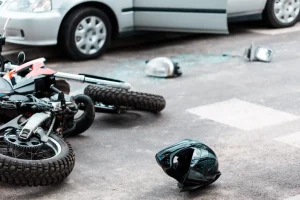
Motorcycle claims often turn on evidence that disappears quickly. A driver’s story can shift once they realize a motorcyclist was seriously hurt, and physical evidence at the scene, like skid marks, debris fields, and gouge marks in the pavement, can fade or get cleared within days. Our attorneys move early to preserve what actually happened.
That work typically includes:
- Collecting scene photos, motorcycle damage photos, and injury documentation as early as possible
- Requesting nearby traffic camera, dashcam, or business surveillance footage before it gets overwritten
- Reviewing the police crash report and identifying and contacting available witnesses
- Sending preservation letters when evidence could otherwise be lost, altered, or destroyed
- Investigating every applicable insurance policy, including the at-fault driver’s liability coverage and the client’s own UM/UIM coverage
- Working with treating providers to make sure injuries and future care needs are properly documented
We confirm liability and coverage early rather than waiting until treatment ends, because knowing what insurance is actually available shapes how a claim should be positioned from the start. Preserving the evidence early also gives the firm something concrete to use when an insurer disputes the rider’s speed, visibility, right of way, or version of the collision. That preparation becomes especially important in disputed-liability cases, where another driver denies fault or tries to shift responsibility onto the motorcyclist.
Texas Motorcycle Laws That Can Affect Your Claim
Helmet Requirements Under Texas Law
Texas requires every motorcycle operator and passenger under 21 to wear a DOT-compliant helmet. Riders 21 and older may legally ride without one if they have completed an approved motorcycle safety course or carry qualifying health insurance, under Texas Transportation Code Chapter 661. Not wearing a helmet does not bar you from recovering compensation after a crash. It can, however, give an insurance company an argument that your own choices contributed to the severity of your injuries, which may affect how much of the claim’s value you can recover under Texas’s shared-fault rules.
Lane Splitting and Lane Filtering
Texas does not allow lane splitting or lane filtering. Under Texas Transportation Code § 545.0605, a motorcyclist may not ride between lanes of traffic moving in the same direction or pass a vehicle while sharing its lane. A rider is entitled to full use of a lane, and other drivers may not crowd that space. If an insurance company claims a rider was lane splitting at the time of a crash, that allegation can become part of the fault dispute in the claim.
Comparative Fault and the 51% Rule
Texas follows a modified comparative fault system under Código de Prácticas y Remedios Civiles de Texas § 33.001. If you are found partly responsible for a crash, your compensation is reduced by your percentage of fault. If you are found more than 50% responsible, you cannot recover compensation at all. Because insurers often try to shift blame onto motorcyclists, understanding how comparative fault works, and how to respond to it, can matter a great deal to the outcome of a claim. These disputes are governed by Texas comparative negligence rules, which determine how an assigned percentage of fault can reduce or eliminate a rider’s recovery.
The Two-Year Deadline to File a Claim
Bajo Código de Prácticas y Remedios Civiles de Texas § 16.003, most personal injury lawsuits, including motorcycle accident claims, must be filed within two years of the date of the crash. Missing that deadline can permanently bar you from recovering compensation through the courts, even if liability is clear.
Serious Injuries in Houston Motorcycle Accidents
Without a vehicle frame or airbags to absorb impact, motorcyclists often suffer injuries that are more severe than what a car occupant would sustain in the same crash. Common injuries we see include traumatic brain injuries from head impact, spinal cord injuries, broken bones, road rash from sliding across pavement, and joint or ligament damage that requires surgery. These injuries frequently mean extended treatment, physical therapy, and, in some cases, permanent limitations on work and daily activities.
Some Houston motorcycle accidents are fatal. Statewide, TxDOT has reported nearly 600 motorcyclist deaths and more than 2,400 serious injuries in a single recent year. When a crash takes a rider’s life, surviving family members may have the right to pursue a claim through our muerte injusta practice, which focuses on holding the responsible party accountable and pursuing compensation for the family’s loss.
What Is a Houston Motorcycle Accident Claim Worth?
There is no set value for a motorcycle accident claim in Texas. What a case is worth depends on the specific facts involved, including the severity of the injury, the amount of medical treatment required, whether the injury will affect future earning capacity, and how much insurance coverage is actually available. Several factors typically shape that value:
- Current and future medical costs, including surgery, physical therapy, and ongoing care
- Lost income from missed work and any reduction in future earning capacity
- Pain, physical limitations, and the effect of the injury on daily life
- Property damage, since a motorcycle is often a total loss after a serious collision
- The insurance coverage available through the at-fault driver’s policy and any applicable UM/UIM coverage
We do not promise a specific settlement figure to any client before reviewing the facts of their case, and no attorney honestly can. The value of a motorcycle accident settlement in Texas ultimately depends on the injuries, treatment, lost income, available insurance, liability evidence, and long-term effect of the crash.
What to Do After a Motorcycle Accident in Houston
What you do in the hours and days after a crash can affect your health and your claim. A few steps can help protect both:
- Get medical attention, even if your injuries seem minor at first. Some injuries, especially head and spinal injuries, are not obvious right away.
- Call the police and request a crash report, which becomes an important piece of evidence in your claim.
- Photograph the scene, your motorcycle, your gear, and any visible injuries before conditions change.
- Get contact information for any witnesses who saw what happened.
- Avoid giving a recorded statement to the other driver’s insurance company before speaking with an attorney.
- Keep all medical records and bills related to the crash, and follow through on recommended treatment.
These steps help preserve the evidence and documentation that a strong motorcycle accident claim depends on.
Preguntas frecuentes
Do I need a lawyer after a motorcycle accident in Texas?
Not every crash requires legal representation, but getting a lawyer after a motorcycle accident can become more important when the rider suffered a serious injury, fault is disputed, multiple insurance policies may apply, or the insurer has already made a settlement offer.
What if I wasn’t wearing a helmet when the crash happened?
Not wearing a helmet does not automatically prevent you from recovering compensation. It may become an issue the insurance company raises to argue that your injuries were worse than they would have been with a helmet, which can affect the value of the claim depending on the facts.
What if the insurance company says I was partly at fault?
Under Texas’s comparative fault rules, you can still recover compensation as long as you are found 50% or less responsible for the crash, though your recovery is reduced by your percentage of fault. Disputed liability does not automatically mean you have no case, particularly when the insurance company’s version of events isn’t supported by the evidence.
Is lane splitting illegal in Texas?
Yes. Texas law prohibits riding between lanes of moving traffic or passing a vehicle while sharing its lane. If an insurer claims a rider was lane splitting at the time of a crash, that allegation typically becomes part of the liability dispute rather than an automatic bar to recovery.
What if the at-fault driver has little or no insurance?
Many Texas drivers carry only the state minimum liability coverage, and some carry none at all. If the at-fault driver’s policy isn’t enough to cover your damages, your own uninsured or underinsured motorist coverage may provide additional compensation, depending on your policy.
¿Cuánto tiempo tengo para presentar un reclamo por accidente de motocicleta en Texas?
In most cases, Texas law gives you two years from the date of the crash to file a lawsuit. Waiting too long can also make it harder to collect evidence, since witness memories fade and surveillance footage is often overwritten within days or weeks.
Contact a Houston Motorcycle Accident Lawyer Today
If you or someone you love was hurt in a motorcycle accident in Houston, the choices you make now can affect the outcome of your claim. Joe I. Zaid & Associates represents injured riders throughout Houston and the surrounding communities from four Houston-area offices, including our office in Downtown Houston. You can find contact information for all of our Houston-area office locations to reach the team nearest you.
Our motorcycle accident attorneys work on a contingency-fee basis, so you pay no attorney fees unless we recover compensation for you. Contact our office today for a consulta gratis with a Houston motorcycle accident lawyer to discuss what happened and what your options may be.