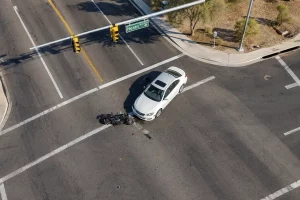
When a driver turns left directly into the path of an oncoming motorcycle, the results are often severe. Federal crash data show this scenario, a car turning left while the motorcycle continues straight, passes, or moves to overtake another vehicle, is the single most common type of fatal two-vehicle motorcycle crash. It happens more often than any other type of car-motorcycle collision.
Houston’s dense intersections, feeder roads, and heavy commuter traffic create frequent opportunities for these crashes. A driver may misjudge a motorcycle’s speed, fail to see the rider in time, or turn without checking a second time.
This article explains why left-turn crashes happen so often, who may be liable, what evidence can establish fault, and how insurance companies often respond to these claims.
Why Left-Turn Crashes Are the Most Common Type of Motorcycle Collision
A driver preparing to turn left usually watches for a gap in oncoming traffic. Motorcycles present a smaller visual profile than cars, so they are easier to miss or misjudge within that gap.
National data show how often this scenario ends in tragedy. According to NHTSA crash data, a driver turning left was involved in 41 percent of two-vehicle fatal motorcycle crashes, more than any other crash type recorded.
Common left-turn scenarios include:
- A driver turning left at a signaled intersection misjudges an oncoming motorcycle’s speed.
- A driver turning into a driveway or parking lot does not see an approaching rider.
- A driver making an unprotected left turn assumes there is enough time to clear the intersection.
Each scenario shares a common problem. The driver misjudges timing or distance, or simply overlooks the motorcycle until it is too late to react.
Researchers sometimes call this a “looked but failed to see” error. A driver glances toward oncoming traffic, registers a car-sized gap, and starts the turn without ever consciously processing the motorcycle in that gap. The rider often has little time or room to brake or swerve once the turn begins.
Who May Be Liable When a Driver Turns Left Into a Motorcyclist’s Path
Texas traffic law generally requires a driver making a left turn to yield to oncoming traffic that is close enough to present a hazard. When a driver turns into a motorcycle’s path, that failure to yield often points to the turning driver’s negligence.
Liability is not always straightforward. The at-fault driver, an insurer, or even a witness may dispute basic facts, including who had the right of way, how fast the motorcycle was traveling, or whether either driver could have avoided the crash.
Texas also follows a proportionate responsibility rule. An injured motorcyclist’s compensation can be reduced by their own percentage of fault, if any is assigned. This makes it important to document the crash accurately from the start.
When liability is disputed, or when an insurance company argues that the motorcyclist shares some fault, a Abogado de accidentes de motocicleta en Houston can help review the police report, available footage, and other evidence to help clarify what actually happened.
Evidence That Can Show Who Caused a Left-Turn Crash
Left-turn crash claims often come down to evidence. Useful evidence may include:
- Traffic camera or nearby business surveillance footage
- Photos of vehicle damage, skid marks, and the intersection itself
- Witness statements from other drivers or pedestrians
- Cell phone records that may show a driver was distracted
- The police crash report
- Data from a vehicle’s event data recorder, when available
Surveillance footage can disappear within days if no one requests it. Acting quickly to preserve this kind of evidence can make a meaningful difference in a disputed liability claim.
How Insurance Companies May Respond to a Left-Turn Motorcycle Claim
Insurance adjusters do not always accept that the turning driver was fully at fault. In a left-turn crash claim, an insurer may argue that:
- The motorcyclist was speeding or riding aggressively.
- The rider was hard to see because of lane position or lighting.
- The motorcyclist could have braked or swerved to avoid the crash.
These arguments can shift some responsibility onto the injured rider, which may reduce the settlement amount under Texas’s proportionate responsibility rule.
When a left-turn crash results in serious or fatal injuries, these disputes can carry even higher stakes. Families dealing with a fatal crash may need to understand their options under Texas’s wrongful death laws in addition to any liability dispute.
Left-Turn Risks on Houston-Area Roads
Harris County’s mix of dense intersections, high-speed feeder roads, and heavy commuter traffic can increase the odds of a left-turn crash. Drivers merging off feeder roads or turning across several lanes of traffic have less time to spot an oncoming motorcycle.
Construction zones and shifting lane patterns, common across much of the Houston area, can also make it harder for a turning driver to judge a motorcycle’s speed and position before committing to a turn.
Unprotected left turns, where a driver turns without a dedicated signal, add another layer of risk. A driver has to judge the speed of multiple approaching vehicles at once, and a motorcycle can be the easiest one to misjudge or miss altogether.
When Legal Representation May Help After a Left-Turn Crash
Not every motorcycle crash requires a lawyer, but a few situations tend to benefit from legal guidance. These include disputed liability, a low settlement offer, or injuries serious enough to need ongoing medical care.
Riders who are unsure whether their situation calls for legal help may want to consult with an attorney to determine whether legal help after a Texas motorcycle accident is necessary.
How Joe I. Zaid & Associates Approaches Left-Turn Crash Claims
Left-turn crash claims often hinge on evidence that can disappear quickly. Surveillance footage may be overwritten within days, and witnesses can become harder to locate as time passes.
Joe I. Zaid & Associates begins working to identify and preserve this evidence early. This includes requesting nearby camera footage, reviewing the police report, and identifying witnesses who saw the crash happen.
Joe Zaid spent nearly a decade working inside the insurance industry before founding the firm. That background gives him insight into how insurers evaluate liability in left-turn crashes and where they may look to shift blame onto an injured rider.
When needed, the firm also works with accident reconstruction professionals to help clarify contested details, such as vehicle speed, position, or the sequence of events leading up to the crash. This approach is meant to build a clearer picture of what happened before the insurance company controls the narrative.
Common Questions About Left-Turn Motorcycle Crashes
Who is usually at fault in a left-turn motorcycle accident?
The driver making the left turn is often found at fault, since Texas law generally requires that driver to yield to oncoming traffic. Fault can still be disputed, especially if the insurance company argues the motorcyclist was speeding or hard to see.
Can a motorcyclist still recover compensation if they were partly at fault?
Texas follows a proportionate responsibility rule, so a rider found partly at fault may still recover compensation. Their total award is generally reduced by their percentage of fault.
What should I do if the other driver denies making an unsafe left turn?
Photos, witness statements, and any available camera footage can help clarify what happened. A police report can also support the account of events, though it is not the only evidence available.
Getting Help After a Left Turn Motorcycle Collision
A left-turn crash can leave a rider with serious injuries and a long list of questions about fault, evidence, and next steps. Understanding how these crashes happen, and how liability is typically evaluated, is a useful starting point.
Joe I. Zaid & Associates offers free consultations for injured motorcyclists in the Houston area. The firm works on a contingency fee basis, so clients owe no attorney fees unless compensation is recovered.
Joe I. Zaid y asociados
1001 Texas Ave Suite 1400
Houston, Texas 77002
(346) 340-0800
Riders with questions about a left-turn crash can contact the firm to discuss their situation.