Yes, a driver can look straight at a hazard and never register it. The brain cannot process everything the eyes take in, so it prioritizes what the driver is focused on and expects to see. When attention shifts to a phone call, a navigation prompt, or a stressful thought, an unexpected hazard can slip past even when the driver’s eyes point right at it.
The 50 percent in the title comes from a famous psychology experiment, not from a count of road hazards. In that study, close to half of the viewers missed a person in a gorilla suit walking through a video while they counted basketball passes. Real roads are not a lab, and no one can say drivers miss half of what they encounter. The research does show a real pattern: attention, not eyesight, decides what a driver notices.
How Selective Attention Decides What a Driver Sees
Driving floods the brain with information: traffic, signs, mirrors, pedestrians, and sounds. The brain handles that load by filtering. It sends attention to whatever fits the driver’s current goal, such as watching the brake lights ahead or finding an exit, and it gives less attention to everything else.
Psychologists call this filtering selective attention. It works well most of the time because most of what a driver sees does not matter in a given second. It fails when something important falls outside the filter. In driver education, the same concept is often described as selective seeing: drivers notice some parts of the traffic environment while filtering out others. Selective seeing helps the brain manage a complex road scene, but it can also cause a driver to miss an unexpected hazard.
The original gorilla research, published in the journal Perception, found that the odds of noticing an unexpected object depend on two things. One is how similar the object looks to the things a person is already watching. The other is how hard the main task is.
Both ideas translate to driving. A driver tracking a car ahead during a tricky merge has a demanding task. A pedestrian in dark clothing, a cyclist, or a motorcycle looks different from the cars the driver is searching for, so it may not register.
Inattentional Blindness: Why Eyes on the Road Is Not the Same as Seeing
The Experiment Behind the 50 Percent Figure
In 1999, psychologists Daniel Simons and Christopher Chabris asked viewers to count the passes made by one team in a short basketball video. Partway through, a person in a gorilla suit walked into the scene, stopped, thumped their chest, and walked off. The gorilla stayed on screen for about nine seconds.
Close to half of the viewers never noticed it. Many were surprised when they watched the video again and saw it. Psychologists call this inattentional blindness. The viewers did not miss the gorilla because of poor eyesight. Their attention was committed to the pass count.
The useful lesson for drivers is the mechanism, not the percentage. A lab result cannot predict how often a particular driver misses a particular hazard. Lighting, speed, experience, and what the driver expects all change the odds.
What Studies of Drivers Show
Researchers have tested the same idea behind the wheel. In a 2003 driving simulator study, drivers who talked on hands-free phones reacted more slowly to braking vehicles ahead. Eye tracking showed they paid less attention to information directly in front of their eyes. They also remembered fewer of the roadside billboards they had looked at.
Those simulated drivers had their eyes forward and their hands on the wheel. Their attention was somewhere else.
Cognitive Distraction: When the Mind Leaves the Road
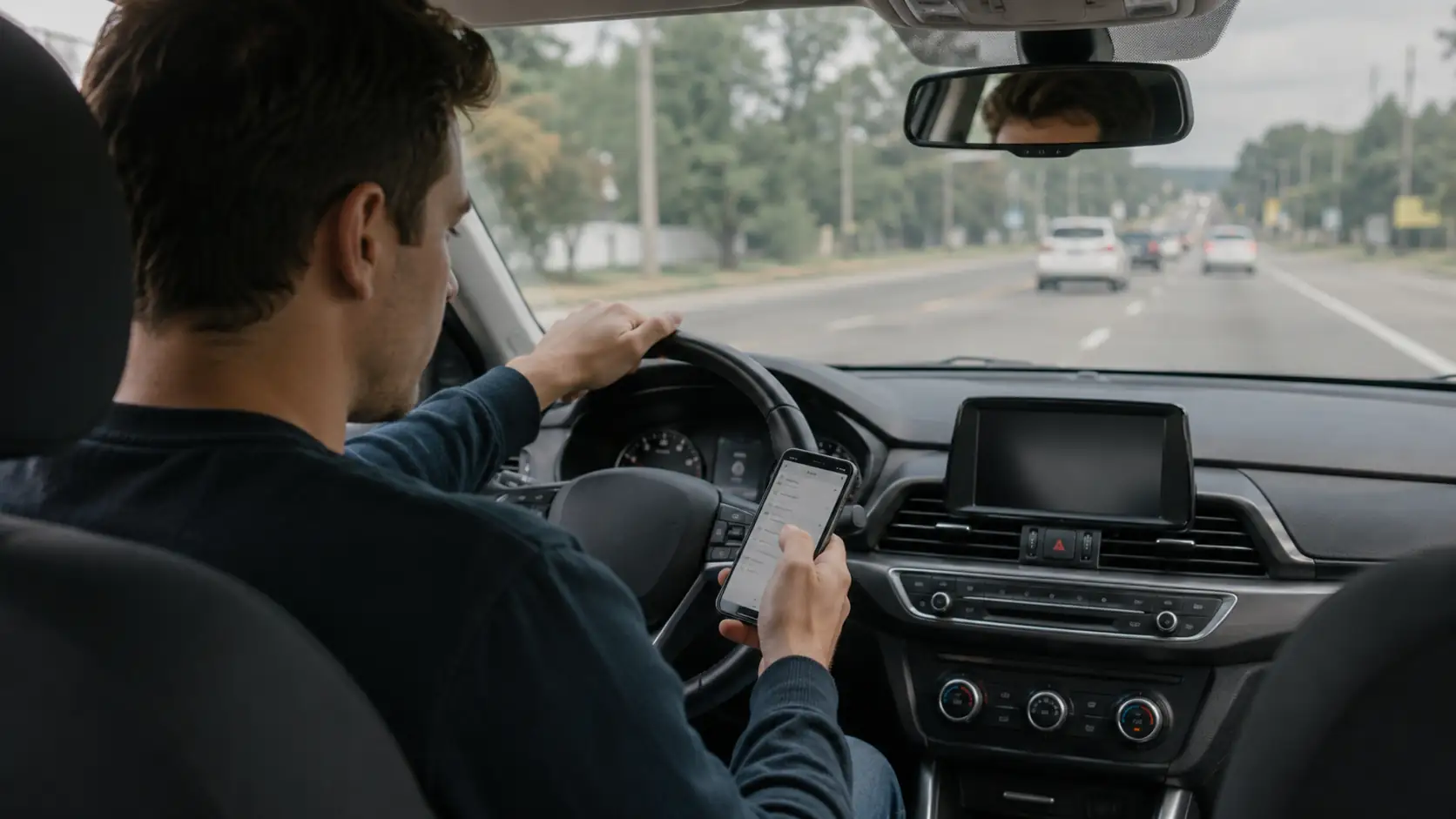
The CDC groups distraction into three types: visual, which takes your eyes off the road, manual, which takes your hands off the wheel, and cognitive, which takes your mind off driving. Cognitive distraction in driving is the hardest to spot. Nothing about a driver’s posture reveals it. A driver can face forward, grip the wheel, and still process very little of the scene.
Cognitive distraction comes from many sources. A work call, an argument with a passenger, a voice command, route planning, and worry about something else all qualify.
Hands-Free Does Not Mean Attention-Free
Many drivers assume hands-free tools are safe because their hands stay on the wheel. The AAA Foundation for Traffic Safety tested voice-based systems in ten 2015 vehicles. In the worst-performing systems, impairment lingered up to 27 seconds after the driver finished the task. At 60 miles per hour, a car travels almost half a mile in 27 seconds.
Why Following the Law Does Not Guarantee Attention
Texas law makes it an offense to read, write, or send an electronic message on a portable wireless device while driving, unless the vehicle is stopped. The statute also lists defenses, including hands-free use and GPS navigation. Because the law carves out those uses, a driver can follow Texas cell phone laws and still lose focus on the road.
What Are Missed Cues in the Driving Environment?
A missed cue is useful information in the driving environment that a driver fails to notice or respond to. Brake lights, a pedestrian approaching a crosswalk, a motorcycle entering a blind spot, or a vehicle beginning to drift lanes can all become missed cues when attention is focused somewhere else.
Selective seeing helps explain why this happens. The driver’s eyes may technically receive the information, but the brain does not give it enough attention to trigger recognition and a response.
Why Drivers Tend to Steer Where They Look
Explain that gaze helps guide steering, and that driver-training programs teach drivers to keep their visual target on the intended path rather than staring at the obstacle.
That preserves the relevance without making questionable claims about panic or “target fixation.”
Why a Missed Hazard Can Matter Legally
In Texas car accident claims, negligence generally asks whether a driver acted as a reasonably careful driver would. A driver who fails to notice a hazard that a careful, attentive driver would have noticed may be negligent, depending on the facts. Saying “I did not see them” does not automatically excuse a crash. It raises the next question: what was the driver paying attention to?
Not every missed hazard proves negligence. Glare, darkness, a sudden obstruction, or a pedestrian stepping out from behind a large vehicle can defeat an attentive driver too. The facts decide whether the hazard was reasonably visible and whether the driver’s attention was where it should have been.
The same reasoning can work against injured people. An insurer may argue that the injured driver, cyclist, or pedestrian also failed to notice a hazard. Texas applies comparative negligence, and under Chapter 33 of the Civil Practice and Remedies Code, a claimant whose percentage of responsibility is greater than 50 percent may not recover damages.
Evidence That Can Show a Driver’s Attention Lapsed
Attention is invisible, so a claim has to rely on the evidence it left behind. Depending on the crash, that evidence may include:
- The driver’s own words. Statements at the scene such as “I never saw you” or “I looked down for a second” can matter. Write them down and make sure the officer hears them.
- Vehicle data. Event data recorders may capture speed and braking in the seconds before impact. A crash with no braking at all may suggest the driver never registered the hazard.
- Phone records and app activity. Records can show calls, texts, or app use around the time of the crash. They usually require formal legal requests.
- Video. Dashcam or surveillance footage can show how the vehicles moved before impact and what the driver could see.
- Witnesses and the scene. Witnesses may describe a driver looking down or drifting. Photos of lighting, obstructions, and sight lines show whether the hazard was reasonably visible.
Proving that a driver was distracted after an accident often takes more than a crash report. Cognitive distraction leaves the least trace, so the surrounding evidence carries more weight.
Vehicle data and phone records may be overwritten or deleted, so we may send preservation letters early and begin reviewing the crash while the evidence still exists. Joe Zaid also spent nearly a decade inside the insurance industry, which helps us anticipate how an adjuster will treat a driver’s explanation.
When an Inattentive Driver Hurt You
A driver’s claim that they never saw you says little about why. The cause might be a phone, a conversation, or a mind somewhere else, and early evidence can show which. We handle injury cases on a contingency basis, so you owe no attorney fees unless we recover compensation. Your first conversation with us is a free consultation.