Si te preguntas qué hacer después de una caída en la propiedad de otra persona, las primeras horas son cruciales. La forma en que reportes el incidente, documentes el peligro, busques atención médica y te comuniques con el propietario o la compañía de seguros puede influir en tu capacidad para obtener una indemnización posteriormente.
La ley de responsabilidad civil por accidentes en propiedades en Texas establece requisitos específicos sobre lo que los propietarios deben hacer y lo que las víctimas lesionadas deben probar. Comprender ambos aspectos le ayudará a proteger su salud, preservar las pruebas y evitar errores que podrían debilitar su reclamación.
Si sufrió lesiones en una caída en la propiedad de otra persona en el área de Houston, hablar con un abogado lo antes posible es importante. Llame a Joe I. Zaid & Associates al (346) 756-9243 para una consulta gratuita.
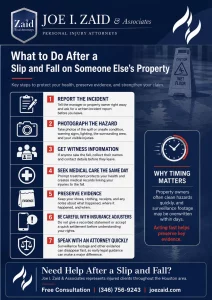
Paso 1: Informe por escrito sobre el resbalón y la caída antes de irse.
La mayoría de la gente le cuenta a un empleado o gerente lo sucedido y luego se marcha. Eso no es suficiente.
La ley de responsabilidad civil por daños en propiedades en Texas exige que la persona lesionada demuestre que el propietario del inmueble tenía conocimiento de la condición peligrosa. Si te marchas sin dejar constancia escrita, el propietario del inmueble podrá alegar posteriormente que desconocía el estado del inmueble o que el incidente nunca ocurrió como se describe.
Antes de irte, pídele al gerente que complete un informe escrito del incidente. Solicita una copia. Si se niegan a dártela, anota el nombre de la persona con la que hablaste, la fecha y la hora, y lo que dijiste. Puedes enviarte esa información por mensaje de texto para que quede registrada con la fecha y hora.
Este registro escrito cumple dos funciones: vincula el incidente a una fecha y hora específicas y dificulta que el propietario niegue posteriormente tener conocimiento del peligro.
Paso 2: Fotografie el peligro antes de que el propietario lo corrija.
El personal de mantenimiento suele limpiar o corregir los peligros a los pocos minutos de un incidente. Una vez que el problema desaparece, la responsabilidad de demostrar su existencia recae exclusivamente sobre usted.
Fotografía lo siguiente antes de abandonar el lugar:
- El peligro específico que provocó la caída, desde múltiples ángulos
- La zona circundante, mostrando si había señales de advertencia presentes o ausentes.
- Tu posición en relación con estanterías, expositores, entradas o zonas de derrames.
- Condiciones de iluminación, incluyendo cualquier área oscura u obstruida
- Cualquier señal de piso mojado, incluyendo dónde fueron colocados en relación con el peligro.
- Tu ropa y calzado, lo cual puede volverse relevante si el propietario de la propiedad argumenta que usted contribuyó a la caída
- Tus heridas visibles, tales como hinchazón, abrasiones o hematomas
Las cámaras de vigilancia son comunes en supermercados, grandes almacenes y centros comerciales. Las grabaciones suelen sobrescribirse en un plazo de 24 a 72 horas. Sin embargo, su abogado puede enviar una carta de preservación para evitar que se eliminen dichas grabaciones. Esto ocurre en lugares como grandes tiendas minoristas, incluidas aquellas gestionadas por una Abogado de lesiones de Walmart, a menudo encienden precisamente este tipo de imágenes.
Paso 3: Busque atención médica el mismo día después de una caída.
No espere para consultar a un médico. Las compañías de seguros registran el tiempo transcurrido entre el incidente y la primera visita médica. Un retraso de tan solo dos o tres días les da a los peritos la oportunidad de argumentar que sus lesiones no fueron graves, que fueron causadas por otra cosa o que ocurrieron antes de la caída.
El tratamiento en el mismo día logra tres cosas:
- Este sistema vincula directamente sus lesiones con el incidente a través de los registros médicos contemporáneos.
- Documenta la naturaleza y la gravedad de sus lesiones antes de que los síntomas empeoren.
- Esto demuestra que te tomaste la situación en serio, lo cual respalda la credibilidad de tu afirmación.
Explícale a tu médico cómo ocurrió la caída, qué partes del cuerpo golpearon el suelo y cualquier síntoma inmediato que hayas notado. Estos detalles se incluirán en tu historial médico y serán difíciles de refutar para las aseguradoras posteriormente. Sigue todas las recomendaciones del tratamiento y asiste a todas las citas de seguimiento. Las interrupciones en el tratamiento se utilizan habitualmente para minimizar o denegar las reclamaciones.
La razón por la que estos primeros pasos son importantes es simple: en un caso de responsabilidad civil por daños en propiedades en Texas, no basta con demostrar que usted se cayó. Debe poder probar por qué se cayó, qué condición peligrosa la causó y si el propietario de la propiedad sabía o debería haber sabido del peligro.
Cómo define la ley de Texas la notificación en casos de responsabilidad por daños en propiedades
La ley de responsabilidad de locales de Texas no solo exige que existiera un peligro. Requiere que la persona lesionada demuestre que el propietario de la propiedad... sabía o debería haber sabido sobre la condición y no la abordó.
Los tribunales reconocen tres formas de notificación:
Aviso real significa que el propietario del inmueble o un empleado observó directamente el peligro o recibió un informe al respecto antes de su caída.
Aviso constructivo Esto significa que la condición existió el tiempo suficiente como para que un propietario razonable la hubiera descubierto mediante inspecciones y mantenimiento ordinarios. Si un derrame permaneció en el piso de un supermercado durante 45 minutos sin limpiarse, esto podría constituir una notificación implícita incluso sin pruebas de que un empleado lo viera.
Condición creada Significa que el propietario o un empleado causó directamente el peligro, como por ejemplo, fregar un suelo sin colocar señales de advertencia o apilar mercancía de forma que creara riesgo de caída. En estos casos, se considera que existe notificación automáticamente porque el demandado creó el peligro.
Comprender qué teoría se aplica a su situación influye en cómo su abogado construye el caso y qué pruebas son las más importantes.
Clasificación de visitantes según la ley de Texas
La ley de Texas clasifica a las personas que ingresan a una propiedad en tres grupos. Su clasificación determina qué obligación tenía el propietario con usted.
Invitados Reciben el máximo cuidado. Un invitado es alguien a quien el propietario invita a la propiedad con fines comerciales, como un cliente de un supermercado, una cadena minorista o una tienda de mejoras para el hogar. Los propietarios deben inspeccionar periódicamente si existen peligros y repararlos o advertirles adecuadamente.
Licenciatarios Se trata de invitados sociales u otras personas que ingresan con permiso, pero sin fines comerciales. Los propietarios deben advertir a los licenciatarios sobre los peligros conocidos, pero no están obligados a inspeccionar activamente las instalaciones.
Intrusos Por lo general, reciben la menor protección. Los propietarios deben evitar dañarlos intencionadamente, pero no tienen la obligación de mantener condiciones seguras.
Determinar su clasificación es el primer paso en cualquier reclamación por responsabilidad civil de las instalaciones. La mayoría de los casos de resbalones y caídas en establecimientos comerciales involucran a personas invitadas, lo que genera la mayor responsabilidad posible por parte del propietario del inmueble.
Culpa comparativa en Texas y lo que significa para su indemnización
Texas sigue una regla de culpa comparativa modificada bajo Capítulo 33 del Código de Prácticas y Remedios Civiles de Texas. Esta regla permite que una persona lesionada recupere daños incluso si comparte cierta responsabilidad por la caída, pero reduce la recuperación en su porcentaje de culpa y la excluye por completo si su culpa alcanza el 51% o más.
Aquí tienes un ejemplo de cómo funciona:
Supongamos que un jurado determina que sus daños totales ascienden a $200,000. El jurado también determina que usted tuvo la culpa (20%) porque estaba mirando su teléfono cuando se cayó. Según el Capítulo 33, su indemnización se reduce en 20%, dejándole con $160,000.
Ahora supongamos que el jurado determina que usted tuvo la culpa según el artículo 55%. Según el artículo 51%, usted no recibe ninguna indemnización.
Los peritos de seguros conocen bien esta regla y la utilizan estratégicamente. Con frecuencia argumentan que la persona lesionada estaba distraída, llevaba calzado inadecuado o ignoró las señales de advertencia visibles. Estos argumentos trasladan la culpa a la víctima y reducen la indemnización de la aseguradora.
Qué hacen los peritos de seguros después de un resbalón y caída.
Los propietarios y comerciantes cuentan con un seguro de responsabilidad civil general. Tras una caída, la aseguradora asigna un perito cuya función es minimizar la indemnización. Comprender sus tácticas le ayudará a evitar errores comunes.
Solicitar una declaración grabada con antelación. Los peritos suelen llamar a los pocos días del incidente, cuando aún recuerdas lo sucedido pero tus lesiones quizás no sean del todo evidentes. Las declaraciones iniciales se utilizan para comprometerte con posturas que luego podrías tener que refutar.
Notificación de impugnación. El perito investigará si la propiedad tenía conocimiento del peligro. Podrá revisar las grabaciones de las cámaras de vigilancia, entrevistar a los empleados y consultar los registros de inspección para argumentar que la situación era desconocida y de corta duración.
Gravedad de las lesiones que supone un desafío. Los peritos solicitan su historial médico completo para encontrar lesiones, afecciones o lagunas en el tratamiento previas que puedan utilizar para argumentar que sus lesiones actuales existían antes de la caída o que no fueron causadas por ella.
Ofrecemos una liquidación rápida y económica. Algunas aseguradoras ofrecen un pequeño pago a los pocos días del incidente. Aceptarlo suele eximir de toda reclamación futura, incluidas las relativas a lesiones que se desarrollen o empeoren con el tiempo.
Argumentar la culpa comparativa. Los peritos suelen argumentar que usted estaba distraído, se movía demasiado rápido o llevaba calzado inadecuado. Esto traslada parte de la responsabilidad a usted y reduce la responsabilidad de la aseguradora según el Capítulo 33.
Caídas en supermercados de Texas, incluidos aquellos manejados por un Abogado de lesiones HEB o un Abogado de lesiones de Kroger, A menudo, implican grabaciones de vigilancia que se convierten en pruebas fundamentales cuando la aseguradora impugna la notificación. Las grabaciones obtenidas antes de su eliminación pueden contradecir directamente la postura del perito.
Estatuto de limitaciones de Texas y excepciones clave
Código de Prácticas y Remedios Civiles de Texas § 16.003 establece el plazo general para presentar una demanda por lesiones personales en dos años a partir de la fecha del incidente. Incumplir este plazo casi siempre implica perder el derecho a reclamar, independientemente de la solidez del argumento subyacente.
En Texas existen dos excepciones importantes:
Propiedad del gobierno. Si la caída ocurrió en una propiedad perteneciente a una agencia municipal, del condado o estatal, la ley de Texas exige que presente una notificación formal por escrito de reclamación ante la entidad gubernamental dentro de seis meses del incidente. La falta de notificación oportuna invalida la reclamación. Este es un plazo estricto que corre independientemente del plazo de prescripción de dos años.
Regla de peaje menor. Si la persona lesionada era menor de edad en el momento de la caída, el plazo de prescripción de dos años no comienza a correr hasta que cumpla 18 años. Un representante adulto aún puede presentar una reclamación en nombre del menor antes de esa fecha.
Estos plazos hacen que la consulta legal temprana sea fundamental. Las pruebas desaparecen, los testigos se vuelven más difíciles de localizar y las grabaciones de vigilancia se borran a los pocos días del incidente.
Daños y perjuicios recuperables en un caso de resbalón y caída en Texas
La ley de Texas permite a las personas lesionadas reclamar daños económicos y no económicos tras un incidente de responsabilidad civil por accidentes en propiedades ajenas.
Daños económicos cubrir pérdidas financieras cuantificables:
- Costos de la sala de emergencias y hospitalización
- gastos quirúrgicos
- Fisioterapia y rehabilitación
- Medicamentos recetados
- Tratamiento médico futuro si las lesiones son a largo plazo.
- Salarios perdidos durante la recuperación
- Disminución de la capacidad de ganancia si las lesiones limitan el trabajo futuro.
Daños no económicos cubrir el costo humano de la lesión:
- Dolor y sufrimiento
- Angustia mental
- Desfiguración
- Discapacidad física
- Pérdida del disfrute de la vida.
El valor de una reclamación por resbalón y caída depende de la gravedad de las lesiones, la claridad de la responsabilidad, la cobertura del seguro disponible y la solidez de la documentación médica que respalde la magnitud del daño. Los casos que involucran fracturas, lesiones de columna o traumatismos craneoencefálicos suelen tener una valoración más alta que las reclamaciones por lesiones de tejidos blandos, pero cada caso requiere una evaluación individual.
Cómo Joe I. Zaid & Associates elabora una reclamación por responsabilidad civil de las instalaciones
Joe Zaid trabajó durante casi una década en el sector de los seguros antes de fundar Joe I. Zaid & Associates en 2013. Esa experiencia le proporciona un conocimiento directo de cómo las aseguradoras evalúan las reclamaciones por resbalones y caídas, dónde buscan las debilidades y qué pruebas son las más importantes cuando un caso avanza hacia un litigio.
Desde el primer día, la firma se centra en:
- Recopilación de fotografías y pruebas de vídeo
- Envío de cartas de conservación para grabaciones de vigilancia
- Obtención de informes de incidentes y registros de inspección.
- Identificación y entrevista de testigos
- Coordinación de la documentación médica
- Confirmar la cobertura del seguro del propietario y los límites de la póliza.
- Construir la posición de responsabilidad antes de que la aseguradora establezca su propia narrativa.
Este enfoque es importante porque las aseguradoras comienzan a preparar su defensa desde el principio. Una empresa que espera a que finalice el tratamiento antes de abordar la responsabilidad se encuentra en desventaja. El objetivo es obtener ventaja desde el inicio.
Joe Zaid se ha ganado un Selección de Super Lawyers 2026, a Los 40 mejores abogados litigantes menores de 40 años reconocimiento y una nominación de La revista H-Texas lo nombró uno de los mejores abogados de Houston.. La firma ha logrado múltiples indemnizaciones millonarias para clientes lesionados, incluyendo un acuerdo de 1,2 millones de dólares en un caso donde un abogado anterior no había logrado establecer la responsabilidad.
Preguntas frecuentes sobre reclamaciones por resbalones y caídas en Texas
¿Importa que el suelo tuviera un cartel de suelo mojado?
Sí, pero una señal no elimina automáticamente la responsabilidad. La señal debe colocarse en un lugar que realmente advierta a las personas del peligro antes de que lo encuentren. Una señal ubicada detrás del derrame, bloqueada por estanterías o colocada después de la caída no cumple con la obligación del propietario. Fotografie la ubicación de la señal con respecto al peligro inmediatamente después de la caída.
¿Qué habría pasado si no hubiera informado de la caída antes de abandonar la propiedad?
Aún puede presentar una reclamación, pero la ausencia de un informe del incidente dificulta determinar la fecha y la naturaleza del peligro. Documente todo lo que pueda lo antes posible, incluyendo fotos, nombres de testigos y un relato escrito de lo sucedido. Póngase en contacto con un abogado de inmediato para que se envíe una carta de conservación de cualquier grabación de vigilancia disponible.
¿Cuánto tiempo suele durar un caso de resbalón y caída en Texas?
La mayoría de los casos se resuelven mediante negociación con la aseguradora en un plazo de varios meses a un año, dependiendo de la gravedad de las lesiones y de si se disputa la responsabilidad. Los casos que requieren litigio tardan más, sobre todo si el propietario impugna enérgicamente la notificación o la culpa comparativa. Su abogado podrá darle un presupuesto más preciso una vez que se conozcan los hechos.
¿Y si yo también tengo parte de la culpa de la caída?
En Texas, se permite la indemnización siempre que su culpa no alcance el 51%. Si un jurado determina que usted tiene la culpa en un 30% en un reclamo de $100,000, usted recibe $70,000. Los ajustadores aumentan los porcentajes de culpa para reducir los pagos. La representación legal ayuda a refutar esos argumentos con pruebas.
¿Debo dar una declaración grabada a la compañía de seguros del propietario del inmueble?
No está obligado a proporcionar una declaración grabada a la aseguradora contraria. Una vez que la proporcione, pasará a formar parte del expediente y podrá utilizarse en su contra. Consulte con un abogado antes de aceptar cualquier declaración grabada.
¿Importa qué tipo de zapatos llevaba puestos?
Los propietarios y sus aseguradoras suelen plantear este argumento. Si bien no invalida automáticamente una reclamación, puede afectar el análisis comparativo de responsabilidades. Si el calzado se convierte en un problema, la atención se centra en si el peligro era irrazonablemente peligroso independientemente del calzado, y si el propietario cumplió con su obligación de advertir o corregir el riesgo.
¿Sufrió lesiones tras una caída en propiedad ajena? Hable con Joe I. Zaid & Associates.
Si usted resultó herido después de un resbalar y caer en la propiedad de otra persona, Joe I. Zaid & Associates puede ayudarle a comprender qué hacer a continuación. La firma representa a víctimas de resbalones y caídas. en toda el área de Houston, incluyendo Pasadena, Humble, Condado de Harris, y comunidades circundantes.
Las consultas son gratuitas. La firma trabaja bajo un modelo de honorarios condicionales: Ganamos o es gratis. Hay sin costo inicial para dar seguimiento a su reclamo. La firma está disponible Las 24 horas del día, los 7 días de la semana.
Para hablar con un abogado, póngase en contacto con Joe I. Zaid & Associates o llame (346) 756-9243.
Joe I. Zaid y asociados 4701 Preston Ave Pasadena, TX 77505 (346) 756-9243