Head-on collisions are among the most violent crashes on the road. When two vehicles strike each other front to front, the combined force of both vehicles transfers directly into the occupants. These crashes happen on Houston-area highways, two-lane roads through surrounding communities, and city streets. They often involve impaired or distracted drivers, wrong-way entries onto divided highways, and dangerous passing attempts on undivided roads.
If you were hurt in a head-on crash in the Houston area, you likely have questions about who was at fault, whether the insurance company is treating your claim fairly, and what your options are before you make any decisions.
What Makes a Head-On Collision Different From Other Crashes
Most car accidents involve a glancing blow, a side impact, or a rear-end strike. Head-on collisions are different because neither vehicle absorbs the energy of the other. Both absorb all of it simultaneously.
At 40 mph, two vehicles colliding head-on create a force equivalent to hitting a fixed wall at 80 mph. The result is often severe injury or death, even with modern vehicle safety features. Traumatic brain injuries, spinal fractures, chest trauma, and internal organ damage are common outcomes. In many cases, the injuries are permanent.
For anyone evaluating a car accident claim after a head-on crash, understanding the nature of the impact matters. It affects the severity of injuries, the cost of treatment, and how the insurance company will evaluate what the case is worth.
What Usually Causes Head-On Collisions
Head-on crashes do not happen randomly. Most are caused by specific, identifiable driver errors. Common causes include:
Wrong-way driving. A driver enters a highway ramp or divided road traveling in the wrong direction. This is especially dangerous on interstate on-ramps and divided highways, and it frequently involves impaired or distracted drivers.
Crossing the center line. On two-lane roads, a driver drifts into oncoming traffic. This can happen due to fatigue, distraction, medical events, or deliberate passing maneuvers that go wrong.
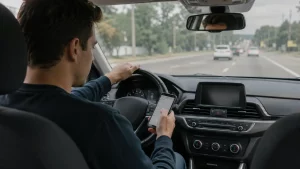
Distracted driving. A driver looking at a phone, adjusting a navigation system, or otherwise not watching the road can drift across lanes without realizing it until the collision is unavoidable. Accidentes por conducción distraída are a documented and growing cause of serious collisions in Texas.
Impaired driving. Alcohol and drugs impair lane tracking, reaction time, and judgment. Impaired drivers who cross into oncoming lanes often do so without braking at all, maximizing the force of impact.
Unsafe passing. Attempting to pass on a two-lane road with insufficient visibility or space can result in a head-on collision when oncoming traffic appears sooner than expected.
Medical emergencies. In some cases, a driver suffers a seizure, cardiac event, or loss of consciousness and crosses into oncoming traffic without any voluntary action.
Who Is Usually at Fault in a Head-On Collision
In most head-on collisions, the driver who crossed into the opposing lane of traffic bears fault. That driver made a decision, whether from distraction, impairment, poor judgment, or a mechanical failure they failed to address, that placed them in a lane where they did not belong.
Fault is rarely ambiguous when the physical evidence is documented. Police reports, skid marks, vehicle final resting positions, and dashcam or surveillance footage can establish which vehicle crossed the center line. Witness accounts often confirm it. In wrong-way driving cases, road conditions, signage, and the driver’s point of entry onto the road are all documented during crash investigation.
However, fault is not always assigned to one driver entirely. Texas follows a modified comparative fault system. If an injured driver is found to share some responsibility for the crash, their compensation reduces in proportion to their percentage of fault. As long as their share of fault stays below 51%, they can still recover damages.
Insurance adjusters and defense attorneys know how to argue shared fault. In a serious head-on collision, where damages are significant, there is strong financial motivation for the at-fault driver’s insurer to find any basis to shift partial blame to the other driver. Speed before the crash, lane position, and reaction time are all points they may raise. Having legal guidance early helps prevent that narrative from taking hold before the facts are fully established.
If you are dealing with a head-on collision claim and are not sure how fault is being evaluated, you can speak with either a Abogado de accidentes automovilísticos en Houston o abogado de accidentes de camiones before giving a recorded statement. Call (346) 756-9243 for a free, no-obligation consultation.
What Evidence Matters in a Head-On Collision Claim
Evidence is the foundation of a fault determination. The more that is documented early, the stronger the position.
Useful evidence in a head-on collision case may include:
- The police report and any citations issued at the scene
- Photos of vehicle damage, final positions, and road markings
- Dashcam footage from either vehicle or nearby traffic cameras
- Surveillance footage from businesses near the crash site
- Witness contact information and statements
- Cell phone records showing distraction at the time of impact
- Toxicology results if impairment is suspected
- Black box data showing speed and braking in the seconds before impact
- Medical records documenting injuries and their connection to the crash
Evidence from the scene can degrade quickly. Skid marks fade, surveillance footage cycles, witnesses become harder to locate. Acting early matters more in high-impact crashes than in minor fender-benders, because the stakes are higher and the insurance company is typically moving faster.
When a Head-On Collision Becomes a Wrongful Death Claim
Head-on collisions are disproportionately fatal. When a crash on a Houston-area road or highway kills a family member, the surviving family may have a demanda de muerte por negligencia bajo la ley de Texas.
Texas wrongful death claims allow eligible family members, including spouses, children, and parents, to seek compensation for the loss of financial support, companionship, and the grief caused by the death. The statute of limitations for wrongful death claims in Texas is generally two years from the date of death, though specific circumstances can affect that timeline.
These cases carry their own distinct legal requirements and often involve complex insurance and liability issues. If a loved one was killed in a head-on collision, legal guidance should be sought as early as possible to preserve evidence and protect the family’s options.
How Texas Insurance Law Affects Your Claim
Texas is an at-fault state for car accidents. The driver responsible for the crash bears financial liability for the injuries and damages caused. That liability is typically paid through the at-fault driver’s auto insurance policy.
In a serious head-on collision, the damages can far exceed a minimum-coverage policy. Texas requires drivers to carry a minimum of $30,000 per person and $60,000 per accident in bodily injury liability coverage. In a crash that causes spinal injuries, brain trauma, or long-term disability, those minimums may fall far short of what the injuries actually cost.
If the at-fault driver is underinsured, the injured driver’s own underinsured motorist coverage, if they carry it, may provide additional recovery. Identifying all available insurance coverage is one of the first things an attorney examines after a serious crash.
The at-fault driver’s insurer will assign an adjuster whose job is to evaluate and limit the claim. That adjuster may contact you quickly, sometimes within hours of the crash. They may ask for a recorded statement. They may make an early settlement offer before the full extent of your injuries is known. Both of those things can work against you if you are not careful.
What to Do After a Head-On Collision in Houston
The steps taken in the hours and days after a serious crash can affect both your health and your claim.
Obtenga atención médica inmediatamente. Head-on collisions involve extreme force. Even if you feel functional at the scene, internal injuries, concussions, and spinal damage may not be apparent right away. A medical evaluation creates a record that connects your injuries to the crash.
Call law enforcement and get a police report. The report documents the scene, identifies drivers and vehicles, and often includes the officer’s preliminary fault determination. Request a copy.
Document the scene if you are able. Photos of vehicle damage, road markings, the surrounding area, and any visible injuries can be valuable later. Get names and contact information from witnesses before they leave.
Do not give a recorded statement to the other driver’s insurance company without speaking to an attorney first. What you say on that call becomes part of the claim file and can be used to dispute your account of what happened.
Seek legal guidance early. In high-impact crashes where serious injury is involved, having an attorney involved before the insurance company builds its defense position matters.
How Joe I. Zaid & Associates Approaches These Cases
Head-on collision claims involving serious injury require a different level of case preparation than minor crashes. The insurance company knows the stakes are high, which means their defense response is more aggressive.
Joe I. Zaid & Associates represents injured drivers and families across Harris County and the surrounding Houston area. Because founder Joe Zaid spent nearly a decade inside the insurance industry before becoming an attorney, the firm understands how insurers evaluate fault, challenge injury documentation, and decide when to make low offers. That background shapes how claims are built from the beginning, not just in response to what the insurance company does first.
With over 1,000 five-star Google reviews and a track record of significant recoveries for injured clients, including a $1.2 million result in a disputed-liability case where another firm had failed to establish fault, the firm has handled the full range of serious car accident claims.
If you were hurt in a head-on crash, or if a family member was killed, a Houston car accident lawyer at Joe I. Zaid & Associates can review your situation and explain what your options may be.
The firm handles personal injury cases on a contingency fee basis. You pay nothing unless compensation is recovered.
For a free consultation at Joe I. Zaid & Associates, call (346) 756-9243. Offices are open 24 hours a day.