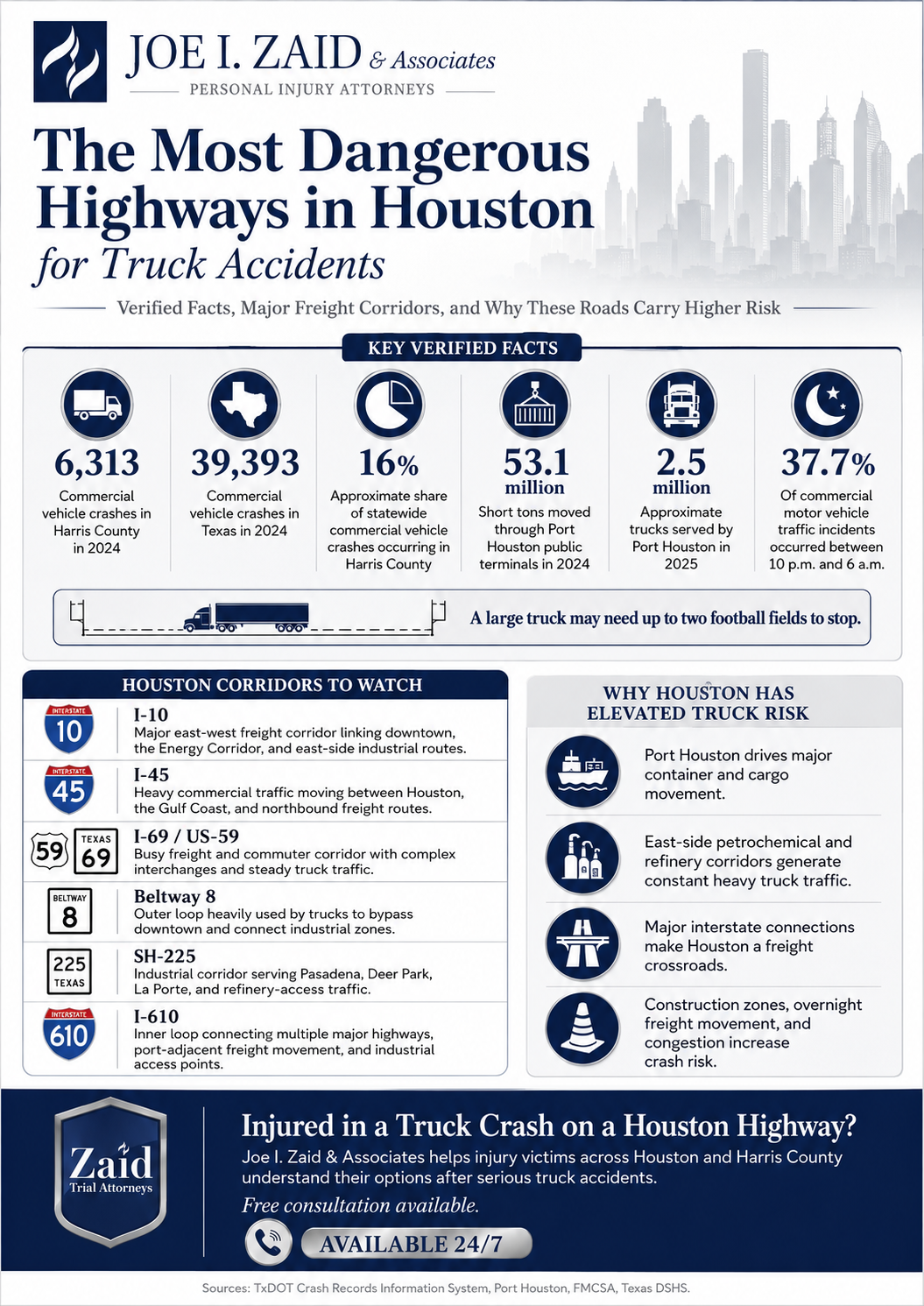
El condado de Harris registró más accidentes de vehículos comerciales que cualquier otro condado de Texas. Según los datos rastreados a través del Departamento de Transporte de Texas Sistema de información de registros de accidentes, Aproximadamente 161.000 de todos los accidentes de vehículos comerciales en el estado ocurren solo en el condado de Harris. En 2024, Texas registró un total de 39.393 accidentes de vehículos comerciales. Esto sitúa al condado de Harris en aproximadamente 6.300 accidentes de vehículos comerciales en un solo año.
Estas cifras no son abstractas. Reflejan accidentes en carreteras específicas, en intersecciones concretas, durante los trayectos que millones de conductores del área de Houston realizan cada semana. Comprender qué autopistas concentran el mayor tráfico de camiones y el mayor riesgo de accidentes puede ayudar a los conductores a tomar decisiones más informadas. Y para quienes ya han sufrido lesiones en una colisión con un camión en una de estas carreteras, conocer el contexto puede ser crucial al iniciar el proceso legal y de seguros.
¿Por qué Houston tiene un problema con los camiones que otras ciudades no tienen?
El número de accidentes de vehículos comerciales en Houston se debe a factores estructurales, no solo al tamaño de la población.
Puerto Houston es el puerto más grande de los Estados Unidos por tonelaje marítimo extranjero. En 2024, más de 53 millones de toneladas de carga se movieron a través de sus terminales públicas. El puerto también atendió aproximadamente 2.5 millones de transacciones de camiones solo a través de sus terminales de contenedores en 2025. Cada contenedor que llega por barco eventualmente sale por camión. Esos camiones se mueven a través del Canal de Navegación, a lo largo de la I-610, hacia la I-10, la I-45 y la Beltway 8, y a través de comunidades como Pasadena, Channelview, Deer Park y La Porte antes de llegar a los centros de distribución en todo el área metropolitana de Houston. Cuando ocurren accidentes en estas rutas, las reclamaciones que siguen rara vez son simples, razón por la cual muchos conductores lesionados recurren a un Abogado de accidentes de camiones en Houston al principio del proceso.
A esto se suma la industria petroquímica y de refinería de la región, que genera un flujo constante de camiones cisterna y de carga a lo largo de la carretera estatal 225 y los corredores industriales al este del centro de la ciudad. Además, hay que tener en cuenta la posición de Houston como nudo de comunicaciones nacional, con la I-10 que cruza el país de costa a costa y la I-45 que conecta la costa del Golfo con el área metropolitana de Dallas-Fort Worth.
El resultado es una ciudad donde los vehículos comerciales no son una presencia ocasional en la autopista, sino constante.
Interestatal 10: Los corredores de la autopista Katy y la autopista Este
La I-10 es uno de los corredores de vehículos comerciales más transitados del país. En el área metropolitana de Houston, discurre de este a oeste a través del centro de la ciudad y se extiende hacia el Corredor Energético al oeste y hacia Channelview y Baytown al este.
El segmento de la autopista este Esta vía transporta tráfico portuario e industrial entre el centro de Houston, el Canal de Navegación, Pasadena y Channelview. La alta densidad de camiones, junto con los carriles de incorporación, la congestión en los intercambiadores cerca de la Beltway 8 y las rampas elevadas, crean condiciones propicias para que las colisiones por alcance y los accidentes al cambiar de carril que involucran a camiones de 18 ruedas sean frecuentes.
El segmento de la autopista Katy Es uno de los tramos de autopista más anchos del mundo, pero aun así registra un número considerable de accidentes de vehículos comerciales durante las horas pico. El tráfico intermitente, sumado a los camiones que circulan a velocidad de autopista, genera un riesgo sustancial de distancia de frenado. Un camión de 18 ruedas completamente cargado que viaja a 105 km/h ya necesita el equivalente a dos campos de fútbol para detenerse en condiciones normales. En el tráfico intermitente de la autopista Katy, este problema de distancia se agrava.
El cruce donde la I-10 se une a la I-69 cerca del centro de la ciudad es también uno de los más congestionados del condado de Harris y registra frecuentes incidentes con vehículos comerciales, especialmente durante los cambios de carril y durante el transporte nocturno de mercancías.
Interestatal 45: Autopista Gulf Freeway a Autopista North Freeway
La I-45 recorre desde Galveston, pasando por el centro de Houston y hacia el norte, en dirección a Dallas. Dos tramos distintos presentan un riesgo elevado de accidentes de camiones en el área de Houston.
La autopista Gulf Freeway (I-45 Sur) Esta ruta atraviesa algunas de las comunidades con mayor actividad industrial en el sureste de Houston, incluyendo las áreas cercanas a Pasadena y las comunidades limítrofes con el condado de Galveston. El tráfico de camiones a lo largo de este corredor incluye carga portuaria, entregas de productos petroquímicos y carga regional que se mueve entre Houston y la costa del Golfo. La autopista Gulf Freeway también es propensa a inundaciones durante fuertes lluvias, lo que aumenta drásticamente el riesgo de vuelco y aquaplaning para los vehículos comerciales.
La Autopista del Norte (I-45 Norte) Esta carretera conecta Houston con la Cuenca Pérmica y sirve como ruta para los camiones de la industria petrolera que transitan por el corredor de Greenspoint y más allá. La fatiga del conductor es un factor documentado en los accidentes en corredores de larga distancia como este. Las regulaciones federales limitan las horas de servicio de los conductores comerciales, pero se producen infracciones, y los largos viajes nocturnos hacia y desde Houston contribuyen al riesgo en este tramo.
La Administración Federal de Seguridad de Autotransportes Se realiza un seguimiento anual de los datos sobre accidentes de camiones y autobuses de gran tamaño, y la fatiga del conductor y las infracciones relacionadas con las horas de servicio aparecen sistemáticamente entre los factores que contribuyen a los accidentes mortales de vehículos comerciales en todo el país.
Interestatal 69 / US-59: Los corredores suroeste y noreste
La US-59, ahora denominada I-69 en gran parte de su recorrido, es un corredor de carga fundamental. Transporta tráfico comercial desde Laredo hasta Houston, con uno de los tramos más transitados que atraviesa el suroeste de Houston y otro que se extiende hacia el noreste en dirección a Humble, Kingwood y más allá.
El tramo cercano al cruce de la I-610 y al cruce de la US-59 y la I-10 cerca del centro de la ciudad es uno de los entornos de navegación para conductores más complejos de Texas, con múltiples puntos de incorporación, estructuras elevadas y una alta densidad de camiones a todas horas.
US-59 en el condado de Harris Según los datos de Texas, esta carretera figura como una de las más accidentadas del estado, con cientos de accidentes mortales registrados durante periodos de seguimiento de varios años. Si bien no todos estos accidentes involucran vehículos comerciales, el constante tráfico de mercancías a lo largo de esta ruta hace que los vehículos comerciales sean un factor habitual en las estadísticas de accidentes de este corredor.
Los conductores que viajen entre Houston y comunidades como Humble, Aldine o Spring a lo largo del segmento noreste de este corredor deben estar especialmente atentos al tráfico comercial, sobre todo durante la noche, cuando el movimiento de mercancías alcanza su punto máximo y la visibilidad se reduce.
Autopista Beltway 8 / Sam Houston Parkway: El anillo exterior
La circunvalación Beltway 8 rodea Houston a lo largo de 142 kilómetros (88 millas) a través del condado de Harris. Los camiones comerciales la utilizan con frecuencia para evitar la congestión del centro de la ciudad. Conecta todos los principales corredores industriales, zonas de centros de distribución y áreas adyacentes al puerto en la región de Houston.
La combinación de altas velocidades, la frecuente actividad de intercambio de carriles y un parque de camiones que incluye vehículos que transportan cargas sobredimensionadas, materiales peligrosos y mercancías pesadas hacen de la Beltway 8 una de las rutas más peligrosas y constantes para los accidentes de vehículos comerciales en el área de Houston.
El tramo donde la Beltway 8 se cruza con la I-10 cerca de Channelview es particularmente relevante. Este cruce se ubica cerca de la zona industrial al este de Houston, próximo al Canal de Navegación, y registra una concentración de tráfico pesado comparable a la de cualquier otra autopista del área metropolitana. Los accidentes en la zona de Channelview que involucran vehículos comerciales pueden generar situaciones de responsabilidad complejas cuando el camión opera bajo un contrato de transporte a través de una terminal o transportista con conexiones al puerto o a instalaciones petroquímicas a lo largo de la SH-225.
El tramo sureste cerca de Pasadena, donde la circunvalación Beltway 8 se acerca a la carretera estatal 225, también presenta una intensa actividad de camiones industriales. Los conductores de Pasadena y Deer Park que transitan por este tramo comparten la carretera diariamente con camiones que transportan mercancías de refinería.
Carretera Estatal 225: El Corredor Industrial
La SH-225 no soporta el mismo volumen de tráfico que las principales autopistas interestatales, pero merece una mención especial debido a la naturaleza del tráfico de camiones que transporta.
El corredor SH-225 se extiende desde la I-610 hacia el este, pasando por Pasadena, Deer Park, La Porte y en dirección a Bayport. Atraviesa una de las zonas petroquímicas y de refinería más concentradas del país. Camiones cisterna, plataformas que transportan equipos industriales y cargas sobredimensionadas son una presencia habitual.
Los accidentes que involucran camiones cisterna en la SH-225 pueden provocar derrames de materiales peligrosos, además de las lesiones habituales por colisión. Los márgenes estrechos de esta carretera y la densidad de vías de acceso a refinerías crean condiciones en las que los camiones entran y salen frecuentemente de los carriles principales. Las colisiones por alcance y las colisiones en intersecciones son tipos de accidentes comunes en este corredor.
Las personas lesionadas en accidentes cerca de la SH-225 o en las comunidades a lo largo de su ruta pueden estar tratando con transportistas comerciales que operan bajo contratos con grandes empresas industriales. Estas situaciones pueden implicar múltiples niveles de responsabilidad que conviene comprender antes de hablar con un ajustador de seguros. Los conductores en comunidades como Pasadena Quienes transitan regularmente por la carretera SH-225 se enfrentan a este entorno a diario.
Preguntas frecuentes sobre accidentes de camiones en las carreteras de Houston
¿Qué autopista de Houston registra el mayor número de accidentes de camiones?
Ninguna autopista en particular tiene la ventaja absoluta, pero la I-10, la I-45, la Beltway 8 y la US-59 registran sistemáticamente la mayor concentración de accidentes de vehículos comerciales en el condado de Harris. La I-10 es especialmente relevante porque transporta tanto mercancías relacionadas con el puerto desde el este como tráfico pesado de pasajeros y vehículos comerciales a través del Corredor Energético hacia el oeste. La Beltway 8 ocupa un cercano segundo lugar, ya que los camiones la utilizan como ruta de circunvalación, lo que genera tráfico comercial de alta velocidad en una carretera que también conecta todas las principales zonas industriales y de distribución de la región.
¿Por qué son tan frecuentes los accidentes de camiones cerca del puerto de Houston?
El puerto de Houston gestionó volúmenes récord de carga en 2024, con millones de transacciones de camiones que transitaron por sus terminales de contenedores. Cada contenedor que llega por barco requiere al menos un viaje en camión para ser trasladado fuera de las instalaciones portuarias a un almacén o centro de distribución. Este volumen genera un flujo constante de vehículos comerciales cargados en las autopistas I-610, I-10, Beltway 8 y SH-225 a todas horas. La densidad del tráfico de camiones cerca del canal de navegación, junto con las vías de acceso industriales y los conflictos de incorporación, crea condiciones donde los accidentes son más probables que en los corredores habituales de transporte.
¿Son los accidentes de camiones en la SH-225 más peligrosos que los accidentes en otras carreteras?
No necesariamente más frecuentes, pero sí potencialmente más complejos. La SH-225 atraviesa una de las zonas petroquímicas y de refinería más concentradas del país. Los accidentes que involucran camiones cisterna en este corredor pueden incluir derrames de materiales peligrosos, además de las lesiones habituales por colisión. Esto puede afectar la forma en que se gestiona la escena, la rapidez con la que se accede a las pruebas y las agencias reguladoras que pueden intervenir. El panorama de responsabilidad en los accidentes de la SH-225 también puede ser más complejo, ya que muchos de los camiones operan bajo contratos con grandes empresas industriales.
¿Influye la hora del día en el riesgo de accidentes de camiones en Houston?
Sí. Según datos del Departamento de Servicios de Salud del Estado de Texas sobre incidentes con vehículos comerciales, 37,71 TP3T de accidentes con vehículos comerciales ocurrieron entre las 10 p. m. y las 6 a. m., en comparación con 24,361 TP3T de accidentes con vehículos no comerciales durante el mismo período. Las horas nocturnas son cuando el transporte de carga de larga distancia alcanza su punto máximo y cuando la fatiga del conductor tiene más probabilidades de ser un factor. Corredores como la I-45 Norte y la US-59 Noreste, que sirven rutas de larga distancia desde Houston, presentan un riesgo elevado específicamente durante las horas nocturnas.
Si me atropellara un camión en una de estas autopistas, ¿quién sería el responsable?
La responsabilidad en un accidente de camión en Houston depende de las circunstancias específicas. El conductor podría ser responsable. La empresa de transporte también podría ser responsable si el conductor actuaba en el ejercicio de sus funciones. Si el camión era arrendado, el propietario del vehículo podría ser una parte independiente. Un agente de carga, una empresa de carga o un contratista de mantenimiento también podrían estar involucrados, según la causa del accidente. Los corredores comerciales de Houston suelen involucrar camiones que operan bajo múltiples contratos y aseguradoras, lo que contribuye a que estas reclamaciones sean más complejas que las reclamaciones por accidentes estándar.
¿Con qué rapidez desaparecen las pruebas tras un accidente de camión en Houston?
Más rápido de lo que la mayoría de la gente espera. Los datos de la caja negra del camión pueden sobrescribirse en cuestión de días. Las grabaciones de vigilancia de negocios cercanos, instalaciones portuarias o cámaras de carretera suelen borrarse en un plazo de 24 a 72 horas. Los registros de conducción y los informes de inspección del vehículo pueden alterarse o perderse si nadie solicita formalmente su conservación. El equipo legal de la empresa de transporte suele iniciar su propia investigación a las pocas horas de un accidente grave. Enviar una carta de conservación a través de un abogado al inicio del proceso es uno de los pasos más importantes que puede dar una persona lesionada.
El circuito I-610: el anillo comercial del centro de la ciudad.
La autopista I-610 Loop rodea el centro de Houston y registra una mezcla de tráfico de viajeros habituales, transporte de mercancías cerca del puerto y vehículos comerciales que atraviesan la ciudad entre zonas industriales.
El lado este del Loop 610, cerca de los cruces del Canal de Navegación y las refinerías y terminales que bordean la vía fluvial, es uno de los tramos más peligrosos. Los camiones que entran y salen de las instalaciones industriales generan conflictos de incorporación con el tráfico de la autopista. La zona del Túnel Washburn y los tramos elevados cerca del lado este del Loop son conocidos por su importante actividad de vehículos comerciales.
El circuito también sirve como punto de conexión para varios cruces importantes de autopistas, incluyendo los cruces de la I-610 con la I-45, la I-10 y la US-59. En estos cruces, donde se producen numerosas incorporaciones, es frecuente la participación de vehículos comerciales en accidentes.
¿Qué tienen en común estas carreteras?
Al observar estas carreteras, surgen varios patrones que explican por qué los accidentes que involucran camiones de 18 ruedas y vehículos comerciales están tan concentrados aquí:
- Volumen de carga impulsado por el puerto. El puerto de Houston atendió aproximadamente 2,5 millones de transacciones de camiones solo en 2025. Muchos de esos vehículos califican como vehículos comerciales Según la ley de Texas, esto significa que los accidentes en los que estén involucrados pueden activar normas de responsabilidad civil y estructuras de seguros diferentes a las de los accidentes estándar.
- Acceso al corredor industrial. La infraestructura petroquímica y de refinería al este de Houston genera un flujo continuo de tráfico de camiones especializados.
- Transporte de mercancías durante la noche. Según datos del Departamento de Servicios de Salud del Estado de Texas sobre incidentes con vehículos comerciales, una proporción significativa de los accidentes de vehículos comerciales en Texas ocurren entre las 10 p. m. y las 6 a. m. Conducir de noche agrava todos los demás factores de riesgo.
- Zonas de construcción. El Departamento de Transporte de Texas (TxDOT) mantiene en marcha importantes proyectos de carreteras en todo el condado de Harris, lo que provoca cambios de carril, reducción de la velocidad y confusión entre los conductores, aumentando así el riesgo de accidentes para todos los vehículos, en particular para los camiones grandes.
Cuando un accidente en una de estas carreteras se convierte en una demanda legal
No todos los accidentes de camiones dan lugar a demandas por lesiones personales. Pero cuando ocurren, la carretera implicada suele influir en las pruebas relevantes y en la rapidez con que estas desaparecen.
Joe I. Zaid y asociados La firma gestiona reclamaciones por accidentes de camiones en todo el condado de Harris y sus alrededores. Recientemente se recuperó $1,2 millones para un cliente cuyo anterior abogado no pudo demostrar la responsabilidad del conductor demandado. En los casos de camiones comerciales, la forma en que se formula la demanda suele determinar su valor.
Si usted resultó herido en un accidente en I-10, I-45, Beltway 8, US-59, SH-225 o cualquier otra carretera del área de Houston., No espere para comprender sus opciones. Póngase en contacto con un Abogado de accidentes de camiones en Houston a Joe I. Zaid y asociados para consulta gratis. Las oficinas están abiertas 24 horas al día.