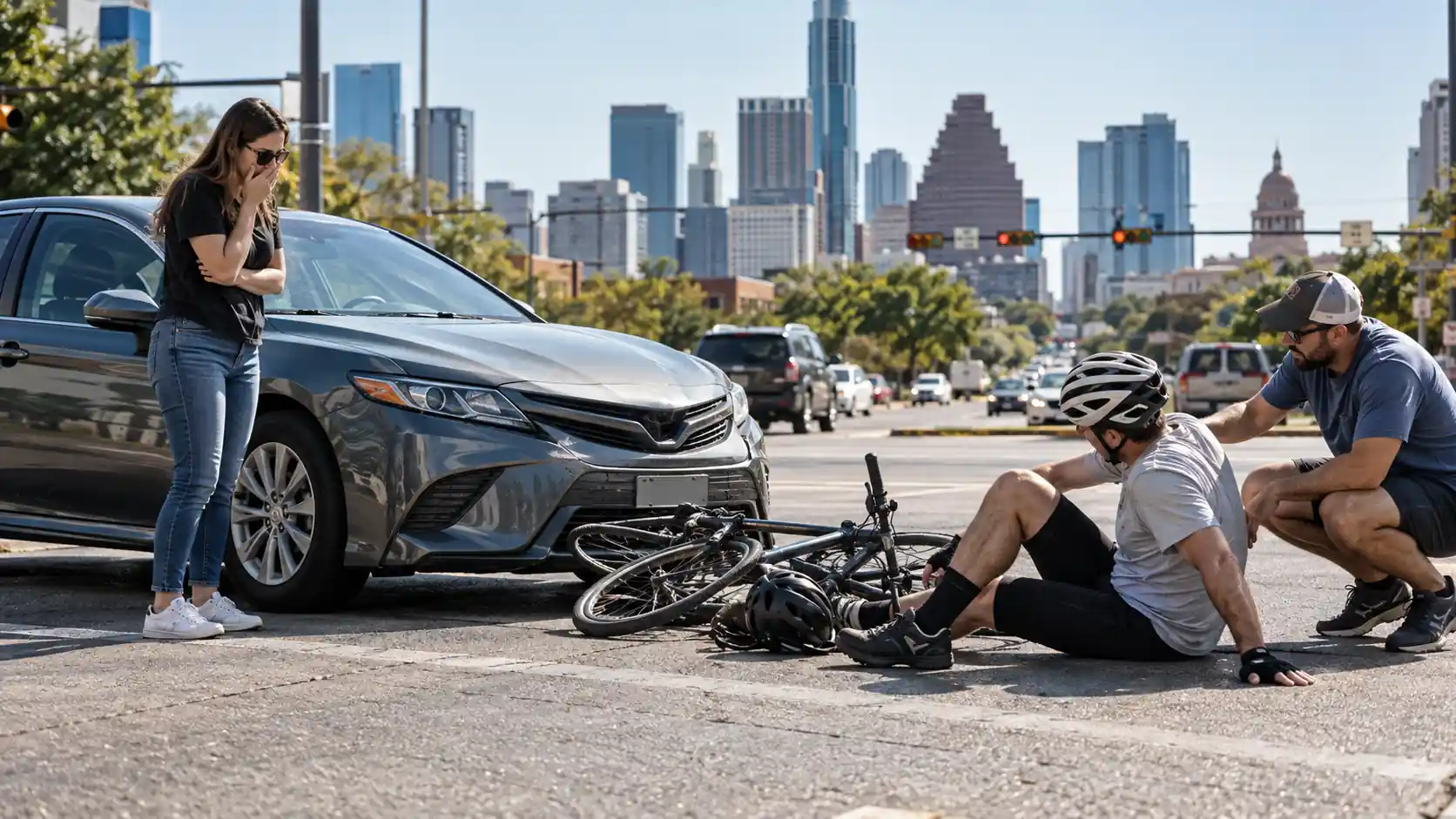
The driver is at fault when the driver breaks a traffic rule or fails to use reasonable care around a bicyclist. That failure must also cause the crash. Texas law treats a bicycle as a vehicle, so bicyclists must follow the same rules. That means fault can be shared between the two people.
Texas does not treat shared fault as all or nothing. A jury assigns a percentage of responsibility to each person, and insurers use the same framework when they negotiate. A bicyclist who is 50 percent responsible or less can still recover compensation, though the amount shrinks. A bicyclist who is more than 50 percent responsible recovers nothing.
If a driver hit you while you were riding, we offer consultas gratuitas to help you understand where fault may land.
Texas Treats a Bicyclist as a Driver
Section 551.101 of the Transportation Code gives a person riding a bicycle the rights and duties of a driver, with limited exceptions. The same rules on yielding, stopping, and signaling apply to both people on the road.
That rule cuts both ways. A bicyclist has the rights of a driver, so a driver cannot treat a rider as an obstacle. A bicyclist who runs a stop sign faces the same scrutiny as a driver who runs one.
Driver Behavior That Often Creates Fault
Several rules in Chapter 545 of the Transportation Code apply to common bicycle crash scenarios.
Failing to Yield at Intersections and Driveways
A driver turning left must yield to oncoming traffic under Section 545.152. A bicyclist riding straight through counts as oncoming traffic. A driver leaving a driveway or private road must yield to vehicles on the roadway under Section 545.155.
Drivers in these crashes sometimes say the bicyclist appeared out of nowhere. A bicycle is harder to spot than a car, but the duty to yield does not shrink with the size of the vehicle.
Turning Across a Bicyclist’s Path
Section 545.103 bars a driver from turning or moving left or right unless the driver can do so safely. Section 545.104 requires a turn signal for at least the last 100 feet before the turn.
A common version of this crash starts with a driver passing a bicyclist, then turning right directly in front of the bicyclist. Whether the driver signaled, and how early the driver slowed, can decide who carries the blame.
Passing Too Closely
Section 545.053 requires a driver to pass another vehicle at a safe distance. A bicycle counts as a vehicle, so the rule covers a driver passing a bicyclist. The statute calls for a safe distance, not a set number of feet. The answer depends on speed, lane width, and how the vehicle moved.
Speed matters too. Section 545.351 bars driving faster than is reasonable and prudent under the circumstances, and the presence of bicyclists can be part of those circumstances.
Opening a Car Door Into a Bicyclist
A bicyclist can also collide with a door that swings into the roadway. Section 545.418 bars a person from opening a door on the traffic side of a vehicle unless doing so is reasonably safe. The open door also may not interfere with moving traffic. A driver or a passenger can break that rule.
What Texas Law Expects From Bicyclists
Insurance adjusters may look for a rule violation by the rider. These are the duties they may point to:
- Lane position. Under Section 551.103, a bicyclist moving slower than other traffic must ride as near as practicable to the right curb or edge. The statute lists exceptions, including a lane less than 14 feet wide with no adjacent designated bicycle lane.
- Signals and signs. Section 551.101 gives bicyclists a driver’s duties, so a rider generally must obey traffic lights and stop signs.
- Equipment. Section 551.104 requires a brake. It also sets lighting rules, including a white front lamp visible from 500 feet and a rear reflector or red lamp.
Section 551.103 also allows bicyclists to ride two abreast on a roadway, so riding next to a friend is not a violation by itself.
A violation does not automatically shift blame. The question is whether the violation helped cause the crash. A missing rear reflector, for example, may have nothing to do with a crash caused by a driver who ran a red light.
How Shared Fault Works After a Bicycle Crash
Texas applies proportionate responsibility to a bicyclist’s reclamo por accidente de coche the same way it applies to any other crash. Under Chapter 33 of the Civil Practice and Remedies Code, the jury assigns a percentage of responsibility. That percentage goes to each claimant, defendant, settling person, and designated responsible third party.
Two rules then decide the outcome. Section 33.001 bars recovery if the claimant’s responsibility exceeds 50 percent. Section 33.012 reduces the damages by the claimant’s own percentage.
How a Few Percentage Points Change the Result
Take a hypothetical bicyclist whose damages total $100,000. If a jury finds the bicyclist 20 percent responsible, the award drops to $80,000. At 51 percent, the bicyclist recovers nothing.
That 50 percent line is why negligencia comparativa en Texas shapes every negotiation after a bicycle crash. A driver’s insurer has every reason to argue for a higher percentage. A defendant can also ask the court to designate a responsible third party, such as another driver, to take a share of the blame.
How Insurers Push Fault Toward the Bicyclist
Adjusters may start with points that are easy to raise and hard for a rider to disprove without evidence. Those points include where the bicyclist rode, whether the lights worked, whether the bicyclist swerved, and whether the bicyclist stopped at the sign. Each point can add percentage points to the rider’s share.
Joe Zaid spent nearly a decade working inside the insurance industry before founding Joe I. Zaid & Associates, so he knows how adjusters build and weigh these arguments.
Evidence That Decides Fault in a Bicycle Crash
Bicycle crashes often come down to two conflicting accounts, so physical and recorded evidence carries real weight. The most useful proof includes:
- Video. Dashcams, doorbell cameras, business cameras along the route, and the rider’s own helmet or handlebar camera can show what happened. Many cameras overwrite footage quickly, so a request for it cannot wait.
- The bicycle and gear. Damage patterns, working lights, reflectors, and a helmet can show how the crash happened. Do not repair or replace them before someone documents them.
- The vehicle. Damage location, brake and turn signal condition, and, in some vehicles, recorded speed and braking data can test the driver’s account.
- The scene. Point of impact, debris, skid marks, lane markings, any bike lane layout, and sight lines at the intersection or driveway all matter.
- Driver records. In a lawsuit, phone records may show whether the driver was distracted.
Witnesses and the crash report matter too. An officer who arrives after the crash relies on what the people involved say. That is why police reports can contain mistakes that an insurer may still rely on.
A fleeing driver adds another problem, because the investigation must identify the vehicle before it can establish fault. Avoiding common mistakes after a hit-and-run accident helps protect the evidence that points to the driver.
Disputed fault calls for investigation rather than guesswork. Joe I. Zaid & Associates recovered a $1.2 million settlement in a Houston car accident. The client’s first attorney could not establish who was at fault. We restarted the claim, reexamined the police report, gathered witness information, worked to reconstruct how the crash happened, and confirmed the driver’s insurance coverage. That work built the liability argument the case had been missing, and the insurer moved from disputing fault to negotiating. Past results do not guarantee or predict a similar outcome in future cases.
When Fault Becomes a Legal Question
Fault becomes more than a conversation when an insurer assigns a percentage to the rider. The same is true when the driver denies the crash happened that way or left the scene. Texas also sets a deadline. Section 16.003 of the Civil Practice and Remedies Code generally requires a personal injury lawsuit within two years after the cause of action accrues.
We can review the crash report, the evidence, and the insurer’s fault argument during a consulta gratis. Bicyclists hurt in or near Pasadena can also work with our Pasadena bicycle accident lawyers through our Pasadena office. Clients owe no attorney fees unless we recover compensation.