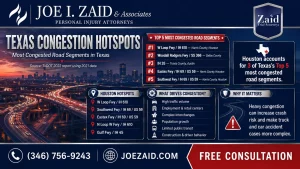
Houston’s most congested roadway is the West Loop of I-610, the stretch between the Katy Freeway/I-10 interchange and the Southwest Freeway/US 59 interchange. State transportation data ranks it as the single most congested road segment in Texas for the third year in a row. The Eastex Freeway, where I-69/US 59 runs between SH 288 and I-10, sits right behind it at number two.
These two freeways are not outliers. According to the 2025 Texas Top 100 Congested Road Segments report from the Texas Department of Transportation and the Texas A&M Transportation Institute, seven of the ten most congested road segments in the entire state fall inside Harris County. TxDOT and TTI 2025 Top 100 Congested Road Segments report
Below is a closer look at which specific segments rank highest, why they stay congested year after year, and when Houston drivers are most likely to hit heavy traffic. If you were hurt in a crash on one of these corridors, our Houston car accident claims team at Joe I. Zaid & Associates can review what happened and explain your options during a consulta gratis.
Houston’s Most Congested Freeways, Ranked by State Data
TxDOT and TTI rank road segments using delay per mile, a measure of how much extra time it takes to travel a mile on a congested road compared to the same mile in free-flowing traffic. The analysis covers more than 2,100 monitored segments statewide.
The Harris County segments that made the statewide top 10 in the 2025 report are:
- West Loop Freeway / I-610 (Katy Freeway/I-10 to Southwest Freeway/US 59): ranked No. 1
- Eastex Freeway / I-69, US 59 (SH 288 to I-10): ranked No. 2
- Southwest Freeway / I-69, US 59 (West Loop/I-610 to South Freeway/SH 288): ranked No. 4
- North Loop Freeway / I-610 (North Freeway/I-45 to Katy Freeway/I-10): ranked No. 5
- Katy Freeway / I-10 (West Loop/I-610 to North Freeway/I-45): ranked No. 6
- Gulf Freeway / I-45 (I-10 to South Loop/I-610): ranked No. 7
- I-10 / US 90 (North Freeway/I-45 to Eastex Freeway/US 59): ranked No. 10
The West Loop segment has held the top spot in Texas for three consecutive reports, and the Eastex Freeway climbed from fifth place last year into second this year. TxDOT and TTI 2025 Top 100 Congested Road Segments report
Notably, the Eastex Freeway also became Texas’s most congested road for truck traffic in this year’s report, moving up from fourth place. Heavy freight and commercial traffic moving between the Ship Channel, I-10, and points north add to the volume already created by daily commuters.
Why These Roadways Stay Near the Top Year After Year
A few factors explain why the same Houston freeways keep showing up at the top of the list.
Houston’s population and job growth have consistently outpaced new roadway capacity, which is the single biggest driver of congestion statewide. Construction is another factor. Of the top 100 most congested segments in Texas, 43 had at least two months of active construction in 2024, and long-term projects on the West Loop and Eastex Freeway have contributed to their rankings in recent years. TxDOT and TTI 2025 Top 100 Congested Road Segments report
TxDOT and TTI also point to congestion outside the traditional rush-hour window as a specific reason the West Loop stays near the top. The report describes I-610 West as a road where “it is always rush hour,” meaning delays build up throughout the day rather than clearing between peak periods. That pattern also makes these roads more vulnerable to secondary problems, since a single crash or stalled vehicle during an already-slow period can back up traffic for miles.
Land use plays a role as well. TxDOT and TTI point to land use as a recurring factor behind Texas’s most congested corridors, since new retail, office, and housing development near a freeway can add thousands of trips before nearby road capacity catches up. TxDOT and TTI 2025 Top 100 Congested Road Segments report The West Loop segment runs along Uptown and areas near the Texas Medical Center, two of Houston’s busiest activity centers, which helps explain why traffic on that stretch rarely lets up.
When Houston Traffic Peaks
Beyond the year-over-year rankings, Houston TranStar tracks how congestion moves throughout the day on specific corridors. Its data shows that Houston’s worst delays cluster around two windows: roughly 7 to 8 a.m. and 5 to 6 p.m. Houston TranStar historical travel times
A few measured examples from that data illustrate how severe those windows can be:
- I-69 southbound inbound between the West Loop and Downtown ran at 79 percent congested during the measured morning period and 100 percent congested during the evening period.
- I-610 North Loop westbound between Gellhorn and Shepherd ran at 71 percent congested in the morning and 93 percent in the evening.
- I-610 West Loop northbound between Stella Link and Shepherd reached 82 percent congestion in the evening period.
These numbers describe travel delay, not crash risk on their own. But they help explain why so much of the traffic on Houston’s busiest freeways moves in slow, stop-and-go conditions for extended stretches of the day rather than during a single short commute window.
What Heavy Congestion Means for Drivers
Stop-and-go traffic on corridors like the West Loop and Eastex Freeway creates frequent braking, merging, and lane changes packed into a small space. Those conditions are a common setting for rear-end car accidents and for chain-reaction crashes involving three or more vehicles.
Chain-reaction crashes can raise complicated fault questions. A driver who never directly struck another vehicle may still share responsibility if their actions started the chain of impacts, and figuring out how much each driver contributed often requires a careful review of the sequence of events. In one case, a driver failed to control speed on a Houston freeway and triggered a three-vehicle chain reaction. After sorting out how fault should be divided among the drivers involved, Joe I. Zaid & Associates secured an $80,000 settlement for the client. Past results do not guarantee a similar outcome in any future case, since every crash depends on its own facts and evidence.
When a crash happens on one of Houston’s busiest freeways, evidence can be harder to sort through simply because more vehicles and more drivers are usually involved. Police reports, witness statements, and any available dashcam or nearby surveillance footage all become more important when insurance companies are trying to divide fault among several parties rather than two.
Multiple insurance companies are also often involved in these crashes, and each one may try to shift blame toward another driver to limit its own payout. Sorting out how each vehicle was struck, and in what order, often matters as much as identifying who was driving too closely or too fast for the traffic conditions.
Getting Help After a Crash on a Congested Houston Freeway
If you were injured in a crash on the West Loop, the Eastex Freeway, or any other Houston-area corridor, the team at Joe I. Zaid & Associates can review the facts of what happened and help you understand how liability may be divided among the drivers involved. The firm’s Downtown Houston office is centrally located to serve clients from these major freeway corridors.
Contact Joe I. Zaid & Associates for a consulta gratis para discutir su caso.