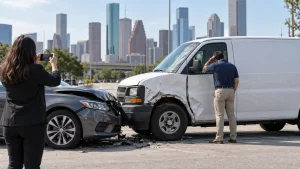
If a vehicle with a company name on the door, or a driver working on the clock, caused your crash, the responsibility does not automatically stop with the driver. Under Texas law, the employer can also be held liable, either because the driver was acting within the scope of the job or because the company itself was negligent in hiring, supervising, or handing over the vehicle to that driver.
Which theory applies, and whether more than one applies at the same time, depends heavily on what the driver was doing when the crash happened and what the company knew about the driver beforehand. Getting this right matters because it usually determines which insurance policy pays and how much money is actually available to cover your injuries. A abogado de accidentes de vehículos comerciales typically starts by pulling employment records, dispatch logs, and insurance information to figure out exactly who was responsible before the company has a chance to shape that narrative on its own.
When the Employer Is Responsible for the Driver’s Actions
Texas recognizes a legal doctrine called respondeat superior, sometimes called vicarious liability. Under this doctrine, an employer can be held responsible for an employee’s negligent driving even though the employer did nothing wrong itself. The Texas Supreme Court has explained that an employer is liable for an employee’s actions only when those actions fall within the scope of the employee’s general authority and serve the employer’s business.
What Counts as Course and Scope of Employment
Courts look at what the driver was actually doing at the moment of the crash and whether that activity was connected to the job. A driver making a scheduled delivery, running a work errand, or traveling between job sites is generally acting within the scope of employment. A driver who takes a company vehicle on a long personal detour, unrelated to any work task, usually is not.
When a driver has stepped away from work duties only briefly, such as a short stop for a quick personal errand on the way to a job site, that minor deviation may still fall within the scope of employment. A significant, unrelated departure from the job is a different matter, and the employer generally will not be liable for what happens during that departure.
The Commute Exception
As a general rule, an employee driving to or from work is not considered to be acting within the scope of employment, even in a company-owned vehicle. Texas courts have applied this rule for decades. There are exceptions. If the employer directs the driver to run a work errand on the way to or from the office, or if the drive itself is part of a special assignment made at the employer’s request, the trip may fall back within the scope of employment. Whether a particular commute qualifies is often a fact-specific question that depends on who controlled the trip and why it was happening.
When the Company Itself Is at Fault
Separate from respondeat superior, a company may face liability based on its own decision to entrust a vehicle to an unsafe driver. Texas recognizes negligent entrustment when a company gives a vehicle to a driver who is unlicensed, incompetent, or reckless, the company knew or should have known about that problem, and the driver’s negligence then causes the crash.
Other facts may also raise questions about the company’s hiring, retention, training, or supervision of the driver. Those theories are distinct from negligent entrustment and depend heavily on the circumstances of the particular case.
In a negligent entrustment claim, evidence about the driver’s history can become just as important as what happened at the crash scene. Prior reckless driving, license problems, or other evidence showing that the driver was unsafe may matter if the company knew or should have known about those problems before allowing the driver to use the vehicle.
Joe I. Zaid & Associates has handled cases where the investigation expanded beyond the driver to the company that hired and equipped them, including a $455,000 commercial vehicle settlement that developed a negligent hiring issue involving the employer. Past results do not guarantee a similar outcome in any other case, but they show why looking beyond the driver’s insurance card can change the direction of a claim.
Independent Contractors and Delivery Drivers Complicate the Picture
Not everyone driving a company vehicle is legally an employee. Businesses that rely on delivery or courier drivers sometimes classify them as independent contractors rather than employees, which can limit vicarious liability under respondeat superior. Vicarious liability generally applies to the employer-employee relationship, and a company may argue it has less control over how an independent contractor performs the job.
That argument does not automatically end the company’s exposure. If the business still owned or controlled the vehicle, dictated the routes or schedule, or knew about the driver’s unsafe history before putting them on the road, negligent entrustment or negligent hiring claims may still apply regardless of how the company labeled the working relationship on paper. Determining whether a driver was truly an independent contractor, or an employee in practice, often requires reviewing the actual working arrangement rather than the title used in a contract. This issue comes up frequently in claims involving delivery driver accident claims, where drivers may be classified differently depending on the company.
Why This Affects the Value of Your Claim
Texas law requires most vehicles on the road, including standard business-owned cars and vans, to carry a minimum of $30,000 in bodily injury coverage per person, $60,000 per accident, and $25,000 in property damage coverage. That floor was set under the Texas Transportation Code and has not changed in recent years.
A minimum policy rarely covers the full cost of a serious injury. When a company can be held responsible through respondeat superior, negligent entrustment, or both, the claim may extend into the business’s commercial insurance policy, which is often written with significantly higher limits than a personal auto policy. Identifying every available source of coverage, not just the driver’s personal insurance, is part of why Joe Zaid’s background inside the insurance industry helps the firm evaluate a company vehicle claim early, before an insurer has settled on its version of who is responsible and for how much.
Evidence That Helps Establish Who Is Responsible
Because employer liability depends heavily on the driver’s role and the company’s own conduct, the evidence in these cases looks different from a typical two-car collision. Useful evidence may include:
- Employment records showing whether the driver was an employee or an independent contractor
- Dispatch logs, delivery schedules, or work orders showing what the driver was doing at the time of the crash
- Vehicle titling and registration records identifying who owned or leased the vehicle
- The company’s insurance declarations page identifying the named insured and policy limits
- Hiring records, driving history checks, and any prior complaints about the driver
- Company policies on personal use of business vehicles
Much of this information is not publicly available and can be difficult to obtain once a company realizes its own conduct may be at issue. Sending preservation requests and formally requesting these records early can prevent a company from later claiming the records were routinely discarded.
When a Large Commercial Truck Is Involved
Some company vehicle crashes involve heavier commercial trucks, such as 18-wheelers or other large freight vehicles, rather than a passenger car, van, or work truck. Those cases often bring in additional federal trucking regulations covering driver qualifications, hours of service, and vehicle maintenance, which go beyond the general employer liability rules discussed here. That distinct set of issues is covered in more depth in our discussion of liability after a truck accident, since a large rig collision typically raises regulatory questions that a standard company car or delivery van accident does not.
Getting Help After a Company Vehicle Accident
Company vehicle accidents rarely come with a straightforward answer about who pays. The driver’s insurance may be limited, the company may dispute that the driver was working at the time, and records that would clarify the picture are held by the business itself. Reviewing the driver’s role, the company’s hiring practices, and the available insurance coverage early can make a meaningful difference in how a claim is resolved.
Joe I. Zaid & Associates ofrece consultas gratuitas for people injured by company vehicles across Houston and the surrounding Texas communities, and can help identify every party who may share responsibility for the crash.