
Por lo general, una reclamación por accidente de camión requiere más pruebas que una reclamación por accidente de coche, ya que el transporte comercial por carretera está regulado por normas federales de seguridad que generan registros que los conductores comunes nunca producen. Además del informe policial, las fotos y las declaraciones de los testigos en los que se basa una reclamación por accidente de coche, una reclamación por accidente de camión suele recurrir a los datos de las horas de servicio del conductor, los datos del accidente a bordo del camión, los archivos de cualificación y mantenimiento del conductor de la empresa transportista, los resultados de las pruebas de drogas y alcohol posteriores al accidente, y los registros de despacho y carga del viaje.
Este registro documental es lo que diferencia las pruebas de accidentes de camiones de las de accidentes automovilísticos, y también lo que justifica su comprensión desde el principio. Gran parte de esta documentación la conserva la empresa de transporte, no el conductor, y algunos documentos solo existen durante un período limitado antes de ser sobrescritos o descartados como parte de la práctica comercial habitual.
Las secciones siguientes analizan las pruebas específicas relativas a las reclamaciones de transporte por carretera, por qué son importantes y qué puede ocurrir si no se abordan con rapidez.
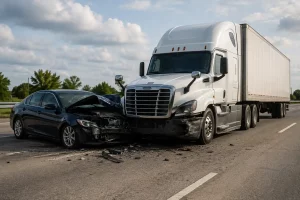
Por qué las pruebas de un accidente de camión difieren de las de un accidente de coche.
Es un error común pensar que una reclamación por accidente de camión se maneja de la misma manera que una reclamación por accidente de automóvil. Un choque entre dos vehículos particulares generalmente se investiga utilizando el informe policial, los daños del vehículo, los registros médicos y cualquier testigo o grabación de cámara disponible. Un caso de accidente de camión comercial puede basarse en esa misma base, pero también involucra las Regulaciones Federales de Seguridad de Autotransportistas que rigen cómo las compañías de camiones contratan conductores, registran las horas al volante, mantienen sus vehículos y responden después de un accidente. Cuando un conductor o transportista viola una de estas normas federales, esa violación puede sustentar una reclamación por negligencia en un caso de accidente de camión en Texas.
La responsabilidad también puede extenderse más allá del conductor al transportista, un contratista de mantenimiento u otra empresa involucrada en la carga o el despacho de la carga, y esta evidencia es a menudo lo que determina quién puede ser responsable después de un accidente de camión. Debido a que pueden estar involucradas más partes y tener mayor cobertura de seguro, las compañías de transporte y sus aseguradoras suelen actuar con rapidez para investigar un accidente según sus propios criterios. Las pruebas específicas para el transporte por carretera son las que permiten que una reclamación se adapte a esa respuesta inicial, en lugar de depender únicamente del contenido de un expediente típico de accidente automovilístico.
Datos de horas de servicio y dispositivos de registro electrónico
Las normas federales limitan la cantidad de horas que un conductor comercial puede pasar al volante antes de tomar el descanso obligatorio, y la mayoría de los conductores deben registrar esas horas utilizando un dispositivo de registro electrónico (ELD, por sus siglas en inglés) que registra automáticamente el tiempo de conducción, la ubicación y el estado de servicio. Estos datos pueden mostrar si un conductor ya ha estado en la carretera más tiempo del permitido. normas federales sobre las horas de servicio permitir en el momento del accidente, lo cual es importante en una reclamación relacionada con la fatiga del conductor.
Por lo general, las empresas de transporte solo están obligadas a conservar los registros de los dispositivos de registro electrónico (ELD) durante seis meses. Una vez transcurrido ese plazo, es posible que los datos ya no estén disponibles, razón por la cual solicitar estos registros al inicio de un caso puede ser más importante que solicitarlos en el caso de otros tipos de pruebas.
Datos de eventos de los sistemas a bordo del camión
Muchos camiones comerciales funcionan con un módulo de control del motor que puede capturar información como la velocidad, el frenado, la posición del acelerador y las RPM en los momentos previos a un choque. Normas federales para registradores de datos de eventos Se aplican principalmente a vehículos de pasajeros más ligeros que a camiones pesados, pero a menudo se puede obtener información similar directamente de los sistemas a bordo del camión, y puede ser igual de útil para reconstruir lo sucedido.
Estos datos generalmente deben descargarse del vehículo mediante equipos especializados. Pueden perderse si el camión se repara, se vende o se desguaza antes de que se realice la descarga, lo que lo convierte en otro ejemplo de evidencia que es más fácil obtener a tiempo que recuperar posteriormente.
El expediente de cualificación del conductor
Las empresas de transporte están obligadas a mantener un archivo de cualificación del conductor para cada conductor que emplean, que incluye la solicitud del conductor, el historial de conducción, el certificado médico, los resultados de la prueba de conducción y el historial de pruebas de drogas y alcohol. Este archivo puede mostrar si la empresa de transporte seleccionó, capacitó y supervisó adecuadamente a un conductor, lo cual resulta relevante cuando un conductor tenía un historial de infracciones, un certificado médico caducado u otra señal de alerta que la empresa de transporte debería haber detectado. Las empresas de transporte están obligadas a conserva este archivo Durante el tiempo que el conductor esté empleado y durante tres años después de que el conductor deje el cargo.
Registros de mantenimiento e inspección de vehículos
Los camiones comerciales están sujetos a requisitos de inspección, reparación y mantenimiento rutinarios Según la ley federal, los registros de mantenimiento y los informes de inspección, junto con los informes de inspección previos y posteriores al viaje del propio conductor, pueden mostrar si un problema mecánico, como frenos desgastados o un defecto en los neumáticos, ya se había detectado antes del accidente y si la empresa de transporte lo solucionó antes de volver a poner el camión en circulación.
Pruebas de detección de drogas y alcohol después de un accidente
Las regulaciones federales exigen que un transportista realice pruebas de alcohol y sustancias controladas a un conductor después de ciertos accidentes, incluidos los accidentes con víctimas mortales o aquellos en los que el conductor recibe una multa y alguien resulta herido fuera del lugar del accidente o un vehículo debe ser remolcado. estas reglas, Las pruebas de alcoholemia generalmente deben realizarse dentro de las dos horas posteriores al accidente y no pueden llevarse a cabo después de ocho, mientras que las pruebas de drogas deben realizarse dentro de las 32 horas. Cuando se requerían pruebas y los resultados, o la falta de ellas, no se documentaron adecuadamente, esa omisión puede ser relevante para una reclamación por sí sola.
Registros de despacho, carga y viaje
Los registros de despacho, los registros de viaje y los conocimientos de embarque pueden mostrar qué transportaba el conductor, cómo se asignó la carga y bajo qué cronograma de entrega trabajaba. Esta información es útil cuando una reclamación plantea dudas sobre la presión de programación o la carga mal cargada o asegurada, y generalmente se encuentra en los sistemas de despacho y logística de la empresa transportista, en lugar de estar disponible únicamente a través del conductor.
Cobertura de seguro y historial de seguridad de la compañía aseguradora
Los requisitos de seguro para camiones comerciales superan con creces los mínimos de las pólizas de automóviles estándar. Los transportistas que llevan carga general suelen estar sujetos a estas condiciones. Se requiere tener una cobertura de responsabilidad civil de al menos $750,000., y los transportistas que transportan ciertos materiales peligrosos deben llevar significativamente más. Una reclamación por accidente de camión también puede involucrar más de una póliza a la vez, como la cobertura de responsabilidad civil primaria del transportista junto con una póliza de exceso o paraguas, particularmente cuando el accidente causó lesiones graves. La Administración Federal de Seguridad de Autotransportistas también mantiene una historial de seguridad pública para cada transportista registrado, incluyendo su historial de inspecciones y accidentes previos.
Confirmar el tamaño y la estructura de la cobertura de una aseguradora es fundamental para fundamentar una reclamación en su valor real, en lugar de basarse en una cifra inicial ofrecida antes de tener una visión completa del caso. En un caso, un camión de la empresa chocó por detrás a un cliente mientras esperaba en la fila del autoservicio, y un tercero ofreció inicialmente 120.000 dólares para resolver las reclamaciones de todos los ocupantes del vehículo. Joe I. Zaid & Associates presionó para que se realizara una evaluación completa de los daños individuales del cliente en comparación con la cobertura comercial de la aseguradora y obtuvo la indemnización correspondiente. $134,000 Para ese cliente en particular. Los resultados anteriores no garantizan un resultado similar en otros casos, pero el ejemplo ilustra por qué desarrollar completamente una reclamación con la cobertura adecuada puede cambiar su valor.
Joe Zaid pasó casi una década trabajando en el sector de los seguros antes de fundar la empresa, lo que influye en la forma en que la empresa aborda cuestiones de cobertura comercial como estas.
¿Por qué las pruebas de los accidentes de camiones pueden desaparecer rápidamente?
Varios de estos registros existen solo durante un período limitado como parte de la práctica comercial habitual, y no es necesario conservarlos indefinidamente solo porque se haya producido un fallo. Los tribunales de Texas han reconocido Una parte tiene la obligación de conservar las pruebas una vez que sabe, o debería saber razonablemente, que es probable que se presente una reclamación y que dichas pruebas son relevantes. Esta obligación no surge por sí sola. Generalmente depende de que la empresa de transporte o su aseguradora tengan conocimiento de la posible presentación de una reclamación, razón por la cual una carta formal de conservación enviada al inicio del caso es una de las maneras más directas de proteger las pruebas relacionadas con el transporte antes de que se pierdan.
Qué significa esto para presentar una reclamación por accidente de camión en Texas
Dado que la mayor parte de esta evidencia se encuentra en poder de la empresa de transporte y no de la persona lesionada, generalmente no se pueden solicitar los datos del dispositivo de registro electrónico (ELD), el archivo de mantenimiento ni los resultados de las pruebas de drogas posteriores al accidente simplemente mediante una petición. Para obtener una visión completa de lo sucedido, normalmente se requieren solicitudes formales, cartas de conservación de pruebas y, en algunos casos, información obtenida durante el proceso de descubrimiento de pruebas si se requiere una demanda.
Si sufrió lesiones en un accidente de camión en Texas, comprender qué pruebas se aplican a su caso y con qué rapidez debe obtenerlas es un buen punto de partida antes de decidir qué hacer a continuación. Joe I. Zaid & Associates ofrece una consulta gratuita para analizar lo sucedido y las pruebas que aún podrían estar disponibles en su caso.